


Breck Gamel: Why Factor V Leiden Matters
Breck Gamel, Heart Hospital Pulmonary Embolism Registry and Program Coordinator and Quality Improvement Consultant at Baylor Scott and White Health, shared National Blood Clot Alliance’s post on LinkedIn, adding:
”My best friend lost her first born in the womb due to a blood clot in the umbilical cord.
It turned out that both she and her baby had Factor V Leiden.
I think of her often in my daily work to improve the care of patients with pulmonary embolism.
I wish even more people appreciated the significance of this not-well-known inherited clotting disorder.”
National Blood Clot Alliance shared a post on LinkedIn:
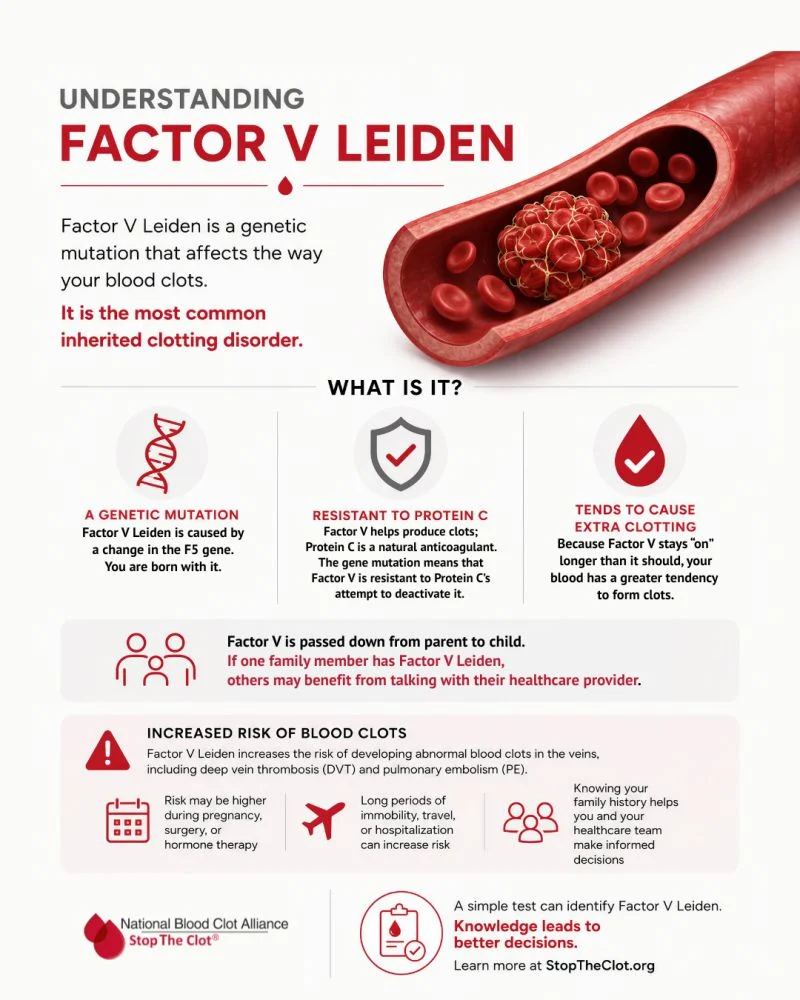
”Factor V Leiden is the most common inherited blood clotting disorder—but many people who have it don’t know they carry it.
Having Factor V Leiden doesn’t mean you’ll definitely develop a blood clot. But it can increase your risk, especially when combined with other factors such as surgery, pregnancy, hormone therapy, long periods of immobility, or certain medical conditions.
If you’ve experienced a blood clot—or if blood clots seem to run in your family—it may be worth having a conversation with your healthcare provider about whether genetic testing is appropriate for you.
Knowledge is one of the most powerful tools we have for preventing blood clots and recognizing them early.
Learn more about Factor V Leiden, blood clot risk factors, and the signs and symptoms of DVT and pulmonary embolism at
Factor V Leiden is the most common inherited blood clotting disorder—but many people who have it don’t know they carry it.
Having Factor V Leiden doesn’t mean you’ll definitely develop a blood clot. But it can increase your risk, especially when combined with other factors such as surgery, pregnancy, hormone therapy, long periods of immobility, or certain medical conditions.
If you’ve experienced a blood clot—or if blood clots seem to run in your family—it may be worth having a conversation with your healthcare provider about whether genetic testing is appropriate for you.
Knowledge is one of the most powerful tools we have for preventing blood clots and recognizing them early.
Learn more about Factor V Leiden, blood clot risk factors, and the signs and symptoms of DVT and pulmonary embolism at StopTheClot.org.”
Stay updated with Hemostasis Today.
-
Sep 22, 2026, 08:06Tim Brümmendorf: Exciting Sessions Ahead at ESHBMFS2026
-
Sep 22, 2026, 08:05Samin Mohsenian: Can Factor VII Activity Predict Bleeding Severity?
-
Sep 22, 2026, 07:59Cesar de Almeida Neto: Jehovah’s Witnesses Update Their Position on Blood Components
-
Sep 22, 2026, 07:39Better Trials and Better Treatments Through Greater Inclusion – American Society of Hematology
-
Sep 22, 2026, 07:18X. Long Zheng: From ADAMTS13 to New TTP Treatment
-
Sep 22, 2026, 07:11Platelet Dependent Protection Against Bacterial Pneumonia – JTH
-
Sep 22, 2026, 07:10Sumita Pandey: Apheresis Beyond Automation
-
Sep 22, 2026, 07:04Wafik El-Deiry: Type 1 interferon Alters Clonal Competition in Human Blood Development
-
Sep 22, 2026, 06:53Tania L.: Women in Hematology Take the Stage in Austin