


C Michael Gibson/Baim Institute
Feb 7, 2026, 14:25
C Michael Gibson: Asundexian Reduces Ischemic Stroke Without Increasing Bleeding Risk
C Michael Gibson, President and CEO at Baim Institute for Clinical Research, shared on LinkedIn:
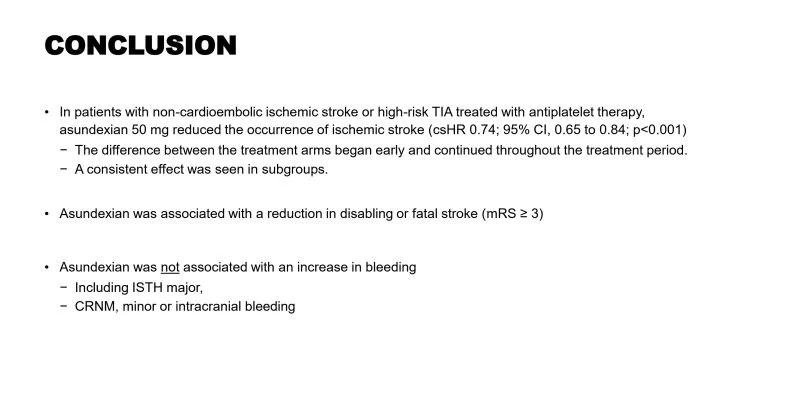
”Among patients with non-cardioembolic ischemic stroke or high-risk TIA treated with antiplatelet therapy, asundexian 50 mg reduced the occurrence of ischemic stroke (csHR 0.74; 95% CI, 0.65 to 0.84; p<0.001).
The difference between the treatment arms began early and continued throughout the treatment period.
A consistent effect was seen in subgroups.
Asundexian was associated with a reduction in disabling or fatal stroke (mRS ≥ 3)
Asundexian was not associated with an increase in bleeding Including ISTH major, CRNM, minor or intracranial bleeding.”
Stay updated with Hemostasis Today.
-
Sep 30, 2026, 13:41Huda Salah Eldin: The Challenge of Balancing Antithrombotic Therapy After PCI
-
Sep 30, 2026, 13:29Abdus Salam: What Can CT Venography Reveal About the Veins?
-
Sep 30, 2026, 13:03Amira Mohy: Diagnostic Flow Cytometry Panels for Hematological Malignancies
-
Sep 30, 2026, 12:52Paul Watton: Could Repetitive Head Impacts Leave a Molecular Memory?
-
Sep 30, 2026, 12:41The Journey to ISTH 2027 Starts in Vancouver
-
Sep 30, 2026, 11:36Basit Ali: A Closer Look at CT Venography
-
Sep 30, 2026, 11:16Christina Pohlman: Could aPL Levels Help Predict Stroke Recurrence?
-
Sep 30, 2026, 10:55Rana Al Hrout: Diagnostic Approach to Hypochromic Microcytic Anemia
-
Sep 30, 2026, 01:52Javed Anees: DADA2 – When a Young Stroke Is More Than a Stroke