

Caitlin Raymond: A Call for Improved Clinical Integration in Transfusion Medicine
Caitlin Raymond, Assistant Professor of Pathology and Transfusion Medicine at University of Wisconsin-Madison, shared a post on LinkedIn:
“Most clinicians don’t know when to call transfusion medicine.
Some don’t know we exist.
This is not a criticism — it’s a visibility problem, and it’s nearly universal.
The blood bank is infrastructure.
Like the electrical grid, you mostly notice it when something goes wrong.
The consequences are real: transfusion reactions managed in isolation, complicated antibody cases that never get a clinical conversation, decisions made without a map.
So I made a map.
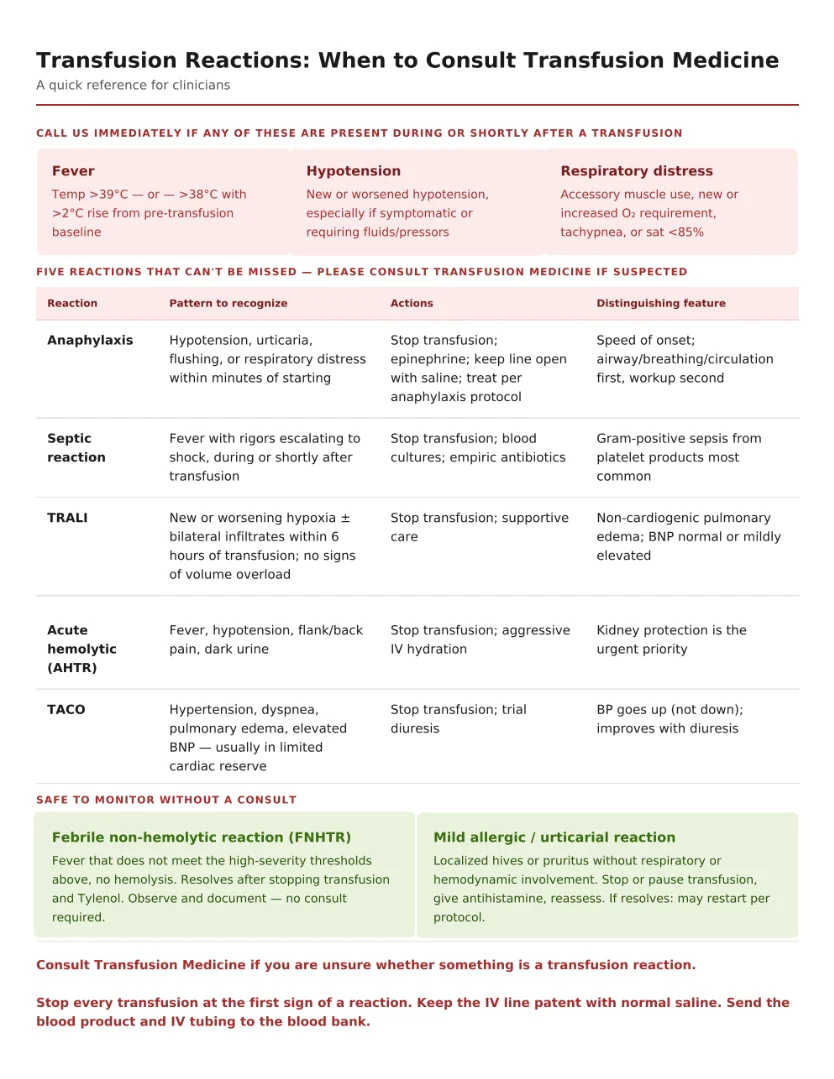
Attached: a one-page clinical reference covering when to consult transfusion medicine, what the five can’t-miss reactions look like, and when it’s safe to monitor without a consult.
The most important line on it: consult us if you’re unsure.
Uncertainty is enough.
That’s what we’re here for.”
Other posts featuring Caitlin Raymond on Hemostasis Today.
-
Oct 17, 2026, 04:07Weihao Li: Global HEPATIC Registry Findings on Post-Transplant Arterial Thrombosis
-
Oct 17, 2026, 03:56Ghaith Abu-Zeinah: ASH Publishes 2026 Guidelines for Myelofibrosis Management in Blood Advances
-
Oct 17, 2026, 03:48Tristan Siokos: Why Vascular Occlusion Is More Than Just Clots – Breakdown of the 8 Pathways
-
Oct 17, 2026, 02:36Archil Jaliashvili: Oxygen Transport in Capillaries
-
Oct 17, 2026, 02:35Carly Newton: Understanding Access to Red Blood Cell Exchange for People Living With SCD
-
Oct 17, 2026, 02:34Raising Awareness of Blood Clots During and After Pregnancy – Thrombosis UK
-
Oct 17, 2026, 02:33Alaa Salamat: Our Research Accepted for Publication at ASH 2026
-
Oct 17, 2026, 02:32Mohammed Al Sharif: Discussing Factor XIII Testing and Its Clinical Significance
-
Oct 17, 2026, 02:31Joanna Popiolek-Kalisz: Talking about Novel Pharmacotherapy for Hypertension at CV Prevention and Intervention