


Edward Lee Carter: Exploring Anticoagulation Paradox
Edward Lee Carter, Clinical Pharmacist Practitioner at U.S. Department of Veterans Affairs, shared a post on LinkedIn:
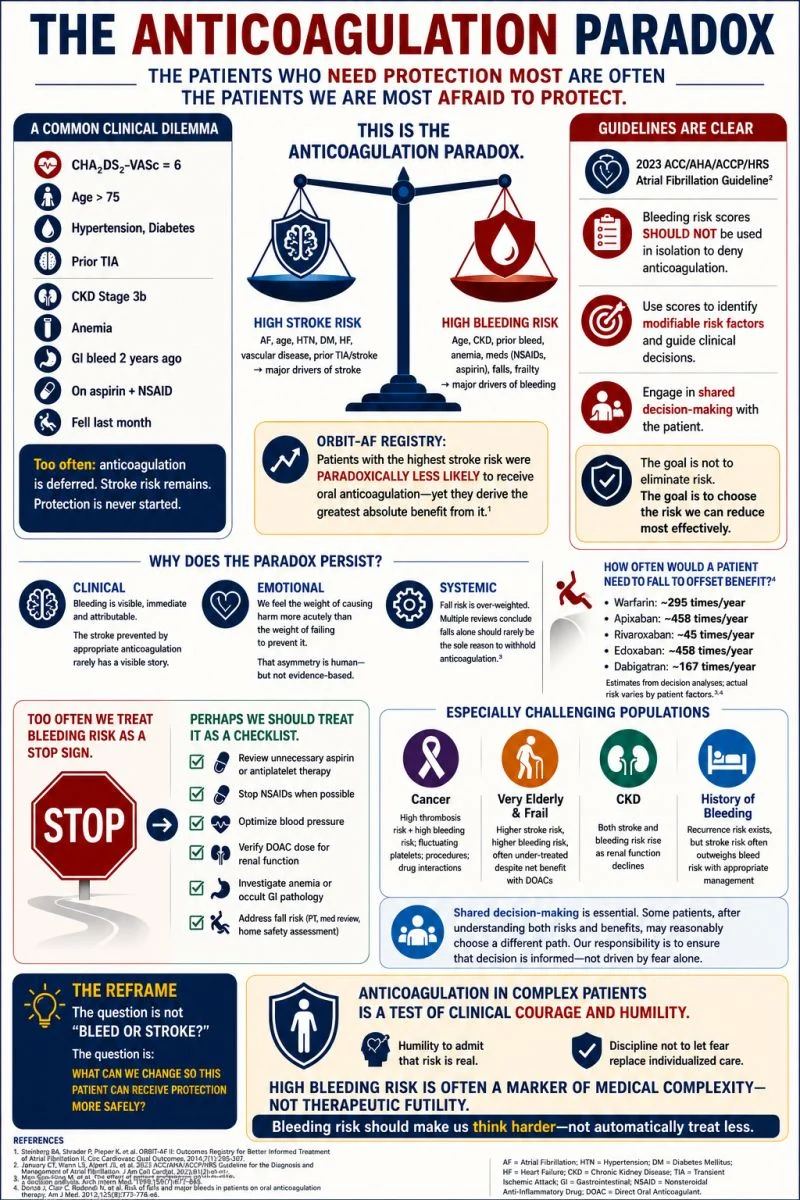
“The Anticoagulation Paradox
The patients who need protection most are often the patients we are most afraid to protect.
Every clinician who manages atrial fibrillation has faced this dilemma.
The patient in front of you has a CHA₂DS₂-VASc score of 6.
- Age over 75.
- Hypertension.
- Diabetes.
- Prior TIA.
Their stroke risk is high.
But they also have CKD stage 3b. Anemia. A GI bleed two years ago. They take aspirin and an NSAID. They fell last month.
So what happens?
Too often, anticoagulation is deferred. The conversation ends with, ‘The bleeding risk is too high.’
The patient leaves unprotected from the very outcome we’re trying hardest to prevent – a disabling cardioembolic stroke.
This is the anticoagulation paradox.
The ORBIT-AF registry highlighted it years ago: patients at the highest predicted risk of stroke were paradoxically less likely to receive oral anticoagulation, even though they often had the greatest absolute benefit.
The paradox exists because the very factors that increase stroke risk – advanced age, CKD, heart failure, frailty, prior bleeding, and polypharmacy – also increase bleeding risk.
The 2023 ACC/AHA/ACCP/HRS atrial fibrillation guideline is equally clear:
Bleeding risk scores should not be used in isolation to deny anticoagulation.
Instead, they should identify modifiable bleeding risk factors, support shared decision-making, and guide safer treatment.
So why does the paradox persist?
Because major bleeding is immediate, visible, and memorable.
The stroke prevented by appropriate anticoagulation rarely has a visible story.
We naturally remember the harm we can see more than the catastrophe that never occurred.
Perhaps we’ve been thinking about bleeding risk the wrong way.
Too often we treat it as a stop sign.
Maybe we should treat it as a checklist.
- Stop unnecessary aspirin or NSAIDs.
- Optimize blood pressure.
- Verify appropriate DOAC dosing for renal function.
- Investigate anemia, occult GI pathology, and reversible fall risk.
The question isn’t:
- ‘Bleed or stroke?’
The better question is:
- ‘What can we change so this patient can receive protection more safely?’
That simple shift changes everything.
It moves us from avoidance to problem-solving.
From therapeutic hesitation to individualized care.
Some patients, after understanding both the benefits and the risks, may reasonably choose a different path.
Our responsibility is to ensure that decision is informed – not driven by fear alone.
High bleeding risk is often a marker of medical complexity – not therapeutic futility.
Bleeding risk should make us think harder, not automatically treat less.
How do you approach the anticoagulation paradox in your own practice?”
Stay updated with Hemostasis Today.
-
Sep 28, 2026, 19:14Aditya Sharma: An Outstanding Start to the Final Day of VSS 2026!
-
Sep 28, 2026, 19:07Dhargam Aljebouri: AIHA Subclassification Research Presented at the 14th Iraqi Society of Hematology Conference
-
Sep 28, 2026, 19:02William Wallace: Your Cholesterol Test is Missing a Particle that May Matter More than the One it Measures
-
Sep 28, 2026, 18:57Indu Thakur: Honoring Sickle Warriors and Advancing Diverse Blood Donation at Sickle Ball 2026
-
Sep 28, 2026, 18:48Orly Leiva: Rethinking JAK Inhibitor Cardiovascular Safety in MPNs
-
Sep 28, 2026, 18:42Wael Saad: Honored to Be Part of Portal and Mesenteric Vein Thrombosis Session at CIRSE 2026
-
Sep 28, 2026, 18:35Alejandro González Veliz: The Unbroken Connection Between Heart and Brain
-
Sep 28, 2026, 16:43Scott Sutton: Community and Connection in Immune Thrombocytopenia
-
Sep 28, 2026, 16:24Pankti Solanki: ISBT Recognized JAMA as the 49th Human Blood Group System