


Edward Lee Carter: Can Anticoagulation Be Safely De-Escalated After AF Ablation?
Edward Lee Carter, Clinical Pharmacist Practitioner at U.S. Department of Veterans Affairs, shared a post on LinkedIn:
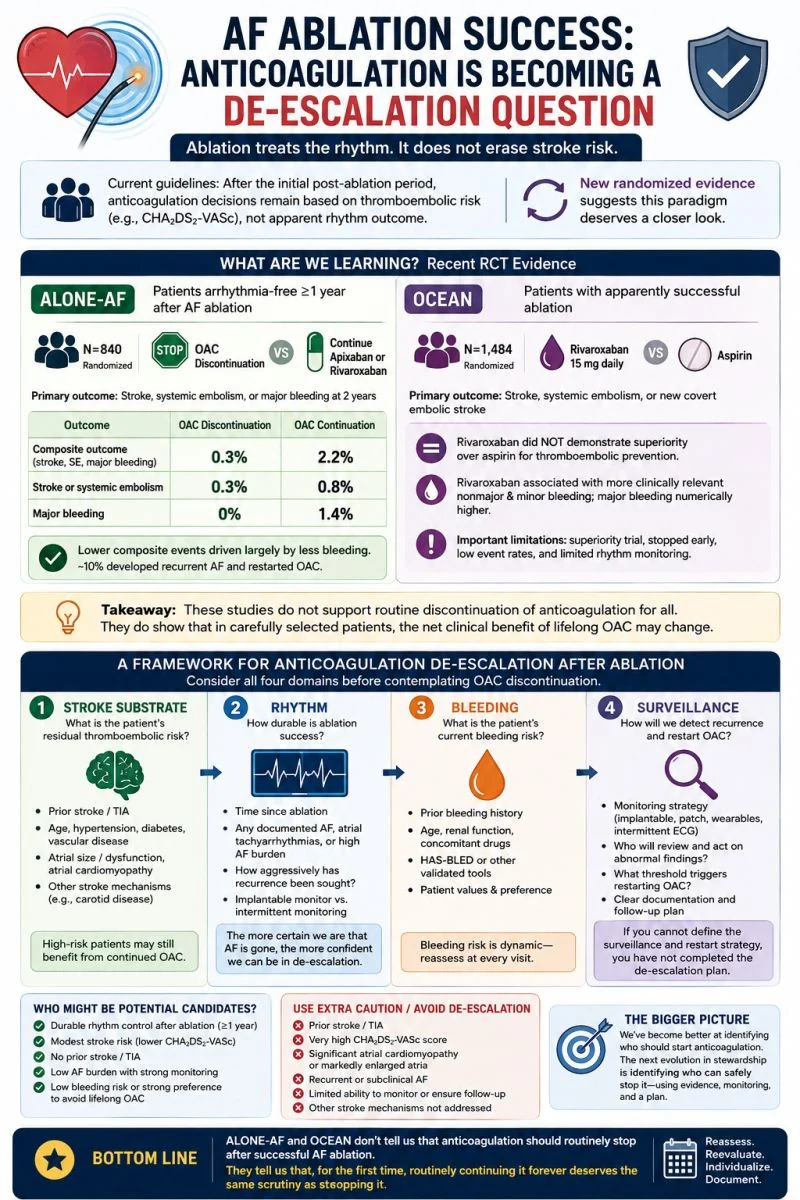
”Anticoagulation after successful AF ablation is becoming a serious de-escalation question.
For years, the framework has been straightforward:
Ablation treats the rhythm. It does not erase the indication for anticoagulation.
Long-term OAC decisions remain based primarily on thromboembolic risk—not apparent maintenance of sinus rhythm.
That remains guideline-based practice.
But ALONE-AF and OCEAN suggest the question deserves another look.
- ALONE-AF studied carefully selected patients free of documented atrial arrhythmia forat least one year after ablation.
At 2 years, stroke/systemic embolism/major bleeding occurred in 0.3 percent after OAC discontinuation vs 2.2 percent with continued OAC.
Importantly, much of the advantage came from less bleeding: major bleeding was 0 percent vs 1.4 percent, while stroke/systemic embolism was uncommon (0.3 percent vs 0.8 percent).
About 10 percent developed recurrent AF and restarted OAC.
This wasn’t simply ‘stop and forget.’
- OCEAN compared rivaroxaban with aspirin after apparently successful ablation.
Rivaroxaban did not demonstrate superiority for thromboembolic prevention and caused more bleeding.
But OCEAN was a superiority trial with low event rates, early termination and limited rhythm surveillance.
It does not establish aspirin or no anticoagulation as equivalent to OAC.
So what changes today?
Not:
Successful ablation means stop anticoagulation.
Instead:
Successful ablation means reconsider whether lifelong anticoagulation still provides net clinical benefit.
For busy clinicians, I would think in four domains:
- Stroke substrate
Prior stroke/TIA, age, vascular disease, atrial disease.
- Rhythm
How durable is ablation success?
How aggressively has recurrent/subclinical AF been sought?
- Bleeding
What is the patient’s current bleeding risk?
- Surveillance
If OAC stops, how will recurrence be detected—and what triggers restarting it?
That last point may be the most important.
De-escalation requires a surveillance system.
Stopping apixaban or rivaroxaban shouldn’t simply mean deleting it from the medication list.
A real strategy defines:
Who can stop, how recurrence is monitored, and when OAC restarts.
And there is an important paradox:
These trials make OAC withdrawal more plausible while exposing how difficult it remains to define ‘successful’ ablation.
We are not at routine anticoagulation withdrawal.
But we may be approaching structured de-escalation in carefully selected patients.
That’s an important evolution in antithrombotic stewardship.
We’ve become disciplined about identifying who should start anticoagulation.
We may need to become equally disciplined about identifying who can safely stop it.
ALONE-AF and OCEAN don’t tell us to routinely stop OAC after successful ablation.
They tell us that routinely continuing it forever now deserves the same scrutiny as stopping it.”
Other posts featuring Edward Lee Carter on Hemostasis Today.
-
Sep 24, 2026, 12:56Maria Helena Parrinello: A New Score for Chronic GvHD Risk Assessment at the SIE Congress
-
Sep 24, 2026, 12:44Shehab Mohamed: TP53 Mutations and Outcomes in Myeloproliferative Neoplasms
-
Sep 24, 2026, 12:34Francesca Palandri: Is There Still a Place for Splenectomy in ITP in the Modern Era?
-
Sep 24, 2026, 12:15Cedric Hermans: RPTH Illustrated Review on Von Willebrand Disease
-
Sep 24, 2026, 11:48Factor XII Inhibition and the Future of Contact Pathway Targeting
-
Sep 24, 2026, 08:55Andres Gudino: Clot Characterization Through Hounsfield Units in Ischemic Stroke
-
Sep 24, 2026, 06:52Gina Sado: Screening-Detected Atrial Fibrillation Carries High Risk of Heart Failure
-
Sep 24, 2026, 06:33Benjamin Vipler: Optimal Oral Anticoagulation Choice in Atrial Fibrillation and Advanced CKD
-
Sep 24, 2026, 06:08Christopher Salerno: AI-Powered At-Home Anemia Screening Advances Telehealth Access