


Edward Lee Carter: Anticoagulation Stewardship is Moving From Recommendation to Measurement
Edward Lee Carter, Clinical Pharmacist Practitioner at U.S. Department of Veterans Affairs, shared on LinkedIn:
”Anticoagulation stewardship is moving from recommendation to measurement.
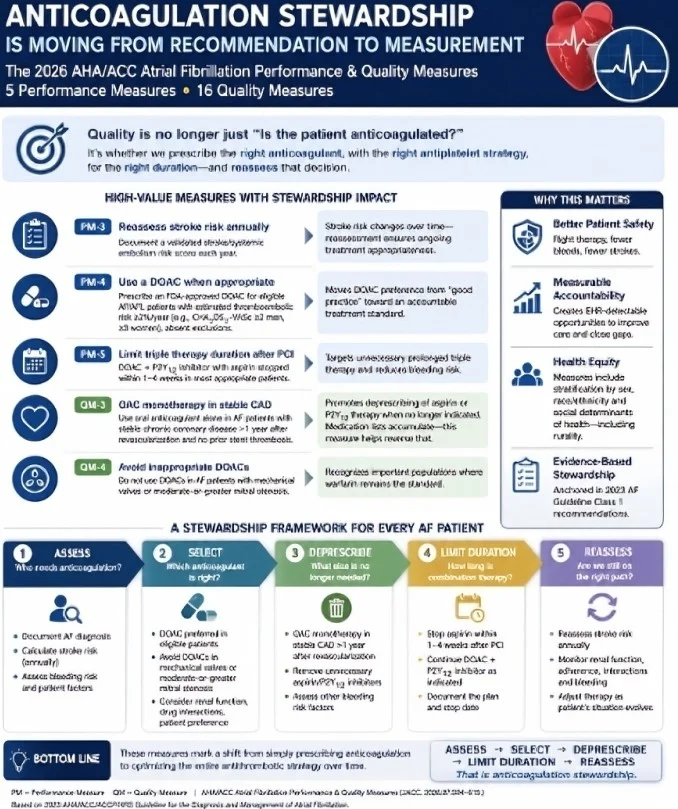
The new 2026 AHA/ACC atrial fibrillation performance and quality measures include 5 performance measures and 16 quality measures.
But the bigger story isn’t the number of measures.
It’s what we’re beginning to measure.
For patients with AF, quality increasingly means more than simply:
‘Is the patient anticoagulated?’
The new framework addresses whether we:
- Reassess stroke risk annually
- Use a DOAC when appropriate for patients at sufficient thromboembolic risk
- After PCI, discontinue aspirin within 1–4 weeks in most appropriate patients receiving OAC and P2Y12 therapy, rather than unnecessarily prolonging triple therapy
- Use OAC monotherapy in appropriate patients with AF and stable chronic coronary disease >1 year after revascularization
- Avoid DOACs where they remain inappropriate, including mechanical valves and moderate-or-greater mitral stenosis
That represents an important evolution.
The question is increasingly:
Is this the right patient, on the right anticoagulant, with the right accompanying antiplatelet therapy, for the right duration — and are we reassessing that decision?
The antiplatelet measures may be particularly valuable.
Medication lists tend to accumulate therapy more easily than they shed it.
Aspirin started appropriately around PCI can remain months – or years – later because nobody revisited the indication.
That creates obvious stewardship opportunities:
AF with OAC and antiplatelet therapy, stable CAD beyond 12 months – reassess the antiplatelet indication.
AF with recent PCI and triple therapy – when should aspirin be stopped?
There is a familiar principle here.
Antimicrobial stewardship taught us to routinely ask:
Why is this drug being used? Is it still necessary? When should it stop?
Antithrombotic therapy deserves similar discipline.
These measures aren’t a complete anticoagulation stewardship program. DOAC dosing, renal-function changes, drug interactions, adherence and bleeding surveillance still require systematic attention.
But the framework gives health systems something important:
Measurable targets.
And measurable targets can become EHR searches, pharmacist interventions, quality dashboards — and ultimately better medication use.
Assess, then Select, Deprescribe, Limit Duration and Reassess
That is anticoagulation stewardship.”
Stay updated with Hemostasis Today.
-
Oct 10, 2026, 15:50M Velia Antonini: ECMO Cannula Design and Its Impact on Blood Flow, Thrombosis and Hemolysis
-
Oct 10, 2026, 15:14Cihan Ay: PhD With Distinction in Thrombosis Research in Patients With Primary Brain Tumors
-
Oct 10, 2026, 15:07Khalid Ahmed: Mortality and Survival in Young People With Sickle Cell Disease and Beta Thalassaemia in England 1997 to 2025
-
Oct 10, 2026, 14:59Matteo Foschi: Antithrombotic Therapy in Secondary Stroke Prevention 10 Clinical Pearls Every Clinician Should Know
-
Oct 10, 2026, 14:33Ahmad Gharehbaghian: Supporting Blood Transfusion Teams and Strengthening Iran’s Blood Supply
-
Oct 10, 2026, 14:17Caitlin Raymond: Long-Term Infection Risk With ECP in GVHD
-
Oct 10, 2026, 14:09Emmanuel J Favaloro: 100 years of von Willebrand Disease in 2026
-
Oct 10, 2026, 13:54WFH Strengthens Collaboration to Advance Hemophilia Care in Paraguay
-
Oct 10, 2026, 13:40Shayan Mohammadmoradi: Platelets as Stress Sensors A New Perspective on Platelet Biology