


Edward Lee Carter: SINGLE-AF Challenges the Gray Zone in AF Anticoagulation
Edward Lee Carter, Clinical Pharmacist Practitioner at U.S. Department of Veterans Affairs, shared on LinkedIn:
“CHA₂DS₂ VASc score of 1 has long been one of anticoagulation’s grayest zones.
SINGLE-AF just made it a little less gray.
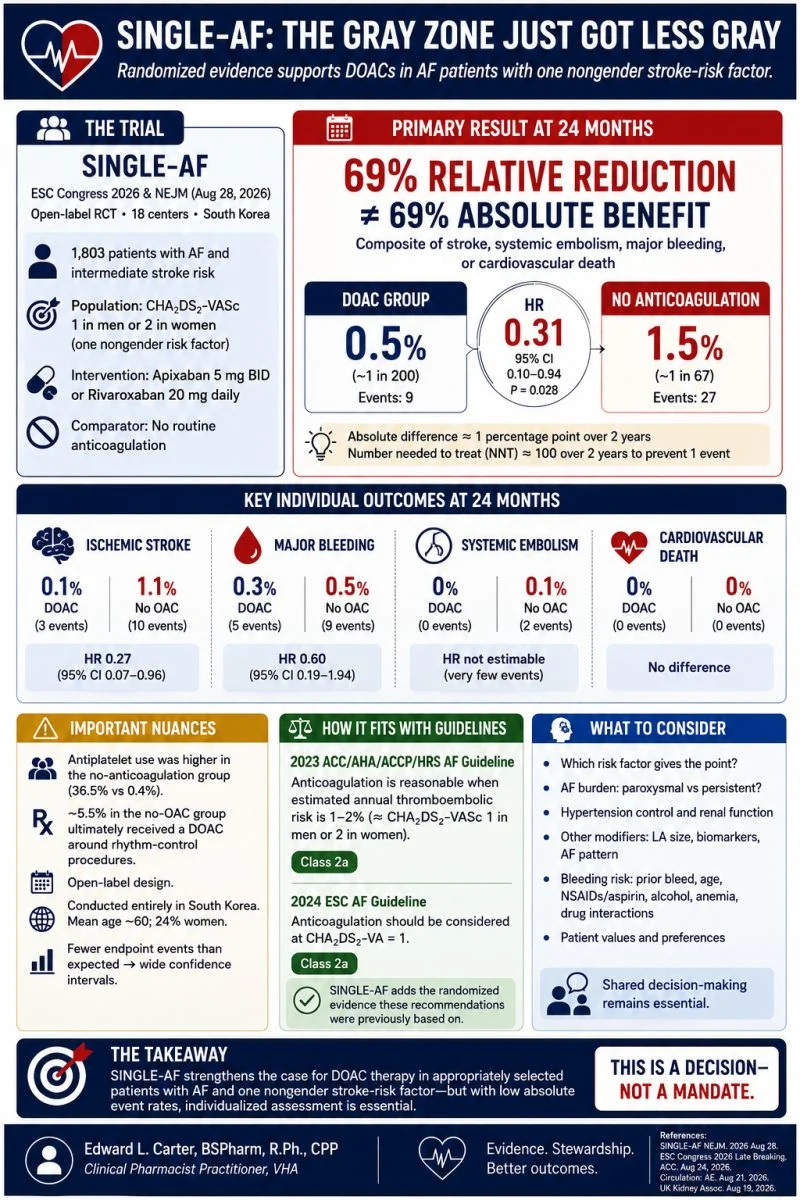
Presented today at ESC Congress 2026 and published simultaneously in NEJM, SINGLE-AF is the first randomized trial to test a DOAC against no routine anticoagulation specifically in patients with AF and one nongender stroke-risk factor.
1,803 patients were randomized to apixaban or rivaroxaban versus no anticoagulation.
At 24 months, the composite of stroke, systemic embolism, major bleeding, or cardiovascular death occurred in:
- 0.5 percent with a DOAC
- 1.5 percent without anticoagulation
HR 0.31 (95 percent CI 0.10–0.94)
A 69 percent relative reduction sounds dramatic.
But the more important story is in the details.
The difference appeared to be driven by ischemic stroke. Only 3 patients in the DOAC group versus 10 without anticoagulation experienced stroke. Major bleeding was similar between groups.
That is encouraging—but it is not a mandate to anticoagulate every patient with a single risk factor.
The absolute event rates were low. The confidence interval was wide. Fewer endpoints occurred than expected. The trial was open-label, conducted entirely in South Korea, and enrolled a relatively young population (mean age of approximately 60).
There is another nuance: antiplatelet use was considerably more common in the no-anticoagulation group, which makes a simplistic comparison of bleeding risk less certain.
And importantly, current guidelines were already leaning in this direction.
The 2023 ACC/AHA/ACCP/HRS guideline says anticoagulation is reasonable when estimated annual thromboembolic risk is 1–2 percent—roughly CHA₂DS₂-VASc 1 in men or 2 in women. The 2024 ESC guideline similarly says anticoagulation should be considered at CHA₂DS₂-VA of 1.
So what changed?
For the first time, we have randomized evidence supporting a decision that previously rested largely on observational data and extrapolation.
To me, SINGLE-AF moves the conversation from:
‘Is anticoagulation reasonable?’
toward:
‘How much does this individual patient stand to benefit?’
That still requires looking beyond a single number:
- Which risk factor gives the point?
- What is the AF burden?
- Paroxysmal or persistent AF?
- How well controlled is hypertension?
- What is the renal function?
- Are aspirin, NSAIDs, or interacting drugs adding bleeding risk?
- What does the patient value?
The gray zone did not disappear.
But it became better informed.
SINGLE-AF strengthens the case for DOAC therapy in appropriately selected patients with AF and one nongender stroke-risk factor—but with such low absolute event rates, individualized assessment and shared decision-making remain essential.
This is a decision—not a mandate.”
Find more posts featuring Edward Lee Carter on Hemostasis Today.
-
Oct 16, 2026, 13:10Emanuel Sueldo: CAHT 2026 Celebrates Scientific Progress and Team Achievements
-
Oct 16, 2026, 13:05Maha Othman: Queen’s Health Sciences Advances CAT Risk Models and Pediatric ISTH-BAT Cut-Offs
-
Oct 16, 2026, 13:03Thrombosis Awareness Must Lead to Timely Action – Roche
-
Oct 16, 2026, 12:49Wolfgang Miesbach: 5-Year CBDR Data Confirms Emicizumab Safety and Efficacy in Hemophilia A
-
Oct 16, 2026, 12:40Edward Lee Carter: How Factor XI Inhibition Could Transform Anticoagulation Therapy
-
Oct 16, 2026, 12:40Marc Carrier: Looking Ahead to ISTH 2027 in Vancouver
-
Oct 16, 2026, 12:30Bob Lempke: How One Blood Donation Can Save Up to Three Lives
-
Oct 16, 2026, 12:30Why VWF Therapies Belong on the EU Critical Medicines List – EHC
-
Oct 16, 2026, 12:17Exploring Endothelial Cells, Genetic Fate Mapping, and Revascularization – ISTH