


Edward Lee Carter: In Antithrombotic Therapy, “More Protection” Can Become More Harm Surprisingly Quickly
Edward Lee Carter, Clinical Pharmacist Practitioner at U.S. Department of Veterans Affairs, shared on LinkedIn:
“In antithrombotic therapy, ‘more protection’ can become more harm surprisingly quickly.
Patients with atrial fibrillation who experience an acute MI and undergo PCI present a difficult therapeutic collision:
- AF creates an indication for anticoagulation.
- ACS and coronary stenting create an indication for antiplatelet therapy.
- Combining them increases bleeding risk.
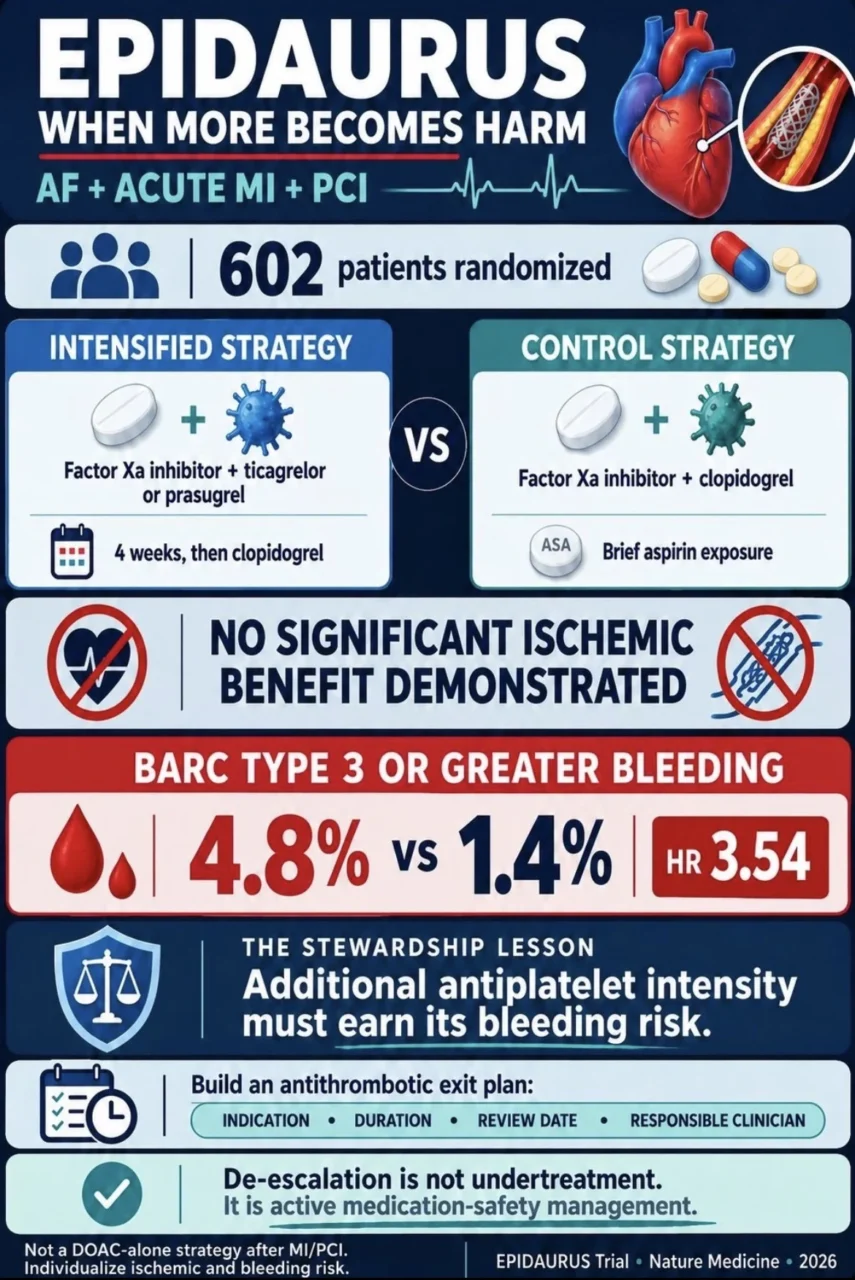
EPIDAURUS asked whether more potent platelet inhibition improves outcomes when a factor Xa inhibitor is already on board.
Investigators randomized 602 patients to:
- A factor Xa inhibitor plus ticagrelor or prasugrel for four weeks, followed by clopidogrel or
- A factor Xa inhibitor plus clopidogrel, with brief aspirin exposure primarily during hospitalization
The intensified strategy did not demonstrate superiority for the primary ischemic endpoint.
It did produce substantially more clinically important bleeding:
- BARC type 3 or greater bleeding: 4.8% vs 1.4%
- Hazard ratio: 3.54
- No significant reduction in the reported ischemic outcomes
Enrollment stopped after 602 of a planned 1,474 participants because superiority appeared unlikely and safety concerns were emerging.
The lesson is not that less treatment is always better – or that anticoagulation alone is sufficient immediately after MI and PCI.
It is that additional antiplatelet intensity must earn its bleeding risk.
EPIDAURUS reinforces a broader stewardship framework:
- After AF-associated PCI, avoid unnecessarily prolonged triple therapy.
- When anticoagulation and a P2Y12 inhibitor are combined, clopidogrel remains preferred for most patients.
- Reassess therapy as coronary risk stabilizes.
- In appropriate patients with AF and stable chronic coronary disease, anticoagulant monotherapy may provide a better balance than continuing an antiplatelet indefinitely.
The trial ended early and cannot settle every ischemic question. Selected patients with exceptionally high stent-thrombosis or procedural risk may require a different approach.
But ‘just in case’ is not a duration plan.
Every patient discharged on multiple antithrombotic agents should have an exit plan:
- Indication for each medication
- Intended duration and review date
- Clinician responsible for reassessment
- Earlier review if bleeding, renal decline, interactions, or procedures change the balance
Planned de-escalation is not undertreatment. It is an active medication-safety intervention.
Does your discharge process document who will reassess each antithrombotic agent – and when?
Views are my own and do not represent the Department of Veterans Affairs.”
Find more posts featuring Edward Lee Carter on Hemostasis Today.
-
Oct 18, 2026, 11:37Lee Anne Sorto: Beyond Compliance – Making Audits Count in Transfusion Safety
-
Oct 18, 2026, 11:26Valentina Ajello: Does ANH Benefit Women in Cardiac Surgery?
-
Oct 18, 2026, 11:06Alex Ballout: Novel FUT1 Variant Linked to a Rare H-Deficient Blood Phenotype
-
Oct 18, 2026, 10:51Lethukwenama Letsoalo: Why Women’s Iron Status Matters Before Childbirth
-
Oct 18, 2026, 10:31Working Together for Better Outcomes in Hemophilia Care – Hemophilia Federation (India)
-
Oct 18, 2026, 08:02Neda Ashayeri: Global Perspectives on Hemophilia and Rare Bleeding Disorders in Abu Dhabi
-
Oct 18, 2026, 07:55Anu Thomas: A Stepwise Laboratory Approach to Positive IAT and Pretransfusion Compatibility
-
Oct 18, 2026, 07:49Matthew Hazell: Molecular Matching and the Future of Transfusion Practice
-
Oct 18, 2026, 07:05Behnood Bikdeli: Vasculearn Network Highlights Expert Perspectives on PE Risk Stratification and Advanced Therapies