


Edward Lee Carter: Provoked VTE May Not Tell the Whole Story About Recurrence Risk
Edward Lee Carter, Clinical Pharmacist Practitioner at U.S. Department of Veterans Affairs, shared on LinkedIn:
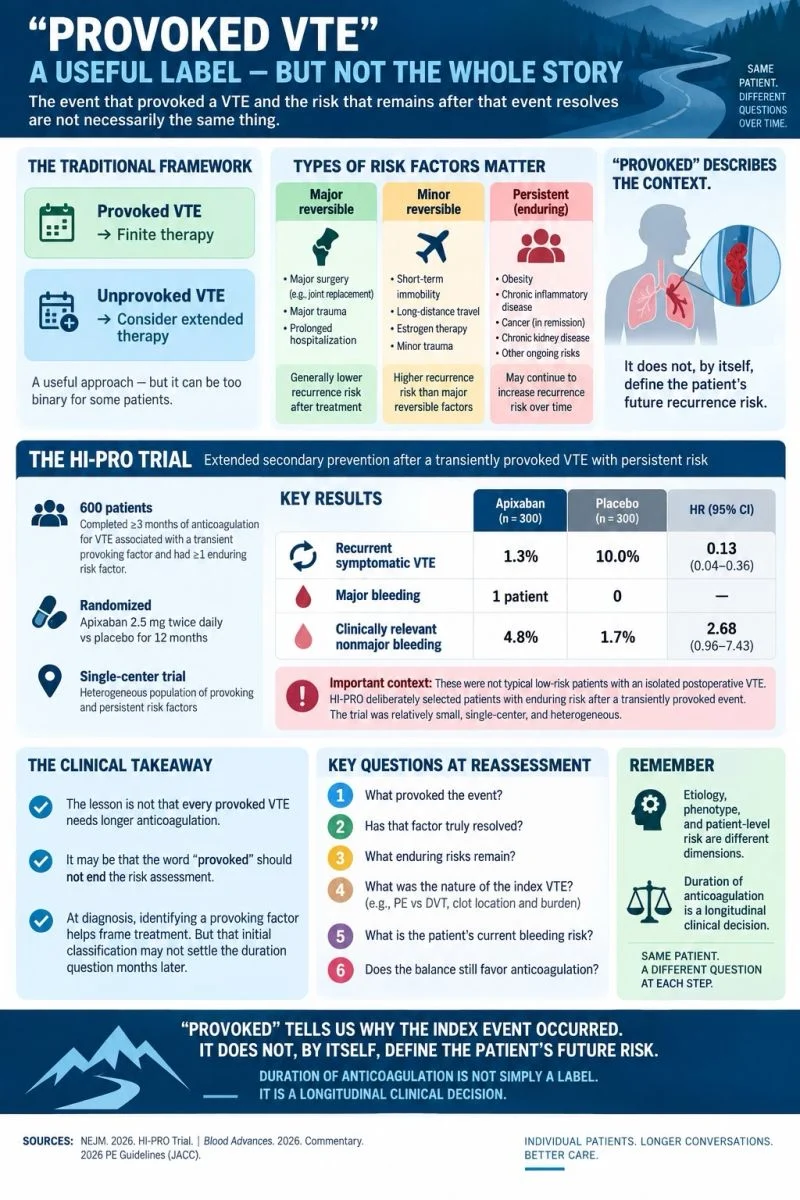
“‘Provoked VTE‘ is a useful clinical label—but it may not tell us everything we need to know about future recurrence risk.
For years, a familiar framework has helped guide anticoagulation duration:
- Provoked VTE: finite therapy
- Unprovoked VTE: consider extended therapy
That framework remains useful. But the HI-PRO trial—and a recent Blood Advances commentary examining its implications—highlight an important gray zone:
What if the transient trigger resolves, but meaningful thrombotic risk remains?
HI-PRO enrolled 600 patients who had completed 3 months or longer of anticoagulation for VTE associated with a transient provoking factor and had 1 or more enduring risk factor.
Patients then received reduced-dose apixaban 2.5 mg twice daily or placebo for another 12 months.
The results were striking:
- Recurrent symptomatic VTE: 1.3% vs 10.0%
- HR 0.13 (95% CI 0.04–0.36)
- Major bleeding: 1 patient vs 0
- Clinically relevant nonmajor bleeding: 4.8% vs 1.7%
But context matters.
These were not typical low-risk patients with an isolated postoperative VTE. HI-PRO deliberately selected patients with enduring risk after a transiently provoked event. The trial was single-center and relatively small, and the population included a broad range of provoking and persistent risk factors.
So the lesson is not that every provoked VTE warrants longer anticoagulation.
It may be that the word ‘provoked’ should not end the risk assessment.
At diagnosis, identifying a provoking factor helps frame treatment. But that initial classification may not settle the duration question months later.
A major surgical trigger, a minor transient trigger, and a persistent prothrombotic condition do not necessarily carry the same implications for recurrence risk.
At reassessment, perhaps the better questions are:
- What provoked the event?
- Has that factor truly resolved?
- What enduring risks remain?
- What was the nature of the index VTE?
- What is the patient’s current bleeding risk?
- Does the balance still favor anticoagulation?
‘Provoked’ tells us something important about why the index event occurred.
It does not, by itself, define the patient’s future risk.
Duration of anticoagulation is not simply a label. It is a longitudinal clinical decision.”
Find more posts featuring Edward Lee Carter on Hemostasis Today.
-
Oct 16, 2026, 13:10Emanuel Sueldo: CAHT 2026 Celebrates Scientific Progress and Team Achievements
-
Oct 16, 2026, 13:05Maha Othman: Queen’s Health Sciences Advances CAT Risk Models and Pediatric ISTH-BAT Cut-Offs
-
Oct 16, 2026, 13:03Thrombosis Awareness Must Lead to Timely Action – Roche
-
Oct 16, 2026, 12:49Wolfgang Miesbach: 5-Year CBDR Data Confirms Emicizumab Safety and Efficacy in Hemophilia A
-
Oct 16, 2026, 12:40Edward Lee Carter: How Factor XI Inhibition Could Transform Anticoagulation Therapy
-
Oct 16, 2026, 12:40Marc Carrier: Looking Ahead to ISTH 2027 in Vancouver
-
Oct 16, 2026, 12:30Bob Lempke: How One Blood Donation Can Save Up to Three Lives
-
Oct 16, 2026, 12:30Why VWF Therapies Belong on the EU Critical Medicines List – EHC
-
Oct 16, 2026, 12:17Exploring Endothelial Cells, Genetic Fate Mapping, and Revascularization – ISTH