


Edward Lee Carter: FDA Removes Additional Estrogen Patch Boxed Warnings – But What About Thrombosis Risk?
Edward Lee Carter, Clinical Pharmacist Practitioner at U.S. Department of Veterans Affairs, stared a post on LinkedIn:
“FDA Removes Additional Estrogen Patch Boxed Warnings – But What About Thrombosis Risk?
October 30, 2026 | FDA Regulatory Update
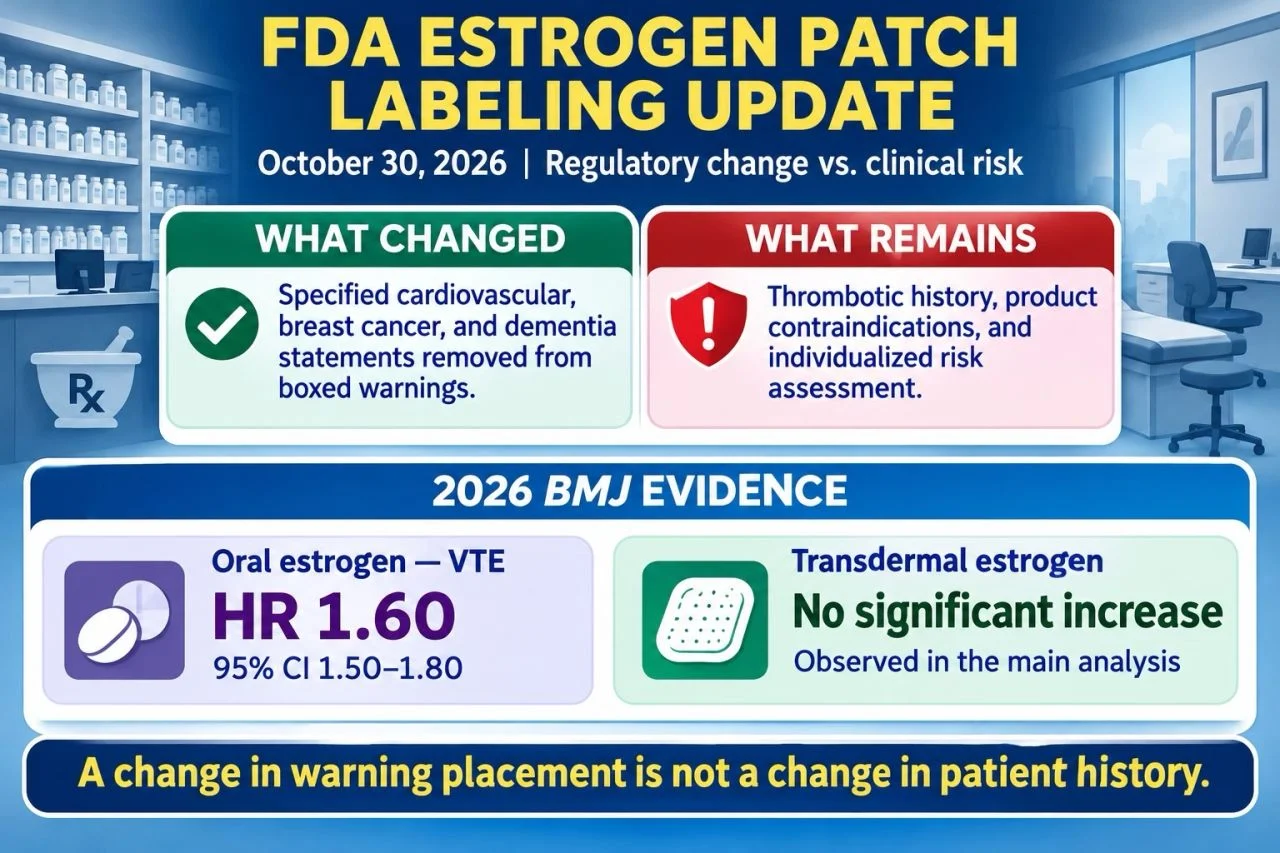
The FDA has approved revised labeling for three additional transdermal estradiol products, removing statements concerning cardiovascular disease, breast cancer, and probable dementia from their boxed warnings.
This follows similar changes to six menopausal hormone therapy products earlier this year.
The decision reflects an important reassessment of historical evidence, particularly the applicability of Women’s Health Initiative findings to contemporary formulations and women beginning treatment closer to menopause.
But here’s the distinction clinicians cannot overlook:
Removing a warning from the boxed-warning section does not mean the underlying risk has disappeared.
Cardiovascular and breast cancer risk information remains elsewhere in systemic hormone therapy labeling. Relevant contraindications also remain.
And the route of estrogen administration matters.
A September 2026 nationwide Danish study published in The BMJ found:
- Oral menopausal hormone therapy was associated with increased VTE risk: HR 1.60 (95% CI 1.50–1.80).
- Transdermal therapy was not associated with a statistically significant increase in VTE, ischemic stroke, or myocardial infarction in the main analysis.
These are observational findings – not proof that transdermal estrogen is risk-free.
The newly published 2026 VA/DoD Clinical Practice Guideline for Menopause also recognizes that nonoral estrogen formulations may carry lower VTE risk than oral formulations.
Importantly, the guideline continues to identify active or recent DVT/PE and arterial thromboembolic disease as contraindications to systemic estrogen therapy, with individualized assessment warranted for patients with prior thrombotic events.
The clinical pharmacy takeaway:
A labeling change is not a substitute for a patient-specific benefit–risk assessment.
Before prescribing systemic menopausal hormone therapy, we still need to consider:
- Prior VTE or stroke
- Thrombophilia and other vascular risk factors
- Oral versus transdermal administration
- Dose, timing, and treatment indication
- Relevant contraindications and alternative therapies
Updated labeling should support informed treatment decisions – not unnecessary fear, but not false reassurance either.
The goal isn’t simply fewer warnings. It’s better risk communication and safer, more individualized care.
The views expressed are my own and do not represent the official positions or policies of the U.S. Department of Veterans Affairs or the U.S. government.”
Stay updated with Hemostasis Today.
-
Nov 1, 2026, 22:52Maria Elisa Mancuso: Remembering Professor Giacomo Mancuso Through the AICE Young Investigator Awards
-
Nov 1, 2026, 22:47Shahzaib Maqbool: Honored to Receive the ASH 2026 Abstract Achievement Award and Present 2 Abstracts
-
Nov 1, 2026, 15:14Christine L. Kempton: Impostor Syndrome in Physicians
-
Nov 1, 2026, 14:3810 Posts Not to Miss This Week
-
Nov 1, 2026, 14:37Christina Pohlman: Understanding and Managing Brain Fog in Antiphospholipid Syndrome
-
Nov 1, 2026, 14:35Heghine Khachatryan: ITP Care in Low- and Middle-Income Countries-Challenges and Priorities
-
Nov 1, 2026, 14:31Travis Phelan: Advancing Anticoagulation Stewardship Through Research and Innovation at RMH
-
Nov 1, 2026, 14:23Miguel Hueso: Mechanical Valve Anticoagulation in a Dialysis Patient With Calciphylaxis
-
Nov 1, 2026, 14:23Shamee Shastry: New Handbook Highlights In-House Reagent Preparation for Transfusion Medicine