


Edward Lee Carter: Is Aspirin Monotherapy Sufficient After Watchman Implantation?
Edward Lee Carter, Clinical Pharmacist Practitioner at U.S. Department of Veterans Affairs, shared a post on LinkedIn:
“After Watchman implantation, could aspirin alone be enough?
A new randomized trial suggests that more antithrombotic therapy may not mean better outcomes following left atrial appendage closure (LAAC).
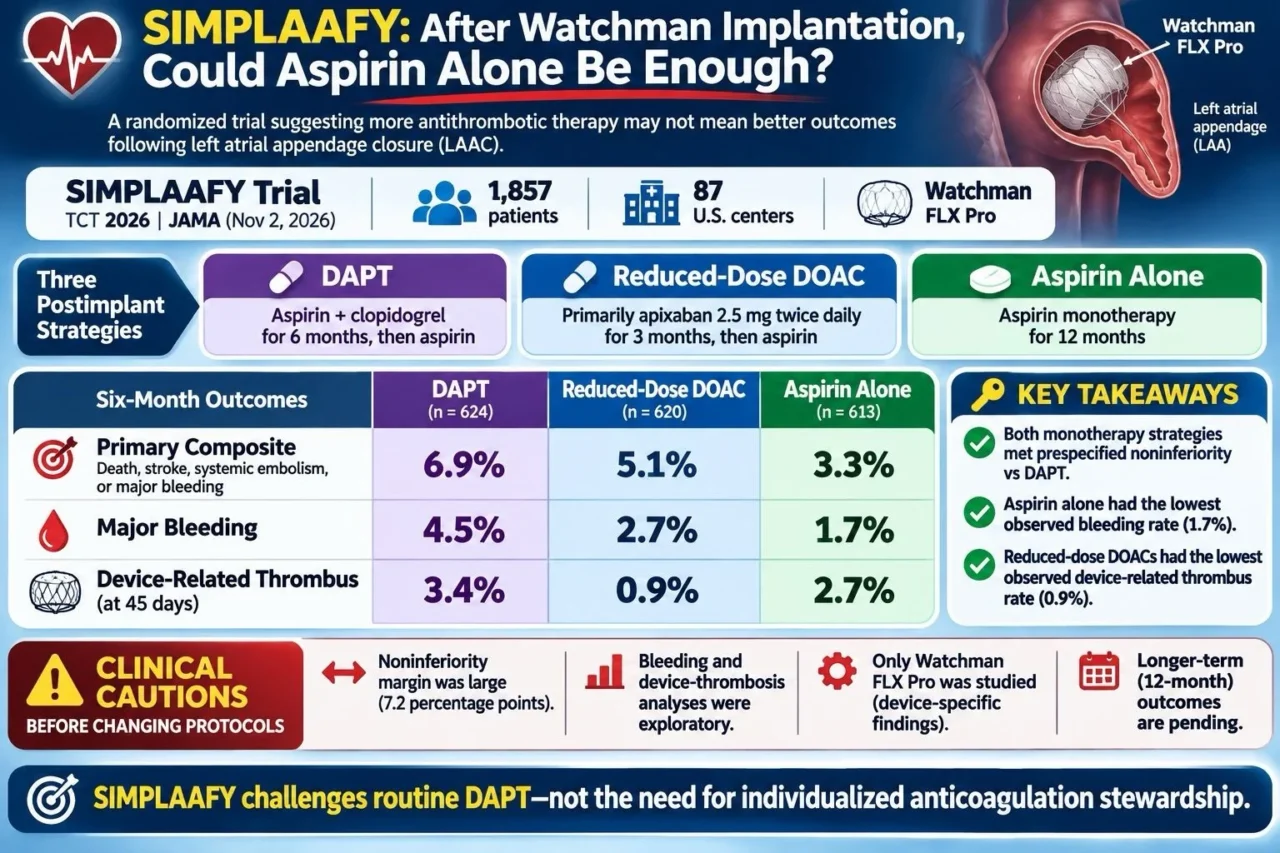
Presented at TCT 2026 and published November 2 in JAMA, the SIMPLAAFY trial challenges routine dual antiplatelet therapy (DAPT) after contemporary Watchman implantation.
- 1,857 patients
- 87 U.S. centers
- Watchman FLX Pro
Three postimplant strategies were evaluated:
- DAPT for 6 months, then aspirin
- Reduced-dose DOAC for 3 months, then aspirin
- Aspirin alone
The DOAC strategy primarily involved apixaban 2.5 mg twice daily.
Six-month primary composite
- death
- stroke
- systemic embolism
- major bleeding
DAPT: 6.9%
- Reduced-dose DOAC: 5.1%
- Aspirin alone: 3.3%
Both monotherapy strategies met prespecified noninferiority criteria versus DAPT.
But here’s where the findings become particularly interesting.
Major bleeding
- DAPT: 4.5%
- Reduced-dose DOAC: 2.7%
- Aspirin: 1.7%
Device-related thrombus at 45 days
- DAPT: 3.4%
- Reduced-dose DOAC: 0.9%
- Aspirin: 2.7%
Ischemic stroke occurred in 0.7% of each group.
Aspirin alone had the lowest observed bleeding rate, while reduced-dose DOACs had the lowest observed device-related thrombus rate.
That distinction matters.
Before changing clinical protocols:
The noninferiority margin was relatively large (7.2 percentage points), although observed confidence bounds were reassuring.
Secondary bleeding and device-thrombosis comparisons were exploratory. The trial was not powered to establish equivalence for individual ischemic outcomes or superiority of aspirin over reduced-dose DOACs.
Only Watchman FLX Pro was studied, and longer-term outcomes remain pending.
My clinical pharmacy takeaway:
SIMPLAAFY raises an important question: Are we exposing some patients to unnecessary bleeding risk by routinely prescribing DAPT after uncomplicated LAAC?
The findings support reconsidering antithrombotic intensity—not abandoning individualized risk assessment.
Device characteristics, bleeding history, thrombotic risk, other anticoagulation indications, and follow-up imaging still matter.
SIMPLAAFY challenges routine DAPT—not the need for thoughtful anticoagulation stewardship.
The views expressed are my own and do not represent the official positions or policies of the U.S. Department of Veterans Affairs or the U.S. government”.
Other posts featuring Edward Lee Carter on Hemostasis Today.
-
Nov 7, 2026, 13:40Leticia Leal: Preventing Blood Clots During Long Flights
-
Nov 7, 2026, 12:06Kinza Raza: Giving Back Through Thalassaemia Awareness – A Journey Back to School
-
Nov 7, 2026, 12:03Sean Langenfeld: Rectal Bleeding on Anticoagulation – Don’t Miss Colorectal Cancer
-
Nov 7, 2026, 11:54Sade Oguntola: Modernizing African Traditional Medicine – A New Hope for SCD
-
Nov 7, 2026, 11:44José Antonio García Erce: Patient Blood Management Needs a National Strategy
-
Nov 7, 2026, 11:37Rana Al-Hrout: ITP Treatment in 2026 – Moving Beyond Platelet Counts
-
Nov 7, 2026, 09:00Charlotte Guzzo: MHRA Approves Gene Editing for Younger Children
-
Nov 7, 2026, 08:47Mohammedbaqer Ali Al-Ghuraibawi: Rethinking Aspirin Use After Acute Coronary Syndrome
-
Nov 7, 2026, 08:28Shayan Mohammadmoradi: Targeting Inflammation in Atherosclerosis