


Erin VanDyke: Creating a Multidisciplinary Forum Where VTE Remains a Visible Institutional Priority Is What Matters
Erin VanDyke, Vice President of NBCA Centers of Excellence, shared a post on LinkedIn:
”One of the most common questions I get when discussing VTE program development is:
‘What should we call our VTE committee?’
My answer?
Honestly, I don’t care.
Call it a Steering Committee.
Call it a Task Force.
Call it a Collaborative.
Call it a Governance Committee.
The name isn’t what matters.
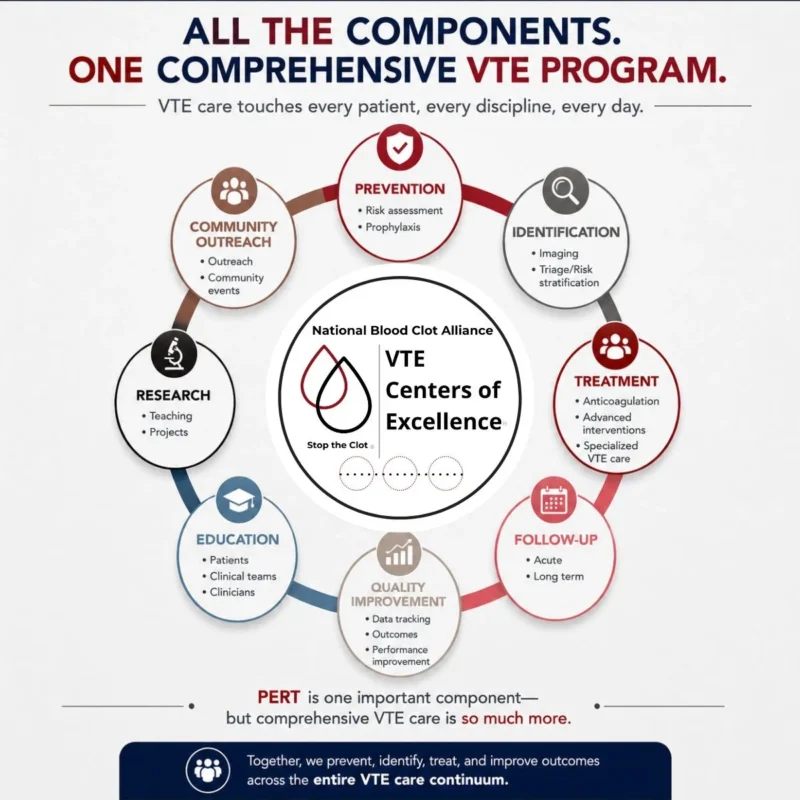
What matters is creating a multidisciplinary forum where venous thromboembolism (VTE) remains a visible institutional priority and where teams come together to discuss opportunities for improvement across the entire continuum of care.
A place where teams can openly discuss:
- Hospital-acquired VTE rates
- Prevention and prophylaxis strategies
- Workflow barriers and operational challenges
- Guideline updates and best practices
- Treatment pathways
- Patient outcomes and follow-up care
- Community outreach and education
- Quality improvement initiatives
One misconception I occasionally encounter is the belief that having a Pulmonary Embolism Response Team (PERT) is synonymous with having a VTE program.
PERTs play an important role in the care of patients with acute PE and can be a valuable component of a broader VTE strategy.
But PERT is only one piece of the puzzle.
The strongest programs recognize that VTE care begins long before a patient develops a massive PE and continues long after they leave the hospital.
After spending most of my clinical career in the interventional space, I often find myself asking a different question:
If advanced intervention volumes are increasing because hospital-acquired VTE rates are increasing, what problem are we actually solving?
The goal isn’t simply to become better at treating blood clots.
The goal is to prevent avoidable clots whenever possible while ensuring exceptional care for patients who develop them.
One of the most consistent themes I’ve observed across NBCA VTE Centers of Excellence is the presence of strong multidisciplinary governance.
These programs bring together physicians,
APPs, nurses, pharmacists, quality leaders, informatics specialists, administrators, and many others who recognize that VTE is not owned by a single specialty or service line.
Because VTE impacts nearly every discipline in healthcare.
The organizations making the greatest impact are the ones creating intentional spaces where prevention, identification, treatment, follow-up, quality improvement, education, and community outreach are discussed together—not in silos.
What does VTE governance look like at your institution?”
Stay updated with Hemostasis Today.
-
Oct 20, 2026, 16:51Suzan Nakasendwa: A Growing Stroke Challenge in Uganda
-
Oct 20, 2026, 16:38Steve Moon: How Does Smoking Cessation Duration Affect Ischemic Stroke Risk
-
Oct 20, 2026, 16:25Cedrice Mentor: Reducing Platelet Wastage Through Cold Storage
-
Oct 20, 2026, 16:09Thirunavukkarasu Angappan: Can a Purified Fibrinogen Concentrate Replace Cryoprecipitate
-
Oct 20, 2026, 16:01Kalyan Roy: Platelet Conservation Through Evidence-Based Transfusion Practice
-
Oct 20, 2026, 15:28Stacy E. Croteau: 33 Countries, One Mission – Better Bleeding Disorder Care
-
Oct 20, 2026, 15:19Teresa Barnes: What Does a Pulmonary Embolism Mean for Jalen Hurts?
-
Oct 20, 2026, 15:04Laura S.: Could Speaking Up Prevent Maternal Deaths from Thrombosis?
-
Oct 20, 2026, 14:44Pete Stibbs: VTE in Professional Athletes – When Fitness Is Not Enough