


Ifeanyichukwu Ifechidere: The Mastermind of Clotting – A Thrombin Story
Ifeanyichukwu Ifechidere, Specialist Biomedical Scientist at Sheffield Teaching Hospitals NHS Foundation Trust, shared a post on LinkedIn:
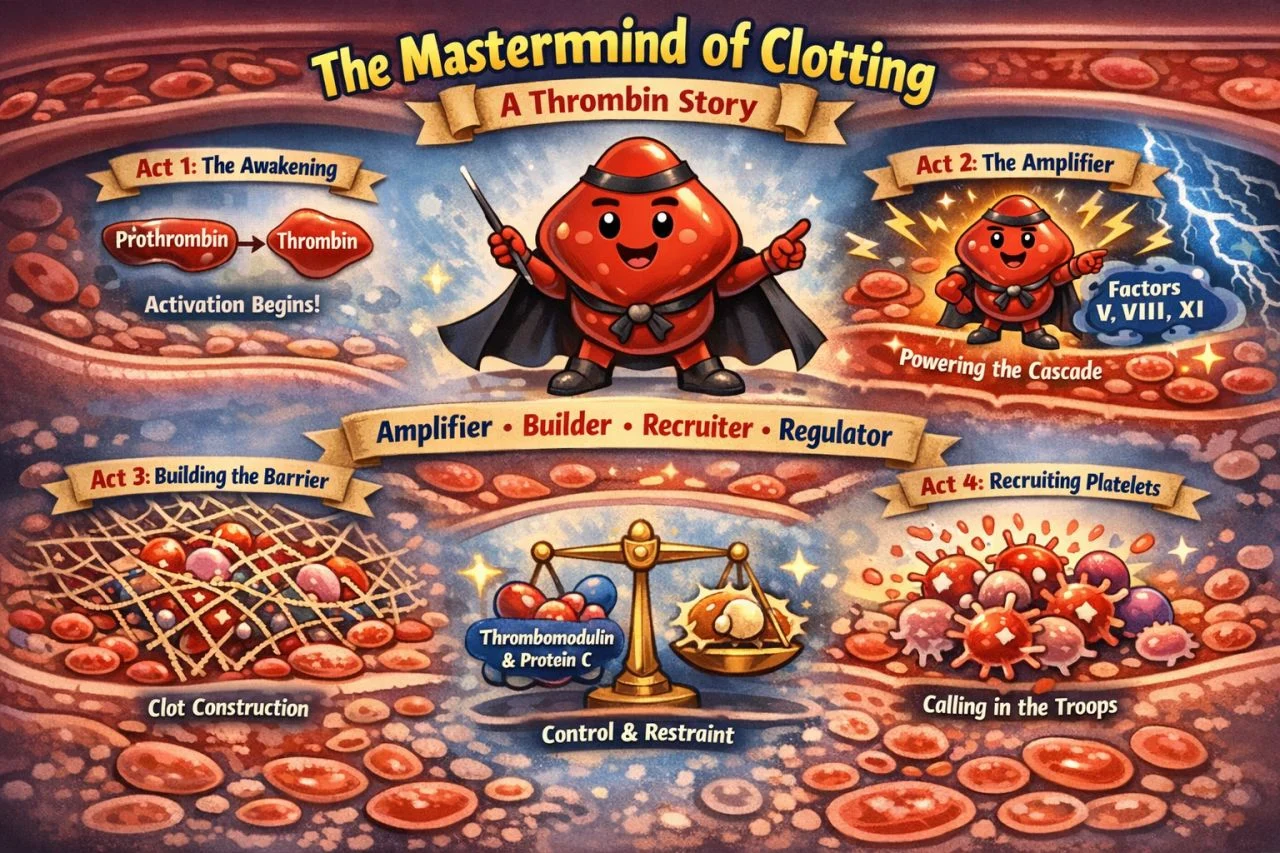
“The Mastermind of Clotting: A Thrombin Story
Imagine a quiet city – your bloodstream – flowing smoothly, minding its business.
Suddenly, disaster strikes:
A vessel wall is injured. Chaos begins. But every great story needs a leader…
Enter Thrombin – not just a participant, but the orchestrator of haemostasis.
Act 1: The Awakening
Thrombin doesn’t start as a hero.
It’s born from its inactive precursor, prothrombin, during the coagulation cascade.
Once activated, it steps onto the scene with purpose – and things escalate quickly.
Act 2: The Amplifier
Thrombin’s first move? It turns up the volume.
It activates clotting factors V, VIII, and XI.
This creates a powerful feedback loop
More thrombin is generated… and then even more
It’s not just participating – it’s building momentum.
Act 3: Building the Barrier
Now comes the construction phase.
Thrombin converts soluble fibrinogen into insoluble fibrin strands – the scaffolding of a clot.
These strands weave together like a net, trapping platelets and forming a stable barrier.
But Thrombin doesn’t stop there…
It activates Factor XIII
This cross-links fibrin
The clot becomes stronger, more resilient – built to last
Act 4: Recruiting Reinforcements
Thrombin is also a powerful communicator.
It activates platelets, making them:
- Change shape
- Release granules
- Aggregate at the injury site
It’s like calling in a specialized repair crew – fast, efficient, and coordinated.
Act 5: Knowing When to Stop
Here’s where the story gets interesting.
Too much clotting?
Dangerous. Too little?
Also dangerous.
Thrombin helps maintain balance by:
Binding to thrombomodulin on endothelial cells
Activating protein C
Slowing down further clot formation
Even as a builder, it understands restraint.
The Takeaway
Thrombin isn’t just another enzyme in the cascade – it’s:
- An amplifier
- A builder
- A recruiter
- A regulator
A single molecule with multiple roles, ensuring haemostasis is not just effective – but controlled.
Next time you think about clotting, don’t picture a simple chain reaction.
Picture a story – one where Thrombin is the strategist ensuring the system responds fast, strong, and just enough.”
More posts featuring Ifeanyichukwu Ifechidere on Hemostasis Today.
-
Oct 14, 2026, 06:00Aymen A.: LAAC vs. OAC in Patients with Atrial Fibrillation Including CHAMPION-AF and CLOSURE-AF Trials
-
Oct 13, 2026, 21:05Francisco Chacón-Lozsán: Heparin-Induced Thrombocytopenia – When an Anticoagulant Triggers Thrombosis
-
Oct 13, 2026, 21:04Aref Zribi: Isolated Tumor Thrombus and the Role of Prophylactic Anticoagulation
-
Oct 13, 2026, 21:01Alex Larson: Why Normal Bloodwork Does Not Always Tell the Whole Story
-
Oct 13, 2026, 20:58Juan Jauregui-Lozano: How Replication Stress Impairs Red Blood Cell Maturation
-
Oct 13, 2026, 20:55Caitlin Raymond: Understanding Platelet Refractoriness Before Ordering More Platelets
-
Oct 13, 2026, 20:54Sanja Seratlic: How Cow Feeding Systems Influence the Anti-Platelet Properties of Cheddar Cheese
-
Oct 13, 2026, 20:50Ruchika Goel: Cord Blood Red Blood Cells as a Physiologically Aligned Transfusion Strategy
-
Oct 13, 2026, 20:47Sophia Delicou: Strengthening Transfusion Safety Through Advanced Screening and Haemovigilance