


Ifeanyichukwu Ifechidere: D-dimer – Why is This Test Being Ordered – and What is It Actually Telling You?
Ifeanyichukwu Ifechidere, Specialist Biomedical Scientist at Sheffield Teaching Hospitals, shared a post on LinkedIn:
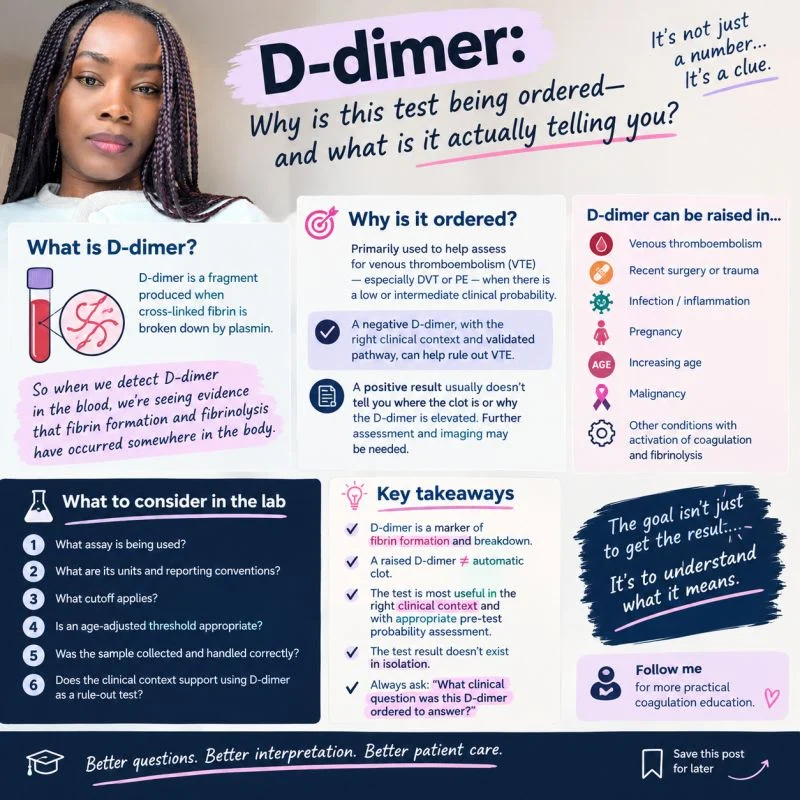
“D-dimer: Why is this test being ordered – and what is it actually telling you?
A D-dimer result is easy to look at.
Understanding why it was ordered is much more important.
D-dimer is a fragment produced when cross-linked fibrin is broken down by plasmin.
So when you detect D-dimer in the blood, you’re seeing evidence that fibrin formation and fibrinolysis have occurred somewhere in the body.
But here is where interpretation gets interesting:
A raised D-dimer does NOT automatically mean the patient has a DVT or PE.
D-dimer can increase in many situations, including:
- Venous thromboembolism
- Recent surgery or trauma
- Infection/inflammation
- Pregnancy
- Increasing age
- Malignancy
- Other conditions associated with activation of coagulation and fibrinolysis
So why order it?
The key is that D-dimer is primarily useful in the right clinical context and with an appropriate pre-test probability assessment.
For suspected DVT or PE, a clinician may use a D-dimer result as part of a diagnostic pathway.
And this creates an important laboratory lesson:
The test result doesn’t exist in isolation.
A negative D-dimer, when an appropriate assay and validated diagnostic pathway are used in a patient with sufficiently low clinical probability, can help exclude VTE.
A positive D-dimer, however, usually doesn’t tell you where the clot is or why the D-dimer is elevated. Further clinical assessment and, where indicated, imaging may be required.
There are also laboratory considerations that matter:
- What assay is being used?
- What are its units and reporting conventions?
- What cutoff applies?
- Is an age-adjusted threshold appropriate?
- Was the sample collected and handled correctly?
- Does the clinical context support using D-dimer as a rule-out test?
This is why simply remembering ‘high D-dimer doesn’t mean clot’ can lead to poor interpretation.
The better question is:
‘What clinical question was this D-dimer ordered to answer?’
Once you understand that, the result starts to make much more sense.
Follow me for more practical coagulation education – where we go beyond memorising results and learn how to understand the reasoning behind them.”
Other posts featuring Ifeanyichukwu Ifechidere on Hemostasis Today.
-
Oct 1, 2026, 15:44A Century of Von Willebrand Disease Awareness – EHC
-
Oct 1, 2026, 15:31Andreas Calatzis: The Power of Teamwork in Postpartum Hemorrhage
-
Oct 1, 2026, 15:09Halimat Olaniyan: The Role of Transfusion Medicine in Sickle Cell Disease Care
-
Oct 1, 2026, 14:58Samir Kumar Beura: Modern Approaches to Platelet Structure and Function
-
Oct 1, 2026, 14:39Understanding the FDA Pathway for Hematology Product Development – American Society of Hematology
-
Oct 1, 2026, 13:56Ravi C Dara: Advancing Red Cell Exchange in Sickle Cell Disease
-
Oct 1, 2026, 13:50Mateo Marin-Cuartas: What Matters After Aortic Valve Replacement in Younger Patients?
-
Oct 1, 2026, 13:17Anirban Sen Gupta: Sharing Ideas, Advancing Biomedical Innovation
-
Oct 1, 2026, 13:01Michael Honigberg: Clonal Hematopoiesis as a Driver of Aortic Valve Calcification