


Jonathan Douxfils: Can Untreated Heavy Menstrual Bleeding Increase the Risk of Venous Thromboembolism?
Jonathan Douxfils, Director of the Research Unit in Clinical Pharmacology and Toxicology at University of Namur, shared on LinkedIn:
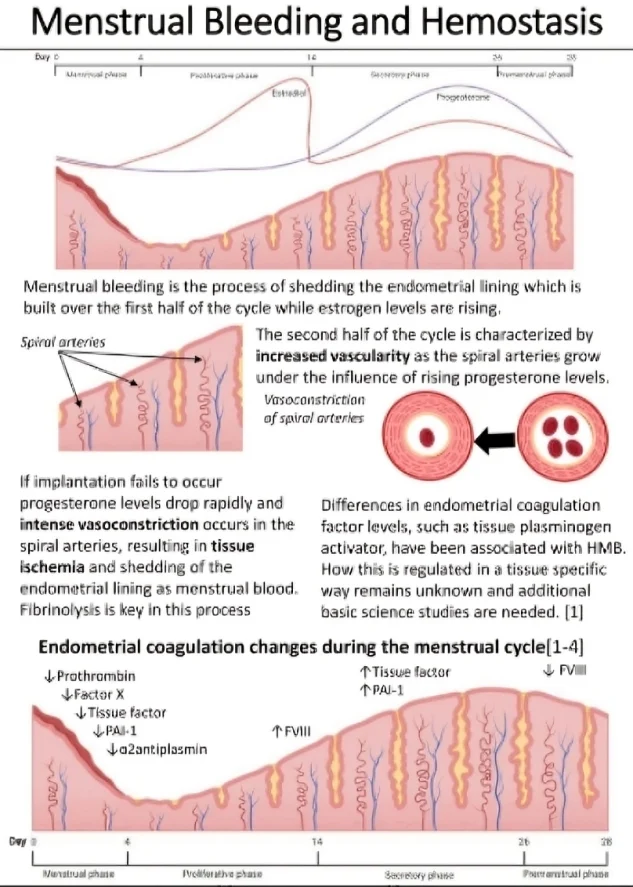
”Did you know that not treating heavy menstrual bleeding may itself increase the risk of venous thromboembolism?
Counterintuitive? Read below.
Heavy menstrual bleeding (HMB) is a major driver of iron deficiency and iron-deficiency anaemia (IDA). And IDA is increasingly recognised as a potentially prothrombotic condition.
The biological rationale is compelling:
- iron deficiency can induce reactive thrombocytosis
- it increases platelet reactivity
- anaemia-related hypoxia and haemodynamic changes can promote endothelial dysfunction
Consistent with this, a recent large cohort found that IDA was associated with a 75 percent higher 1-year risk of VTE (HR 1.75), with an even greater association for pulmonary embolism (HR 2.05). Importantly, much of this excess risk appeared to be mediated by thrombocytosis.
So, leaving HMB untreated is not thrombotically neutral.
And we have effective treatments
- LNG-IUS is generally the most effective medical option, reducing menstrual blood loss by up to ±70–95 percent.
- Combined hormonal contraception, particularly extended or continuous regimens, can markedly reduce bleeding.
- Progestogen-only strategies can suppress menstruation and are particularly useful when estrogen is not appropriate.
- Tranexamic acid (TXA) offers an effective non-hormonal option, reducing menstrual blood loss by approximately 40–50 percent.
Fibrinolysis is key in this process!
Yet TXA is still sometimes withheld because of fear of thrombosis.
But the evidence is reassuring…
Across 49,538 non-surgical patients, systemic TXA was not associated with increased DVT, PE, myocardial infarction or stroke. Across another 125,550 patients in randomized trials, thromboembolic events were also not increased: RR 1.02; 95 percent CI 0.94–1.11. Even the Danish study that identified a very modest VTE signal translated into an estimated NNH of 78,549 women for one 5-day course. But this study suffered from lack of adjustment and does not adjust for the disease itself.
Importantly, available evidence does not demonstrate an additional thromboembolic signal from short-course TXA in women using combined hormonal contraception.
This directly echoes one of the messages from my recent ISGRE presentation: when discussing thrombosis in women’s health, we need to consider the risk of the treatment but also the risk of not treating.
Women with HMB deserve rapid access to effective treatment, not therapeutic delay driven by an exaggerated perception of thrombotic risk.
TXA is efficacious in reducing HMB and the current evidence does not associate it with an excess risk even when use concomitantly with COC. Both treatments may help women with HMB.”
Stay updated with Hemostasis Today.
-
Oct 13, 2026, 02:01Nour Al-Mozain: Is It Really Anti-D? – Unraveling Auto-Anti-LW in the Transfusion Laboratory
-
Oct 13, 2026, 01:51Berenice Villegas: The Role of Morphologic Evaluation in Body Fluid Differential Analysis
-
Oct 13, 2026, 01:44Debadrita Ray: Evaluating vWF and VITRO Score for Detecting CSPH in cACLD Patients
-
Oct 13, 2026, 01:34Nagesh Ramesh: Donating Blood for International Plasma Awareness Week
-
Oct 12, 2026, 21:51Sam Botchey: Orthobiologics Are Advancing but the Evidence Must Keep Pace
-
Oct 12, 2026, 21:50Serum Vitamin D, Platelet Function, and Bleeding in Primary ITP – Platelets Journal
-
Oct 12, 2026, 21:30Nika Samadzadeh Tabrizi: Looking Forward to the PACeS Trial on Anticoagulation for POAF
-
Oct 12, 2026, 21:28Michael Megaly: Does Coronary Ectasia Affect Outcomes in Acute Coronary Syndromes?
-
Oct 12, 2026, 21:25Vitor Borin P. de Souza: Think Twice Before Anticoagulating an Isolated Subsegmental PE