


Khaled Kandil: A Rare Case of Recurrent Thromboembolism with Pulmonary Artery Aneurysms
Khaled Kandil, Professor of Internal Medicine at Faculty of Medicine Azhar University, shared on LinkedIn:
”Case Presentation :
A 36 – year- old man with medical history of inferior vena cava thrombus and recurrent pulmonary embolism (PE) presented to ER with fever , malaise, and night sweats for 3 days and hemoptysis (approximately half a tablespoon) in the last 24 hours.
He reports the first diagnosis of inferior vena cava thrombus in December 2022, when he presented with similar symptoms and was started on apixaban.
Since then , he had 3 additional episodes in the following 6 months in which he was found to have a recurrent PEs despite compliance and changes in regimen (warfarin then enxoparin).
However, this first episode of hemoptysis.
Patient has never smoked, abd denies personal and family history of coagulopathy or cancer.
Physical Examination Findings
- The patient was febrile ( 39.6 C ).
- Heart rate 108 beats/min.
- Respiratory rate 16 breaths/ min.
- He appeared already and without any signs of stress.
- No rashes, or oral or genital ulcers, eye pain or redness, visual disturbances.
- No lack of strength in extremities, or joint pain/ stiffness.
- All other aspects if Physical examination were within normal limits.
Diagnostic Studies:
- Initial laboratory work up, including: CBC , comprehensive metabolic panel, and CXR were unremarkable.
- Inflammatory markers were elevated (C- reactive protein CRP 160mg/dl and ESR 144 mm/h.
- Urine analysis showed microscopic Hematuria with 3- 10 RBCs per field.
- Doppler ultrasound of both legs was negative for clots.
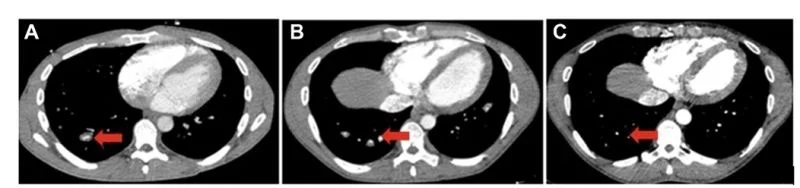
- CT scan of the chest with contrast revealed new, multiple dilated and aneurysmal pulmonary arteries and veins with in situ thrombosis A .
- Additional evaluation took place to elucidate the cause of recurrent thromboembolism and systemic inflammation.
Hypercoagulable work-up was negative, including IgG/IgM, anticardiolipin and IgG/IgM anti- B2GPI and inherited thrombophilia markers
- Autoimmune serologies including anti nuclear antigen and antinuclear cytoplasmic antibodies were negative.
- Blood Culture and all microbiologic work-ups were negative as well.
Organ- specific evaluations included a kidney biopsy showing mild glomerular microangiopathy and acute tubular injury but without evidence of vasculitis.
BM biopsy which was normocellular with trilineage hematopoiesis and no dysplasia of blast proliferation.
Flow Cytometry revealed no abnormal blast cells.
What is your diagnosis?”
Stay updated with Hemostasis Today.
-
Oct 16, 2026, 18:12Adil Nawaz: Extended Dual Antiplatelet Therapy After Coronary Stenting
-
Oct 16, 2026, 17:50Elad Asher։ STORM-PE Shows Functional Benefits of Thrombectomy
-
Oct 16, 2026, 17:32Shruthi Narayan: STORM-PE and STRIKE-PE Studies Advance Understanding of Recovery After Pulmonary Embolism
-
Oct 16, 2026, 17:22Wolfgang Miesbach։ What a Near-Perfect FISH Score Fails to See
-
Oct 16, 2026, 17:06Troels Wienecke: Connecting Myeloproliferative Disease and Ischemic Stroke
-
Oct 16, 2026, 17:03Only 5 Days Left to Submit Your Research for EAHAD 2027
-
Oct 16, 2026, 16:48Abdul Rahman: Reticulocyte Count and Bone Marrow Activity
-
Oct 16, 2026, 16:44DOAC Adherence in Stroke Patients With Atrial Fibrillation – International Journal of Stroke
-
Oct 16, 2026, 16:22Shannon Farmer: Driving Patient Blood Management Forward in Australia and New Zealand