


Mahesan Subramaniam: Just 8 Minutes of Anger Can Spike Heart Attack Risk
Mahesan Subramaniam, Co-Founder of United Health Tourism, shared a post on LinkedIn:
”Just 8 minutes of anger can ‘paralyze’ your blood vessels for nearly an hour, significantly raising the risk of heart attack and stroke.
Recent research highlights a startling physiological link between temper and heart health, revealing that just eight minutes of intense anger can physically impair your vascular system. A study of 280 adults found that recalling anger-inducing memories reduced the ability of blood vessels to dilate by roughly 50 percent, an effect that lingered for up to 40 minutes after the emotion subsided. Unlike sadness or anxiety, which did not produce the same significant vascular impairment, anger caused the endothelium—the inner lining of blood vessels—to stiffen and lose its essential elasticity, effectively restricting healthy blood flow.
While a single episode of frustration may not be immediately fatal, the cumulative impact of repeated anger can be devastating for long-term health. This temporary restriction in blood vessel function increases the risk of heart attacks, strokes, and atherosclerosis by preventing the cardiovascular system from repairing itself effectively over time. Experts from the American Heart Association suggest that managing these emotional outbursts is not just a matter of mental well-being, but a critical physical intervention for preventing chronic heart disease and maintaining arterial health.”
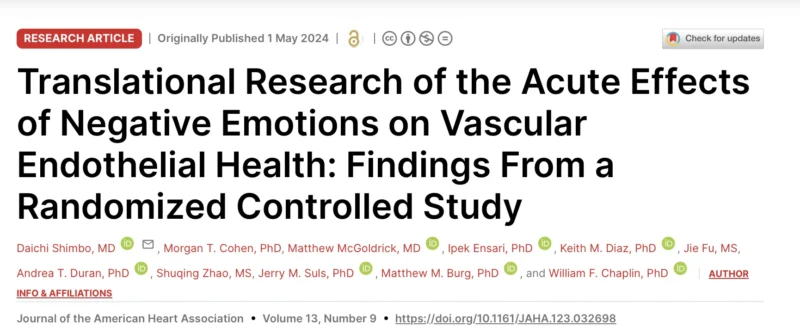
Title: Translational Research of the Acute Effects of Negative Emotions on Vascular Endothelial Health: Findings From a Randomized Controlled Study
Authors: Daichi Shimbo, Morgan T. Cohen, Matthew McGoldrick, Ipek Ensari, Keith M. Diaz, Jie Fu, Andrea T. Duran, Shuqing Zhao, Jerry M. Suls, Matthew M. Burg, William F. Chaplin
Read the Full Article in the Journal of the American Heart Association.
Stay updated with Hemostasis Today.
-
Oct 2, 2026, 17:40Chokri Ben Lamine: A Two-Day Journey Through Modern Hematology at KFSHRC
-
Oct 2, 2026, 17:27Reza Shojaei: The Invisible Crisis, Part 1: Donor Deferral in Whole Blood
-
Oct 2, 2026, 16:02Advancing Antithrombotic Stewardship to Optimise Care – American Heart Association
-
Oct 2, 2026, 15:37Pall T. Onundarson: Monitoring Warfarin Beyond Factor VII
-
Oct 2, 2026, 15:26Nicola Carter: World Thrombosis Day Highlights Gender Specific Risks and Prevention
-
Oct 2, 2026, 14:56Wolfgang Miesbach: Direct Comparison Reveals Distinct Mechanisms Among FVIIIa Mimetics
-
Oct 2, 2026, 14:47Strengthening Hemophilia Care Through Advocacy and Partnership – World Federation of Hemophilia
-
Oct 2, 2026, 14:40Maxime Dely: CAR T Cell Therapy Starts With Collection
-
Oct 2, 2026, 14:30Sadashiva Pai: The Molecular Gateway for Sphingosine-1-Phosphate Release