

Edward Lee Carter: Can EZPLAZ Bring Plasma to Patients Earlier?
Edward Lee Carter, Clinical Pharmacist Practitioner at U.S. Department of Veterans Affairs, shared a post on LinkedIn:
“For decades, plasma has had a geography problem.
Plasma works. But frozen storage, thawing, inventory management and blood-bank infrastructure have largely determined where—and how quickly—it can be given.
That may be starting to change.
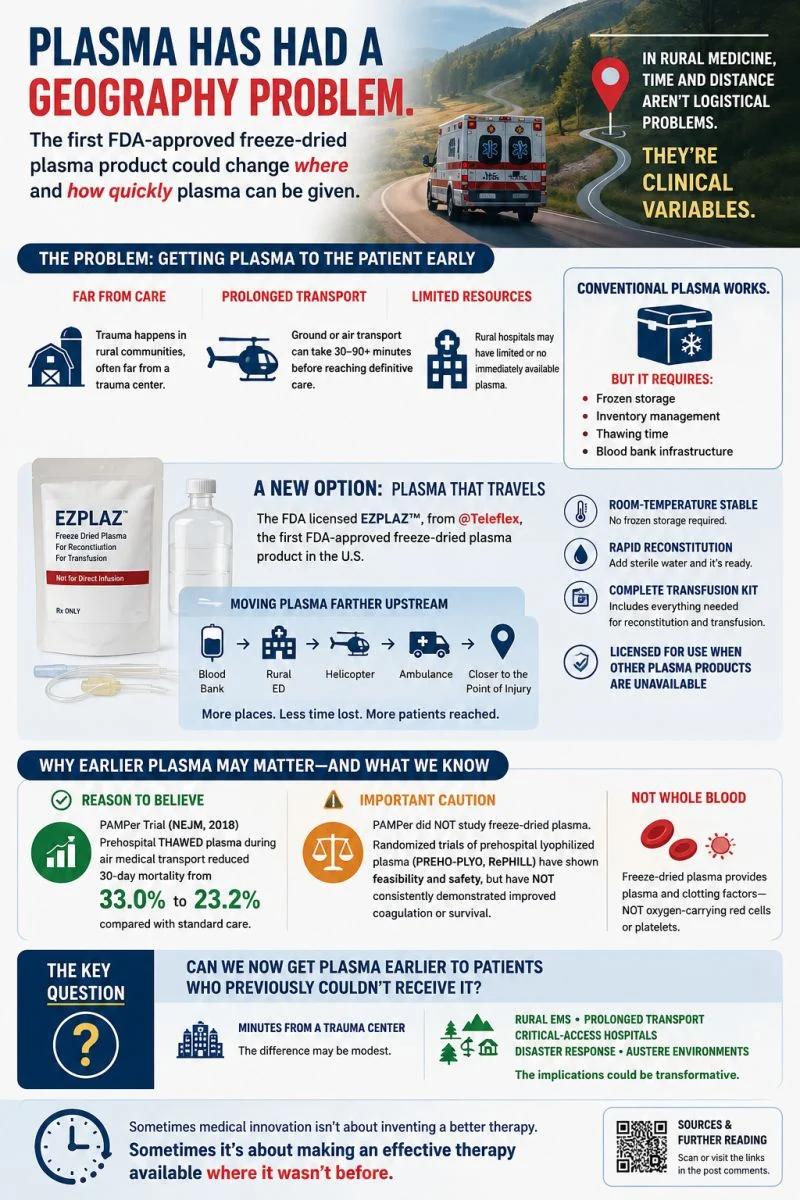
The FDA recently licensed EZPLAZ™, from Teleflex, the first FDA-approved freeze-dried plasma product in the U.S.
The bigger story may not be the approval itself.
It’s what happens when plasma becomes portable.
Consider major hemorrhage in rural America:
- A farm or highway trauma occurs far from a trauma center.
- Transport may take considerable time.
- The nearest hospital may have limited immediately available plasma.
Conventional plasma works.
Getting it to the bleeding patient early is the problem.
EZPLAZ is room-temperature stable and can be reconstituted when needed—potentially moving plasma farther upstream:
Blood bank to rural ED, helicopter, ambulance, and ultimately closer to the point of injury.
That matters because earlier plasma may matter.
In the PAMPer trial, prehospital thawed plasma during air medical transport reduced 30-day mortality from 33.0 percent to 23.2 percent compared with standard care.
But we need to be careful with that comparison.
PAMPer did not study freeze-dried plasma, and randomized trials of prehospital lyophilized plasma have established feasibility without consistently demonstrating improved clinical outcomes.
So this isn’t evidence that freeze-dried plasma improves survival.
And it isn’t a replacement for whole blood. Plasma provides coagulation factors, but not oxygen-carrying red cells or platelets.
The more interesting question may be:
Can we now get plasma earlier to patients who previously couldn’t receive it?
For someone minutes from a Level I trauma center, the difference may be modest.
For rural EMS, prolonged transport, critical-access hospitals, disaster response and austere environments, the implications could be much larger.
Because in rural medicine:
Time and distance aren’t merely logistical problems.
They’re clinical variables.
Sometimes medical innovation isn’t about inventing a better therapy.
Sometimes it’s about making an effective therapy available where it wasn’t before.”
Stay updated with Hemostasis Today.
-
Oct 10, 2026, 17:58Archo Farzana Batool: Exploring Medical Writing Through an Article on Iron Deficiency Anemia
-
Oct 10, 2026, 17:53Assessing Frailty in Adults With Hemophilia – JTH
-
Oct 10, 2026, 17:52Fatma Sadeghi: Reducing Maternal Health Inequalities Through Nursing Advocacy
-
Oct 10, 2026, 17:50Grzegorz Hensler: How Apheresis Transformed Blood Cell Separation and Collection
-
Oct 10, 2026, 17:47Hemant K Sharma: Japan’s Universal Artificial Blood Research – A Potential Breakthrough in Transfusion Medicine
-
Oct 10, 2026, 17:40John Strouse: Learning About Bleeding Disorders and Sickle Cell Disease at FWGBD
-
Oct 10, 2026, 17:34Mae Caime: Speaking at the Annual Women’s Retreat for the Hemophilia Community in Florida
-
Oct 10, 2026, 17:30Chokri Ben Lamine: PNH beyond the Textbook Triad
-
Oct 10, 2026, 17:29Ruah Alyamany: Thrombosis and Anticoagulation in Hematological Malignancies at SOHO KSA 2026