

Mar 4, 2026, 14:21
Midhuna Krishnan: Simplifying Doppler Effect and Ultrasonography Using the Feynman Method
Midhuna Krishnan, Student at Dr N.G.P. Institute of Technology, shared a post on LinkedIn:
“Exploring the physics behind diagnostic imaging
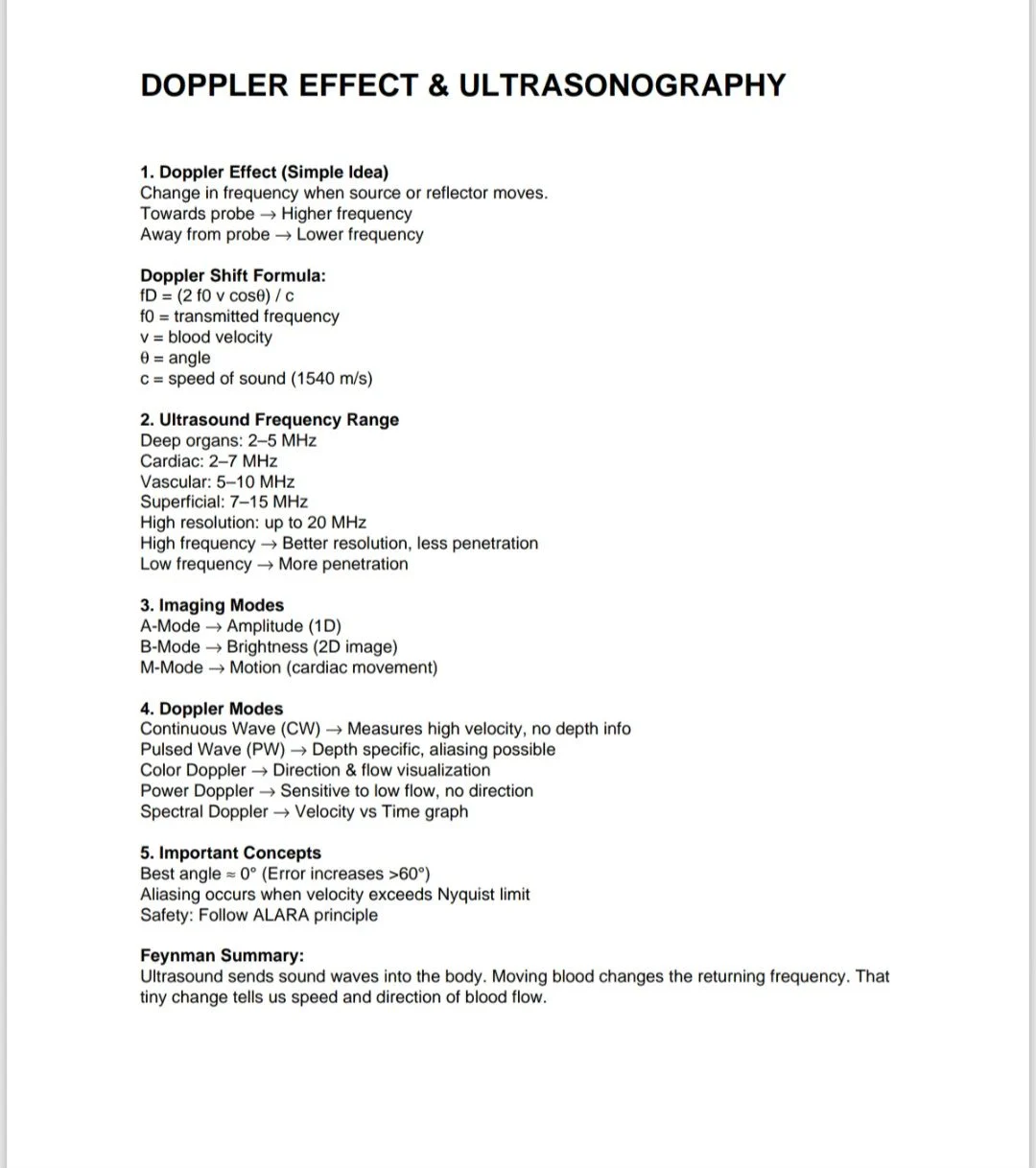
Simplifying Doppler Effect and Ultrasonography using the Feynman method.
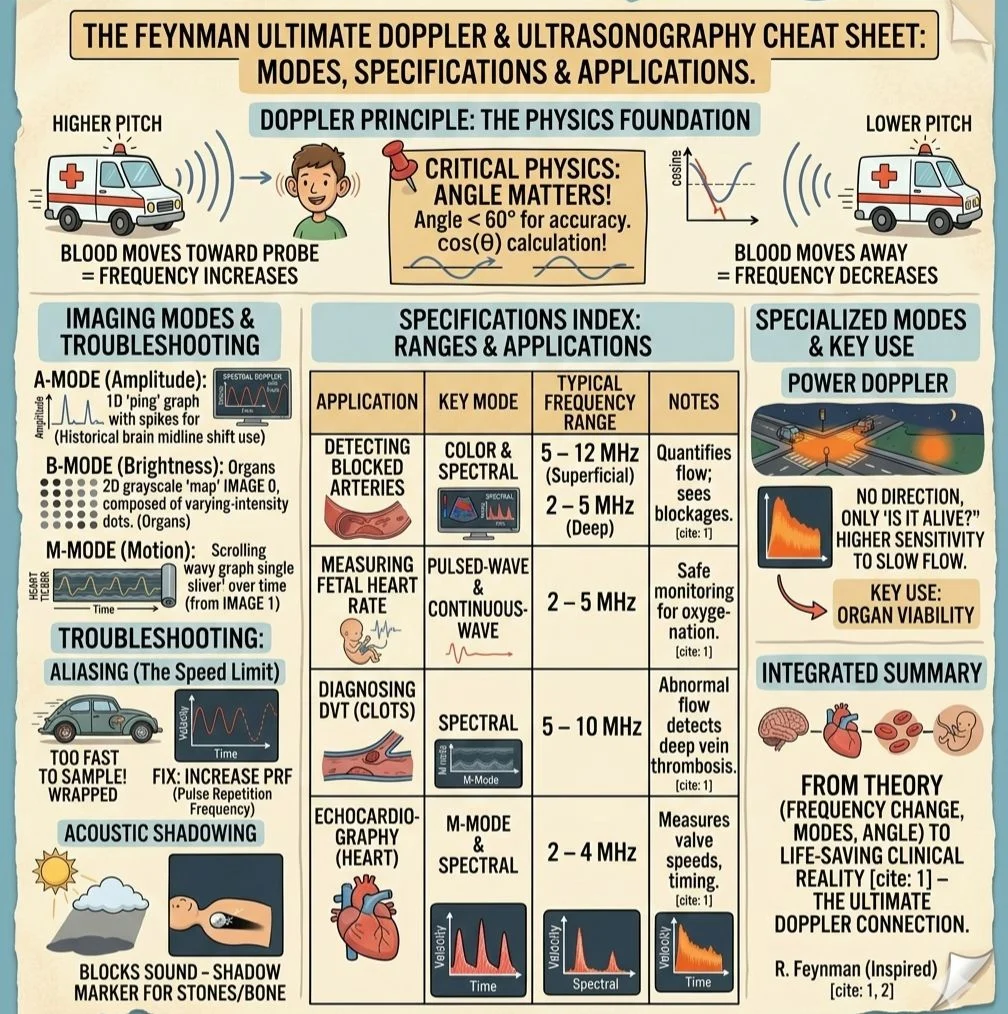
This cheat sheet explains:
- Frequency increases when blood moves toward the probe
- Frequency decreases when blood moves away
- Angle correction (less than 60 degrees) gives accurate velocity
- Different ultrasound modes – A, B, M
- How the frequency varies with different applications
- Doppler modes – CW, PW, Color, Power, Spectral
- Errors like aliasing and how to correct them
Clinical applications include:
- Detecting blocked arteries
- Measuring fetal heart rate
- Diagnosing deep vein thrombosis (DVT)
- Performing echocardiography
Simple concept.
Great impact.
Grateful for Sri Roshini R mam for turning topics into clear understanding .
Thank you for your guidance in Medical Physics .”
Stay updated with Hemostasis Today.
-
Sep 30, 2026, 11:16Christina Pohlman: Could aPL Levels Help Predict Stroke Recurrence?
-
Sep 30, 2026, 10:55Rana Al Hrout: Diagnostic Approach to Hypochromic Microcytic Anemia
-
Sep 30, 2026, 01:52Javed Anees: DADA2 – When a Young Stroke Is More Than a Stroke
-
Sep 30, 2026, 01:51How a Venous Thrombus Becomes Revascularized – ISTH
-
Sep 29, 2026, 22:45Victor Agunyego: Paracetamol – The Most Common Drug We Underestimate
-
Sep 29, 2026, 22:42Nova Sinclair: Advancing the Future of Hematology – Meet Our 2027 Organizing Committee
-
Sep 29, 2026, 22:41Lorenz Räber: Intracoronary Imaging in PCI – Why, When, How, and Which Modality?
-
Sep 29, 2026, 22:31Selma Turkovic: Pleased to Deliver the Opening Presentation at Kingston Hospital
-
Sep 29, 2026, 22:31Miguel Teran: Ultrasound and Simulation in Arterial Blood Sampling