


Milad Abdalla: Elevating Phlebotomy Standards – Why Order of Draw and Blood Cultures Matter
Milad Abdalla, Medical Laboratory Technologist at Al Yalayis Government Transactions Center, shared a post on LinkedIn:
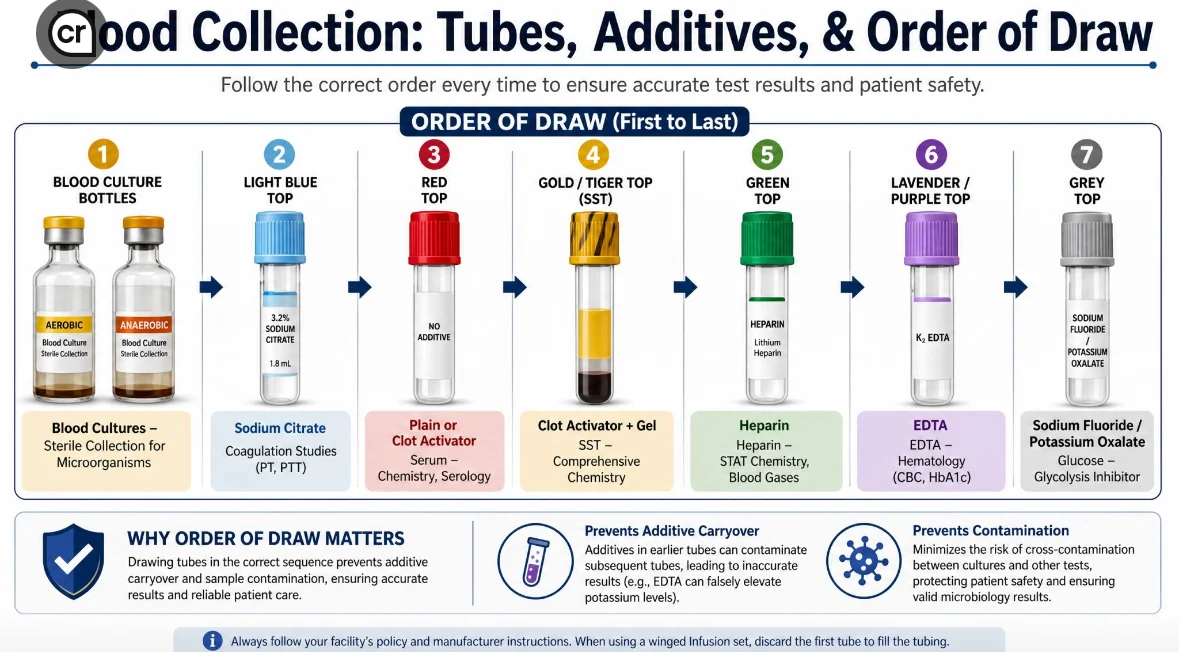
“Elevating Phlebotomy Standards – Why Order of Draw and Blood Cultures Matter
Accurate diagnostics start long before the sample reaches the analyzer. The pre‑analytical phase – especially the Order of Draw and proper Blood Culture collection – remains one of the most critical determinants of result integrity.
Why It Matters?
Additive carryover can alter results, delay diagnosis, and compromise patient safety. That’s why the CLSI sequence is the global benchmark for preventing contamination and ensuring reliable outcomes.
CLSI Order of Draw (Simplified)
- Blood Cultures — Always first to maintain sterility and avoid additive interference.
- Light Blue – Citrate — Coagulation tests requiring precise 1:9 ratio.
- Serum Tubes – Red/Gold/SST — Chemistry, serology, immunology.
- Green – Heparin — STAT chemistry and blood gases.
- Lavender – EDTA — CBC, HbA1c; collected late to avoid metal chelation interference.
- Grey – Fluoride/Oxalate — Glucose and lactate; strong inhibitors, so always last.
Blood Cultures – The First Line in Infection Diagnosis
Their accuracy depends on:
- Strict aseptic technique
- Correct blood volume
- Drawing them before any other tube
Key Takeaways
- Sterility first — Blood cultures always lead the sequence.
- Prevent additive carryover — Follow CLSI strictly.
- Volume accuracy — Especially for coagulation and cultures.
- Continuous competency — Phlebotomy excellence is a global responsibility.
By mastering these fundamentals, we elevate diagnostic accuracy and strengthen patient safety across healthcare systems worldwide.”
Stay updated with Hemostasis Today.
-
Oct 22, 2026, 18:04Basem Goueli: Blood Clots in the NFL
-
Oct 22, 2026, 17:57Syed Ahmed: Viral Triggers of Immune Thrombocytopenia and Thrombosis
-
Oct 22, 2026, 17:49Valerie Tutwiler: Bridging Engineering and Medicine to Advance Thrombosis Research
-
Oct 22, 2026, 17:41Jesus Ardila Novoa: How Patient Education Can Transform Hemophilia Care
-
Oct 22, 2026, 17:30Filipe Gonçalves: Advancing Bleeding Disorder Diagnosis Through Multidisciplinary Collaboration
-
Oct 22, 2026, 17:17Storage Pool Deficiency An Overview of a Rare Platelet Disorder – EHC
-
Oct 22, 2026, 17:10Matthew Hazell: Optimizing the Use of Rare Red Blood Cell Units
-
Oct 22, 2026, 17:03Smita Patil: New Insights Into Platelet Alpha-Granule Secretion
-
Oct 22, 2026, 16:48Ahmed Alotaibi: Rare Rh Phenotype and Severe Fetal Anaemia