


Mostafa Hammam: Antibody Panels in Blood Bank Feeling Like a Chaotic Puzzle? Here is How to Master the Grid
Mostafa Hammam, Blood Bank Laboratory Technician at Specialized Medical Centers in Egypt, shared a post on LinkedIn:
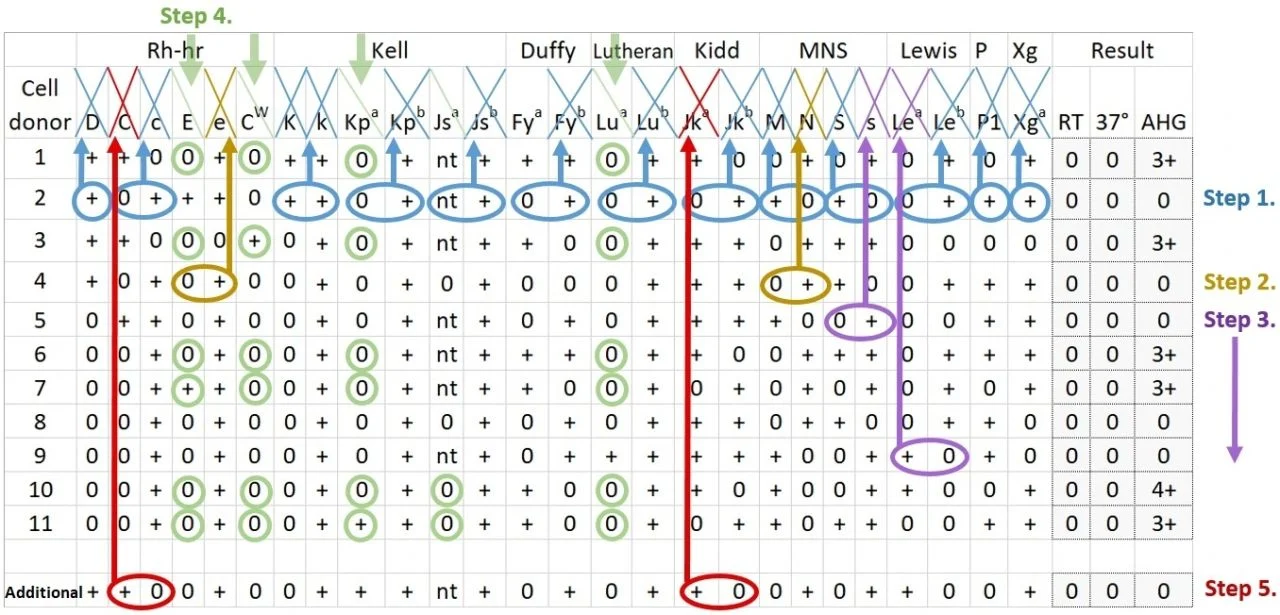
“Antibody panels in Blood Bank feeling like a chaotic puzzle? Here is how to master the grid.
Solving antibody panels is one of the most critical skills in Blood Banking and a top topic on the ASCP exam.
It might look intimidating at first, but it all comes down to pattern recognition.
Here are the 4 fundamental steps to decode any antibody panel with confidence:
1. Rule Out on Negative Cells only
The Rule: You can only rule out an antibody if a cell expresses the antigen but produces a negative reaction.
Why? If the reaction is positive, you don’t know which specific antibody is causing it, so positive cells cannot be used for rule-outs.
2. Check the Phase of Reactivity
Immediate Spin (IS) / Room Temp: Usually indicates clinically insignificant cold-reacting IgM antibodies (e.g., Anti-M, Anti-N, Anti-P1, Anti-Lea/Leb).
37°C / AHG (Coombs) Phase: Indicates clinically significant IgG antibodies that can cause HTR or HDFN (e.g., Rh, Kell, Kidd, Duffy).
3. Evaluate Reaction Strengths
Single Strength (e.g., all 2+): Usually points to a single antibody.
Variable Strengths (e.g., 1+, 3+, 2+): Suggests dosage (homozygous vs. heterozygous expression) or multiple antibodies reacting together (especially in Kidd, Duffy, and MNS systems).
4. Confirm with Patient Antigen Typing (Phenotyping)
The Rule: A patient can only make an antibody against an antigen they lacks.
If the patient types negative for the antigen, they are capable of forming the corresponding antibody.
Antibody identification is basically detective work!
Compare reactivity phases, antigen profiles, and reaction consistency until the pattern fits.
Once the pattern fits, the antibody makes perfect sense!”
Stay updated with Hemostasis Today.
-
Sep 20, 2026, 16:42Kate Grushetzkaya: The Essential Flow Cytometry Checklist – 6 Steps to Better Data
-
Sep 20, 2026, 16:32New Episode of The Hematologist Podcast – ASH
-
Sep 20, 2026, 16:26Thomas Schinecker: A New Era for Health Innovation – Inside the Roche Genentech Innovation Center
-
Sep 20, 2026, 16:19Astha Srivastava: The Missing Megakaryocytes in Amegakaryocytic Thrombocytopenia
-
Sep 20, 2026, 16:19Heghine Khachatryan: An Elegant Example of Precision Thrombolysis – Targeting the Scaffold of Microvascular Thrombosis
-
Sep 20, 2026, 16:01Mohamed Ismail: Managing Extensive Iliofemoral and Inferior Vena Cava DVT
-
Sep 20, 2026, 15:58Can αIIbβ3 Receptor Play a Role in Platelet Production – Glanzmann’s Research Foundation
-
Sep 20, 2026, 15:46Alexsander Santiago: Evaluating Clinical Harm from Missing versus Overdiagnosing HIT
-
Sep 20, 2026, 15:28Nico Gagelmann: iMTSS to Dissect the Drivers of Post-Transplant Outcomes