


Ney Carter Borges: Pulse Pressure as an Integrated Marker of Arterial Stiffness and Cardiovascular Risk
Ney Carter Borges, Member Cardiologist of Global Physician Association at Cleveland Clinic Florida, shared a post on LinkedIn:
”Pulse Pressure as an Integrated Marker of Arterial Stiffness and Cardiovascular Risk
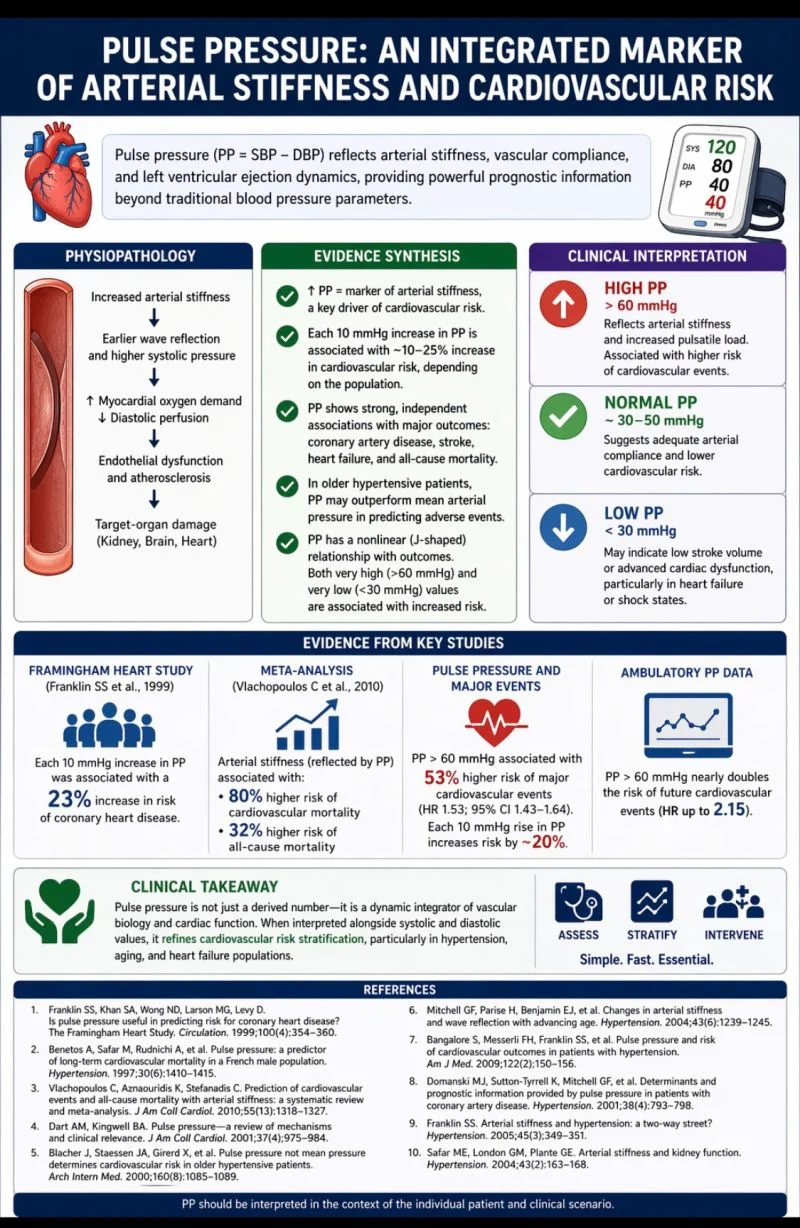
Pulse pressure (PP), defined as the difference between systolic and diastolic blood pressure, has emerged as a clinically meaningful biomarker that extends beyond traditional blood pressure parameters.
Rather than being a simple arithmetic derivative, PP reflects the interplay between arterial stiffness, vascular compliance, and left ventricular ejection dynamics, making it a powerful integrator of cardiovascular physiology.
Evidence from landmark studies consistently demonstrates its prognostic value. In the Framingham Heart Study, each 10 mmHg increase in PP was associated with a significant rise in coronary heart disease risk, independent of mean arterial pressure.
Similarly, observational cohorts and meta-analyses have confirmed that elevated PP is strongly associated with cardiovascular mortality, stroke, and heart failure, particularly in aging populations where arterial stiffening predominates.
Mechanistically, increased PP reflects reduced elasticity of large arteries, leading to earlier wave reflection and amplification of systolic pressure. This results in increased myocardial oxygen demand, impaired coronary perfusion during diastole, and progressive endothelial dysfunction.
Over time, these effects contribute to atherosclerotic progression and target-organ damage, including renal and cerebral injury.
From an evidence-based perspective, several consistent patterns emerge. First, elevated PP is a robust marker of arterial stiffness, a central driver of cardiovascular risk. Second, each 10 mmHg increment in PP is associated with an approximate 10–25% increase in cardiovascular risk, depending on the population studied.
Third, PP shows strong and independent associations with major clinical outcomes, including coronary artery disease, stroke, heart failure, and all-cause mortality. Notably, in older hypertensive patients, PP may outperform mean arterial pressure as a predictor of adverse events.
Importantly, PP demonstrates a nonlinear (J-shaped) relationship with outcomes. While high PP (>60 mmHg) reflects vascular aging and increased pulsatile load, very low PP (<30 mmHg) may indicate reduced stroke volume or advanced cardiac dysfunction, particularly in heart failure or shock states.
Clinically, PP provides incremental value in risk stratification when interpreted alongside systolic and diastolic pressures. It serves as a functional marker of vascular aging and subclinical organ damage, offering practical insight into patient prognosis.”
Other posts featuring Ney Carter Borges on Hemostasis Today.
-
Sep 24, 2026, 08:55Andres Gudino: Clot Characterization Through Hounsfield Units in Ischemic Stroke
-
Sep 24, 2026, 06:52Gina Sado: Screening-Detected Atrial Fibrillation Carries High Risk of Heart Failure
-
Sep 24, 2026, 06:33Benjamin Vipler: Optimal Oral Anticoagulation Choice in Atrial Fibrillation and Advanced CKD
-
Sep 24, 2026, 06:08Christopher Salerno: AI-Powered At-Home Anemia Screening Advances Telehealth Access
-
Sep 24, 2026, 05:38Aya Qattan: When a Normal CBC Does Not Mean Normal Iron Status
-
Sep 24, 2026, 05:11Mastering Warm Autoimmune Hemolytic Anemia Diagnosis and Practice – ASH Education
-
Sep 23, 2026, 16:04Monia Ezzalfani: Advancing Patient-Centered Care in Hemophilia A and B
-
Sep 23, 2026, 15:49Bilge Başak: How Activated PRP Modulates Osteoarthritic Chondrocyte Function
-
Sep 23, 2026, 14:50Mbonjo Bitsie Dora: Strengthening Sickle Cell Care Through Education, Awareness and Innovation