


Omar Adwan/LinkedIn
Jun 19, 2026, 11:41
Omar Adwan: The Role of Reticulocytes in Anemia Evaluation
Omar Adwan, Medical Laboratory Technologist at Modawah lab center, shared a post on LinkedIn:
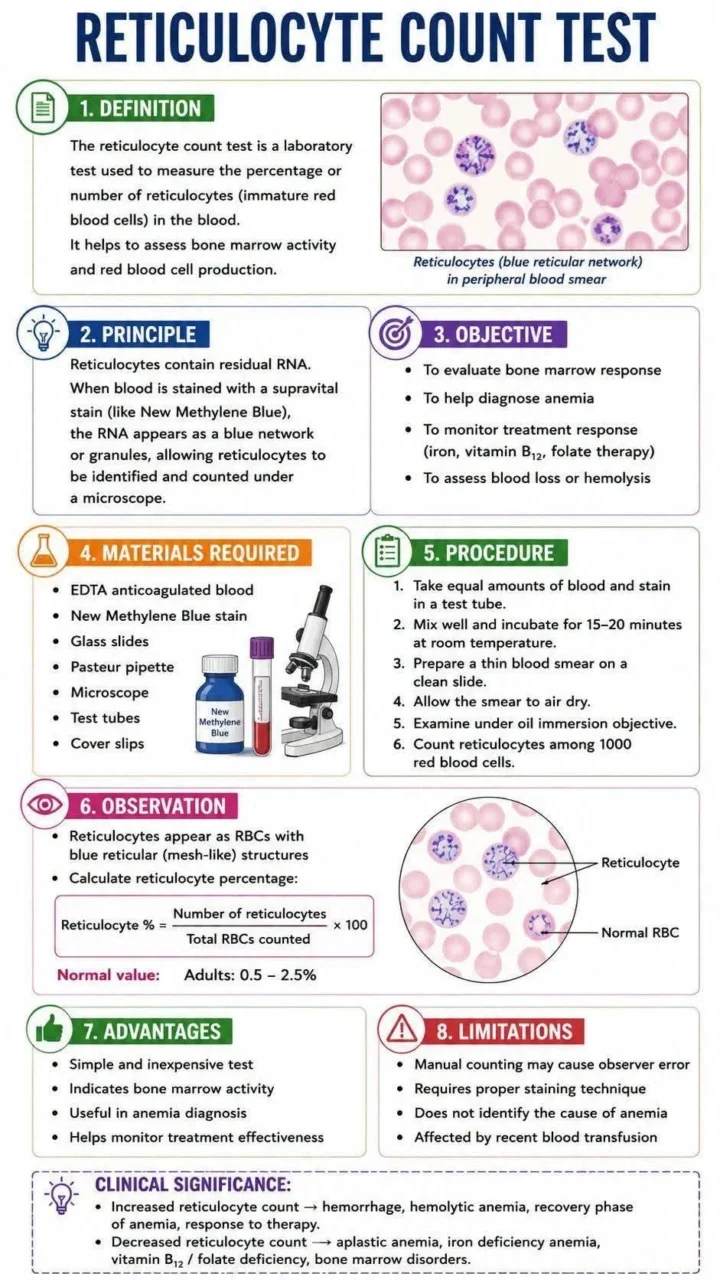
“Reticulocyte Count Test
1. Definition
The reticulocyte count test is a laboratory test used to measure the percentage or number of reticulocytes (immature red blood cells) in the blood.
It helps to assess bone marrow activity and red blood cell production.
2. Principle
Reticulocytes contain residual RNA.
When blood is stained with a supravital stain (like New Methylene Blue), the RNA appears as a blue network or granules, allowing reticulocytes to be identified and counted under a microscope.
3. Objective
- To evaluate bone marrow response
- To help diagnose anemia
- To monitor treatment response (iron, vitamin B₁₂, folate therapy)
- To assess blood loss or hemolysis.
4. Materials Required
- EDTA anticoagulated blood
- New Methylene Blue stain
- Glass slides
- Pasteur pipette
- Microscope
- Test tubes
- Cover slips.
5. Procedure
- Take equal amounts of blood and stain in a test tube.
- Mix well and incubate for 15–20 minutes at room temperature.
- Prepare a thin blood smear on a clean slide.
- Allow the smear to air dry.
- Examine under oil immersion objective.
- Count reticulocytes among 1000 red blood cells.
6. Observation
- Reticulocytes appear as RBCs with blue reticular (mesh-like) structures
- Calculate reticulocyte percentage:
7. Advantages
- Simple and inexpensive test
- Indicates bone marrow activity
- Useful in anemia diagnosis
- Helps monitor treatment effectiveness.
8. Limitations
- Manual counting may cause observer error
- Requires proper staining technique
- Does not identify the cause of anemia
- Affected by recent blood transfusion.”
Other posts featuring Omar Adwan on Hemostasis Today.
-
Sep 29, 2026, 19:00Caitlin Raymond: Can Artificial Blood Solve Blood Supply Shortages?
-
Sep 29, 2026, 18:51Chaza Alaji: Dyslipidemia, Thrombosis and the DIC Diagnostic Trap
-
Sep 29, 2026, 17:31Rajnikant Patel: Bridging Ayurvedic Concepts and Modern Toxin-Mediated Disease
-
Sep 29, 2026, 17:13Nicholas Lang։ A Meaningful Case of Immune Thrombocytopenia
-
Sep 29, 2026, 16:55Ayatullah Gamal Wahab: When the CBC Lies
-
Sep 29, 2026, 16:35Jonathan Douxfils: Navigating the VTE Risk Continuum in Reproductive Medicine
-
Sep 29, 2026, 16:35Chaima Rajeh: Types of Anemia and Their Laboratory Features
-
Sep 29, 2026, 16:27Scott Isaacs: How GLP-1 RAs Target Systemic Inflammation to Drive Cardio, Autoimmune, and Gut Health
-
Sep 29, 2026, 16:21Yitshak Kreiss: From Treating Patients to Defining the Standard of Knowledge