


Pall T. Onundarson: Is PT/INR the Problem, Not Warfarin?
Pall T. Onundarson, Professor Emeritus at Landspitali University Hospital, shared a post on LinkedIn:
“I call Fiix-monitored warfarin ‘Fiix-warfarin’ (or ‘neowarfarin’) because it is fundamentally different from traditional PT-monitored warfarin (‘PT-warfarin’).
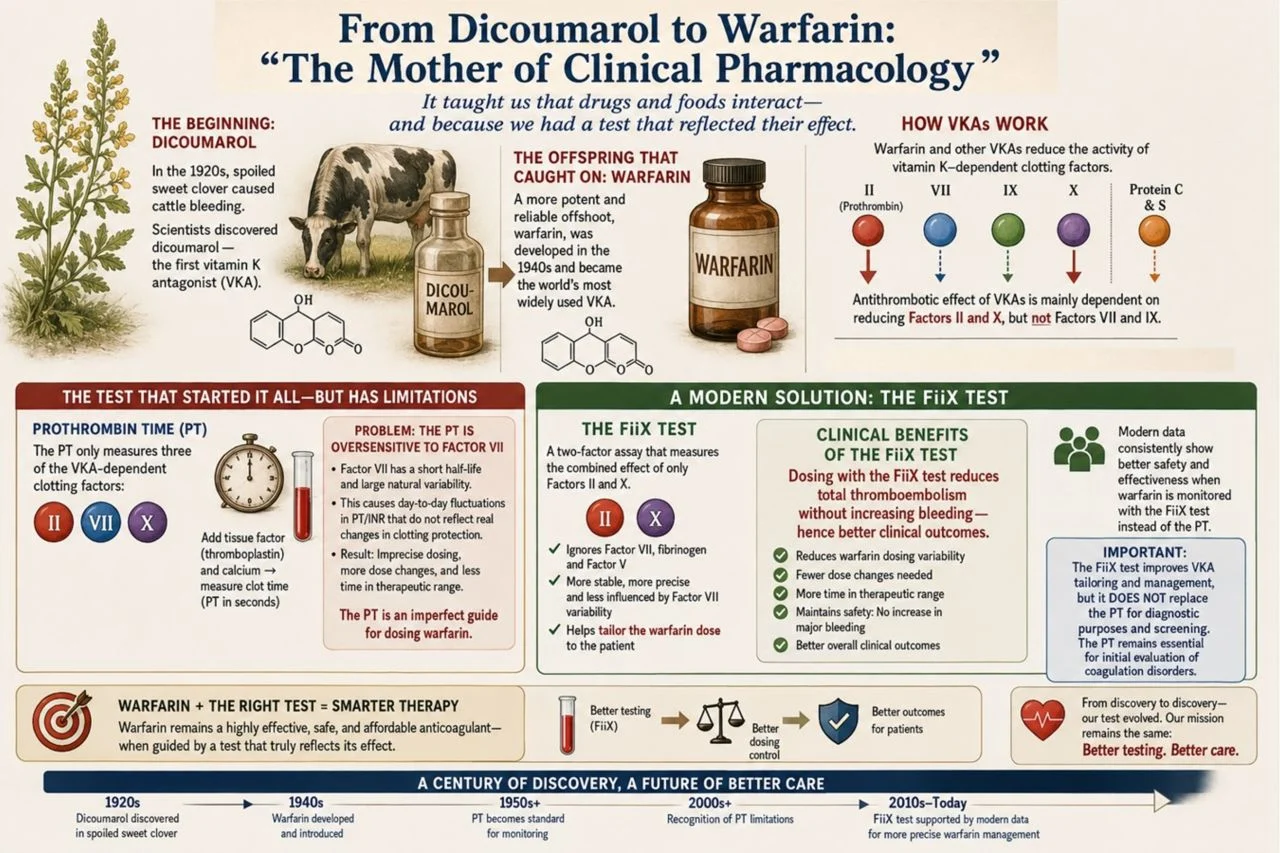
PT-warfarin has long been regarded as the mother of clinical pharmacology because it led to the discovery of countless food and drug interactions.
This was possible because, unlike most drugs, warfarin/VKAs had a laboratory test that purported to measure their biological effect.
Without monitoring, how else can clinically important interactions be identified?
The overlooked assumption, however, was that the monitored effect accurately reflected anticoagulation. It does not.
Both Quick and Owren prothrombin time (PT) tests are highly sensitive to the short half-life coagulation factor VII (proconvertin), which contributes relatively little to the antithrombotic effect of vitamin K antagonists.
Consequently, PT exaggerates the apparent impact of many food and drug interactions and often triggers unnecessary dose adjustments.
For more than 70 years, clinicians have been managing PT variability as though it represented true anticoagulant variability.
The consequences have been substantial: fluctuating PT-INRs, frequent dose changes, unstable anticoagulation, excess clinical events, extra anxiety and considerable costs to patients and healthcare systems.
Yet manufacturers market PT-based monitoring, perpetuating a test that is not fit for that purpose.
Ironically, the current response has been to conclude that new oral anticoagulants should not be monitored at all and they have been trialed against suboptimal PT-warfarin.
That conclusion is difficult to justify.
We routinely individualize treatment by monitoring blood glucose, blood pressure, cholesterol, chemotherapy, immunosuppressants, and many other therapies.
Why should oral anticoagulants be the exception?
The problem is not monitoring – it is monitoring the wrong biological effect.
When monitoring accurately reflects the pharmacodynamic effect responsible for clinical benefit, dose individualization should improve outcomes rather than impair them.
Fiix monitoring was developed on this principle.
By focusing on the vitamin K-dependent coagulation factors that primarily determine antithrombotic efficacy while eliminating the misleading influence of factor VII, it provides a more biologically relevant measure of warfarin effect.
Our clinical studies, including the blinded randomized Fiix trial (Lancet Haematology, 2015), showed that this approach reduced thromboembolic events without increasing bleeding, suggesting that the perceived limitations of warfarin may have been, to a significant extent, limitations of the PT test rather than of the drug itself.
In conclusion: warfarin itself is not the primary problem – the traditional PT/INR test is.
It also ends with what I consider the strongest takeaway: many of the shortcomings attributed to warfarin may actually reflect decades of relying on an inadequate monitoring test.”
Other posts featuring Pall T. Onundarson on Hemostasis Today.
-
Sep 22, 2026, 03:05Sumyea Kabir: Jehovah’s Witnesses Update Their Position on Blood Components
-
Sep 22, 2026, 02:33Gerardo Moscatelli: The Spike Protein Cascade – From Endothelial Binding to Vascular Collapse
-
Sep 21, 2026, 20:56George Touma: ApoB Should Be Central to All Lipid Guidlines
-
Sep 21, 2026, 20:55Christopher Robinson: Obstetric Risks Are Seen at the Extremes of Birthweight
-
Sep 21, 2026, 20:54Emicizumab for Refractory GI Bleeding in Myeloma-Associated Acquired VWD – JTH
-
Sep 21, 2026, 20:52Ross Baker: ASH 2026 Guidelines on Iron Deficiency in HMB and Bleeding Disorders
-
Sep 21, 2026, 20:50Rainer Kaiser: Genes and Signalling Pathways Implicated in Procoagulant Platelet Generation
-
Sep 21, 2026, 20:49Natalia Dovlatova: Celebrating Stan Heptinstall and His Legacy in Platelet Science
-
Sep 21, 2026, 20:48Norm Roulet: The Interaction of Pb and SARS-CoV-2 and Its Impact on the Cardiovascular System