

Reza Shojaei: The Global Plasma-to-Ig Supply Chain
Reza Shojaei, Chief Operating Officer at Canadian Plasma Resources, shared a post on LinkedIn:
“The Global Plasma-to-Ig Supply Chain
The global plasma-to-immunoglobulin (Ig) supply chain has become one of the most strategically important healthcare ecosystems in modern medicine. Immunoglobulins -derived exclusively from human plasma- are lifesaving therapies used in primary immunodeficiencies, autoimmune diseases, neurological disorders, hematology, transplantation, and critical care medicine. Yet unlike conventional pharmaceuticals, Ig therapies cannot currently be manufactured synthetically at scale. Every gram of immunoglobulin begins with ahuman plasma donor (Bolcato et al., 2024).
This dependence on plasma donors creates a uniquely fragile and highly interconnected supply chain in which donor recruitment, plasma collection infrastructure, manufacturing capacity, fractionation technology, cold-chain logistics, and national healthcare policies all influence patient access to therapy. Over the last two decades, global Ig demand has increased steadily and continues to outpace the expansion of plasma supply in many regions (Belmonte et al., 2025).
Understanding the Plasma-to-Ig Supply Chain
The plasma-to-Ig pathway is considerably more complex than the manufacturing process for traditional pharmaceuticals. Depending on regulatory requirements and manufacturing timelines, the process from plasma donation to final Ig product release may take 7-12 months (Bolcato et al., 2024).
The supply chain generally includes six major stages
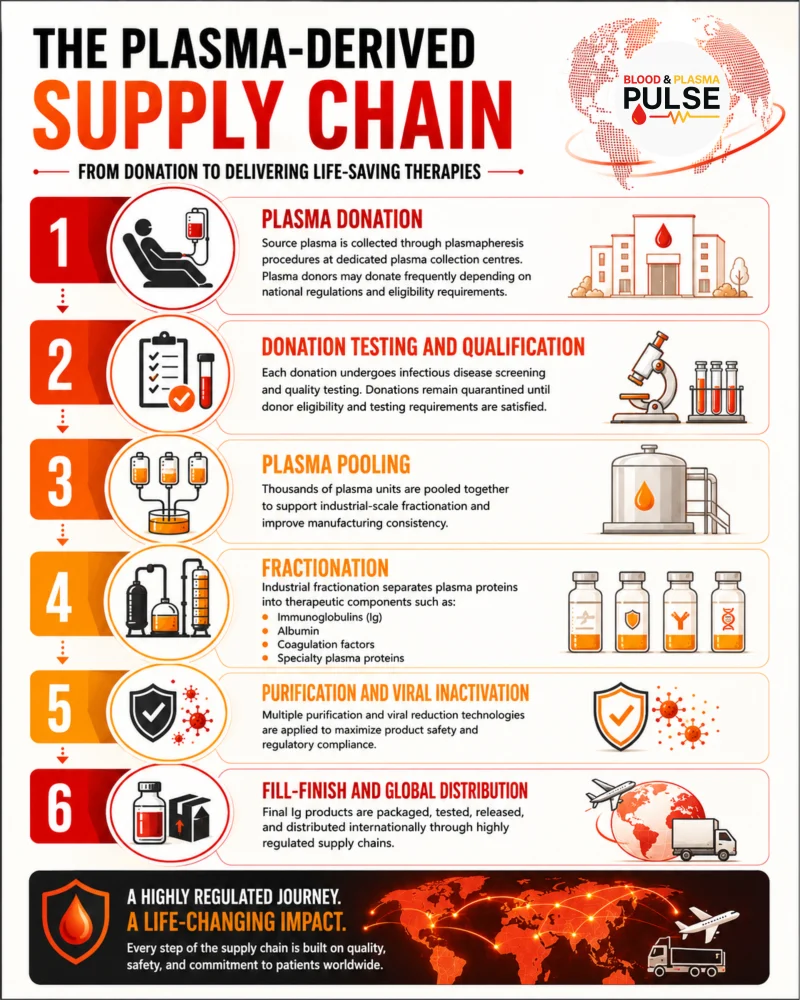
Unlike chemically synthesized pharmaceuticals, plasma-derived medicines cannot be rapidly scaled during shortages because their manufacturing depends on biological collection systems and lengthy production cycles (Bolcato et al., 2024).
Why Global Immunoglobulin Demand Keeps Increasing
Global immunoglobulin utilization has risen dramatically over the past 20 years due to several structural healthcare trends:
- Improved diagnosis of primary immunodeficiency disorders
- Expanded neurological and autoimmune indications
- Aging populations
- Greater physician awareness
- Longer treatment durations
- Improved patient access in emerging healthcare systems
- Demand growth is expected to continue globally throughout the next decade (Global Market Insights, 2025).
Australia, for example, remains among the highest per-capita users of immunoglobulins worldwide, prompting the Australian government to strengthen stewardship and utilization review programs (Australian Government Department of Health and Aged Care, 2023).
Importantly, experts increasingly argue that current Ig demand figures still underestimate actual global medical need because many patients with rare diseases and immunodeficiencies remain undiagnosed or untreated, particularly in low- and middle-income countries (Value in Health, 2024).
The United States: The Engine of Global Plasma Supply
The modern plasma economy is heavily dependent on the United States. The U.S. supplies the majority of the world’s source plasma through a large network of compensated plasma donation centres (Hartmann, 2020).
Several factors contribute to U.S. dominance in plasma supply:
- Extensive private-sector investment
- Large donor participation base
- Mature collection infrastructure
- Established reimbursement systems
- Integrated manufacturing and logistics networks
- However, this concentration also creates systemic risk.
Because many countries rely heavily on U.S.-sourced plasma or plasma-derived medicinal products (PDMPs), disruptions affecting the U.S. collection ecosystem can rapidly influence global immunoglobulin availability.
The COVID-19 pandemic clearly exposed this vulnerability. During lockdowns and public health restrictions, plasma collections declined significantly, contributing to prolonged global shortages of Ig products (Bolcato et al., 2024)
Europe’s Dependence on Imported Plasma
Europe continues to face structural challenges in achieving plasma self-sufficiency. Many European countries primarily rely on voluntary non-remunerated plasma donation systems, but domestic collection volumes often fail to meet growing demand for plasma-derived medicines (European Patients’ Forum, 2022).
As a result:
- Europe imports large amounts of plasma or finished Ig therapies
- Many healthcare systems remain dependent on U.S. plasma supply
- Strategic autonomy discussions are becoming increasingly prominent
European policymakers increasingly recognize plasma as a strategic healthcare resource rather than a routine pharmaceutical commodity (PPTA, 2021).
Recent concerns regarding shortages of anti-D immunoglobulins and other PDMPs have further intensified discussions around supply-chain resilience and long-term plasma security within the European Union (AABB, 2025).
Canada and the United Kingdom: Building Domestic Resilience
Several countries are now investing in domestic plasma strategies to improve long-term healthcare resilience.
United Kingdom
The United Kingdom has resumed manufacturing plasma-derived medicines using UK donor plasma after historical restrictions were lifted. By the end of 2025, the NHS expects domestically collected plasma to meet approximately one-quarter of national immunoglobulin demand (UK Government, 2025).
Canada
Canada is also strengthening domestic plasma initiatives through partnerships involving Canadian Blood Services and industrial manufacturing organizations. These efforts aim to improve national supply stability and reduce long-term reliance on international plasma markets (Canadian Blood Services, 2024).
These developments reflect a broader international trend: Countries increasingly view plasma collection and PDMP manufacturing as components of national healthcare security and strategic preparedness.
Why Immunoglobulin Shortages Continue
Despite industry expansion and investment, immunoglobulin shortages persist globally due to several structural limitations in the plasma supply chain.
- Long Manufacturing Timelines: The plasma-to-product cycle requires many months, limiting responsiveness to supply demands (Bolcato et al., 2024).
- Dependence on Human Donors: No synthetic substitute currently exists for plasma-derived Ig products.
- Geographic Concentration Risks: Heavy reliance on a small number of plasma-producing countries increases vulnerability to disruptions (Hartmann, 2020).
- Complex Regulatory Requirements: PDMP manufacturing is among the most heavily regulated sectors within biopharmaceutical production.
- Rapid Clinical Demand Growth: Utilization often increases faster than collection infrastructure and manufacturing capacity can expand.
- High Capital Requirements: Fractionation facilities require substantial capital investment, advanced expertise, and lengthy development timelines.
Collectively, these factors create a supply chain with limited elasticity and persistent vulnerability to disruption (Bolcato et al., 2024).
The Future of the Plasma-to-Ig Ecosystem
Several major trends are expected to shape the future of the global plasma supply chain:
- Expansion of Plasma Collection Networks: Both public and private organizations continue investing in new plasma centres worldwide.
- National Self-Sufficiency Strategies: Governments increasingly seek partial domestic independence from imported plasma-derived therapies.
- Diversification of Supply Sources: Countries are seeking to reduce overreliance on a single geographic region.
- Improved Demand Stewardship: Healthcare systems are implementing evidence-based frameworks for utilization and prescribing to optimize Ig use (Australian Government Department of Health and Aged Care, 2023).
- Recognition of Plasma as Critical Infrastructure: Plasma is increasingly viewed as critical infrastructure, comparable to vaccines, essential medicines, and strategic healthcare reserves.
Final Thoughts
The plasma-to-Ig supply chain represents one of the most sophisticated examples of global healthcare collaboration. Every immunoglobulin infusion administered to a patient
depends on thousands of plasma donations, highly specialized manufacturing processes, strict regulatory oversight, and complex international logistics systems.
Yet despite its sophistication, the system remains inherently fragile.
As demand for immunoglobulin therapies continues to rise globally, healthcare systems face an increasingly important challenge: building a plasma ecosystem that is scalable, resilient, ethically sustainable, and capable of ensuring equitable patient access.
The long-term future of plasma-derived therapies will depend on how effectively nations balance donor engagement, collection infrastructure, manufacturing investment, policy
modernization, and global supply security.
References
- AABB. (2025). EMA issues recommendations to strengthen anti-D immunoglobulin supply.
- Australian Government Department of Health and Aged Care. (2023). Immunoglobulin review pilot process.
- Belmonte, M., et al. (2025). Understanding supply sustainability of plasma-derived medicinal products. Vox Sanguinis.
- Bolcato, M., Rodriguez, D., Aprile, A., & Russo, M. (2024). Shortage of plasma-derived medicinal products: What is next? Frontiers in Pharmacology, 15.
- Canadian Blood Services. (2024). Agreement to manufacture immunoglobulins for patients in Canada.
- European Patients’ Forum. (2022). Tackling immunoglobulins shortages through a multistakeholder approach.
- Global Market Insights. (2025). Immunoglobulin market size report.
- Hartmann, J. (2020). Supply and demand for plasma-derived medicinal products: A critical reassessment through the lens of the COVID-19 pandemic. Transfusion, 60(Suppl.3), S34-S39.
- Plasma Protein Therapeutics Association (PPTA). (2021). PPTA statement on immunoglobulin use to meet clinical need. https://www.pptaglobal.org/material/ppta-statement-on-immunoglobulin-use-to-meet-clinical-need.
- UK Government. (2025). NHS patients receive first home-grown blood plasma treatments.
- Value in Health. (2024). Global unmet need in rare disease diagnosis and immunoglobulin access. Value in Health.
- World Health Organization. (2021). Guidance on increasing supplies of plasma-derived medicinal products in low- and middle-income countries through fractionation of domestic plasma.
- World Health Organization. (2025). Blood safety and availability.“
Find more posts featuring Reza Shojaei on Hemostasis Today.
-
Oct 6, 2026, 12:39Sarah Garvey: Putting The Patient Experience At The Heart Of VTE Care
-
Oct 6, 2026, 12:33Platelets Without Donors: Can Freeze-Dried Artificial Platelets Transform Trauma Care?
-
Oct 6, 2026, 12:03Louise St. Germain Bannon: Supporting the World Thrombosis Day
-
Oct 6, 2026, 11:39Joining the Hemophilia and Bleeding Disorders Community at the EHC 2026 – WFH
-
Oct 6, 2026, 10:56Moustafa Abdou: LE Cells and the Early Diagnosis of Lupus
-
Oct 6, 2026, 10:35Caitlin Raymond: Understanding IgA Deficiency and Anaphylaxis Risk
-
Oct 6, 2026, 10:15Zeeshan Ali Baig: AI-Designed Peptide for Rare Bleeding Disorder
-
Oct 6, 2026, 10:12Srivatsan Rangachari: Stem Cell Transplant for 12-Year-Old with Fanconi Anaemia
-
Oct 6, 2026, 09:56Anitha Narayanamurthy: A Possible Missing Link in Unexplained Blood Test Abnormalities