


Rishdha Roshad: Activated Clotting Time – Adult vs Pediatric
Rishdha Roshad, BS Cardiac Perfusion Technology Student at Dow University of Health Sciences, shared a post on LinkedIn:
“One ACT target. Different patients. Different physiology.
Activated Clotting Time (ACT) is one of the most frequently monitored parameters during cardiopulmonary bypass.
Yet, it is often interpreted as a single number rather than a reflection of a patient’s unique physiology.
This raises an important question:
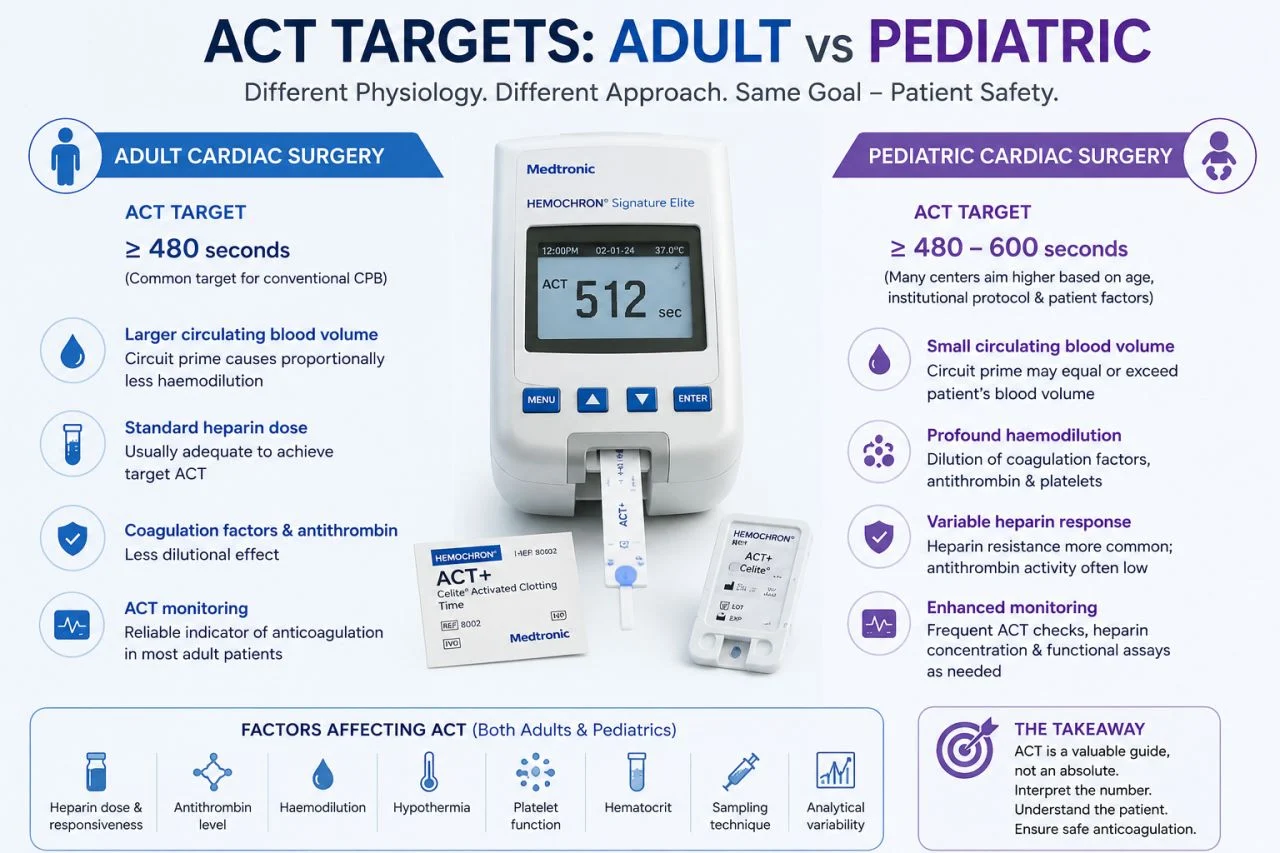
Why is an ACT ≥480 seconds generally acceptable for adult CPB, while pediatric patients often require different anticoagulation strategies—and sometimes even higher ACT targets?
The answer lies in the relationship between the patient and the extracorporeal circuit.
In adult cardiac surgery, the patient’s circulating blood volume is substantially larger than the circuit prime, resulting in comparatively less haemodilution.
Standard weight-based heparin dosing with ACT monitoring is usually sufficient to achieve safe anticoagulation.
In neonates and infants, however, the circuit prime may equal or even exceed the patient’s circulating blood volume.
This leads to profound haemodilution, dilution of coagulation factors and antithrombin, altered platelet function, and greater variability in the heparin response.
Consequently, many pediatric programs target ACT values between 480–600 seconds, often complemented by heparin concentration monitoring or viscoelastic coagulation testing.
Importantly, ACT is influenced by more than heparin alone.
Hypothermia, haemodilution, hematocrit, platelet dysfunction, antithrombin deficiency, thrombocytopenia, and even sampling technique can all affect the result.
ACT is not the goal—safe anticoagulation is.
For perfusionists, the responsibility extends beyond achieving a target value. It lies in understanding the physiology behind that value and integrating it with sound clinical judgment to ensure safe extracorporeal circulation.
Because in perfusion, we don’t treat numbers—we treat patients.”
Stay updated with Hemostasis Today.
-
Sep 29, 2026, 12:37Dan Milikovsky: Uncovering Cerebrovascular Injury in Sickle Cell Disease
-
Sep 29, 2026, 12:02Hajra Malik: Bridging Language Gaps in Hematology With AI
-
Sep 29, 2026, 11:57Joan Montaner: Can Blood Test Identify Intracerebral Hemorrhage Within Minutes?
-
Sep 29, 2026, 11:43From Years Without Answers to Life With Hemophilia Care – WFH
-
Sep 29, 2026, 11:32Sara Al Dallal: Transforming Hemophilia Care Across the Gulf
-
Sep 29, 2026, 11:21Richard Davis: Rapid Rescue in Massive Pulmonary Embolism
-
Sep 29, 2026, 11:14Nissan Brown: Every Step Counts for the Hemophilia Community
-
Sep 29, 2026, 11:03Zain Khalpey: SINGLE AF Adds New Evidence to the Anticoagulation Debate
-
Sep 29, 2026, 10:54How Does Haemophilia Affect Motor Development in Infants? – EAHAD