

Sifat Jubaira/LinkedIn
Feb 15, 2026, 10:26
Sifat Jubaira: K₂-EDTA vs K₃-EDTA – Same Anticoagulant, Very Different Accuracy
Sifat Jubaira, Lab Medicine Specialist at United Hospital Limited, shared a post on LinkedIn:
“K₂-EDTA vs K₃-EDTA – Same Anticoagulant, Very Different Accuracy
Both K₂-EDTA and K₃-EDTA prevent blood clotting by binding calcium.
But their impact on hematology results is not the same.
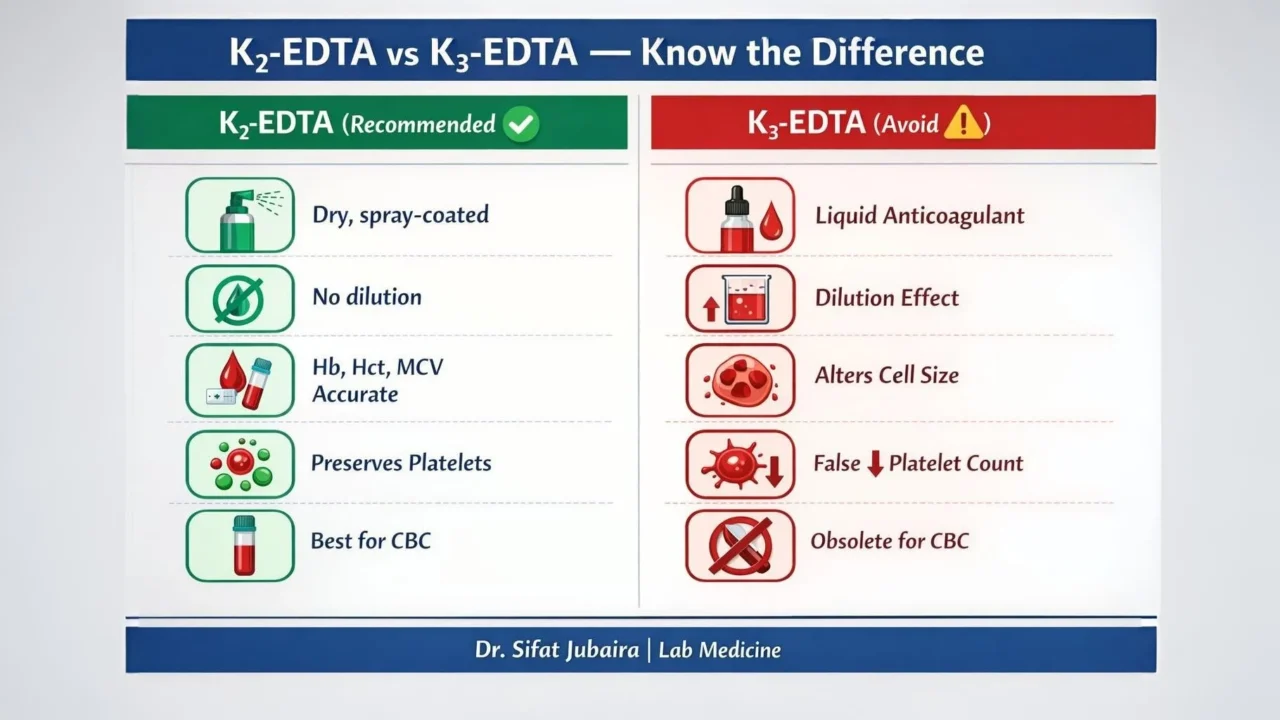
K₂-EDTA (Dipotassium EDTA)
- Dry, spray-coated
- No dilution effect
- Preserves RBC size and platelet count
- Gold standard for CBC
K₃-EDTA (Tripotassium EDTA)
- Liquid leads to sample dilution
- May falsely decrease Hb, Hct, MCV and platelets
- Alters cell morphology
- No longer recommended for routine hematology
Bottom line:
For accurate hematological values and reliable cell morphology, K₂-EDTA is the anticoagulant of choice.
Authentic References
- ICSH Guidelines – Recommendations for EDTA anticoagulants in hematology
- CLSI GP34 / H21 – Collection, transport and processing of blood specimens
- Bain BJ. Blood Cells: A Practical Guide, Wiley-Blackwell
- Dacie and Lewis. Practical Haematology, Elsevier”
Find more posts featuring Sifat Jubaira on Hemostasis Today.
-
Oct 9, 2026, 10:40What New U.S. Data Reveal About GT – Glanzmann’s Research Foundation
-
Oct 9, 2026, 10:32Anjali Pandey: The Morphologic Clues to MDS With del(5q)
-
Oct 9, 2026, 10:13Reza Shojaei: 5 Leadership Responsibilities for a Sustainable Plasma Ecosystem
-
Oct 9, 2026, 08:38Johannes Gratz: Perioperative Care in Factor VII Deficiency – Treating the Patient, Not the Number
-
Oct 9, 2026, 08:28Ghanim Fajish: Vascular Cells May Retain a Prothrombotic Memory of Oxidative Stress
-
Oct 9, 2026, 07:43Mehmet Cilingiroglu: The First Diagnosis of Coronary Thrombosis in a Living Patient
-
Oct 9, 2026, 07:21Federico Ravaioli: 40 kPa Spleen Stiffness May Help Avoid Endoscopy in Chronic PVT
-
Oct 9, 2026, 07:00Danny Reardon: Closing the Global Awareness Gap on Blood Clots
-
Oct 9, 2026, 00:54Mary Catherine Moffett: Advancing Advocacy Together – Highlights from the Sanofi Bleeding Disorders Summit