


Simon Senanu: Not Every Thrombocytopenia Is Real
Simon Senanu, Medical Laboratory Scientist at Perkins Medical Centre, shared a post on LinkedIn։
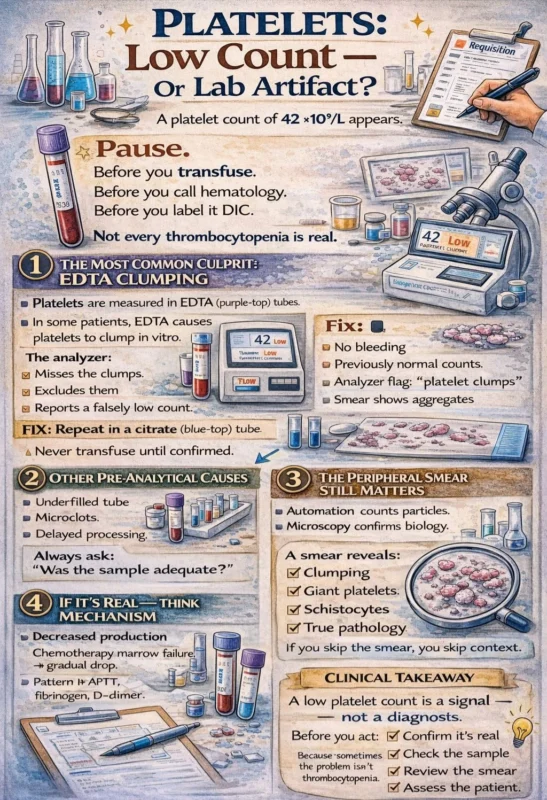
“Platelets: Low Count – Or Lab Artifact?
A platelet count of 42 ×10⁹/L appears.
- Before you transfuse.
- Before you call hematology.
- Before you label it DIC.
Pause.
Not every thrombocytopenia is real.
The Most Common Culprit: EDTA Clumping
Platelets are measured in EDTA (purple-top) tubes.
In some patients, EDTA causes platelets to clump in vitro.
The analyzer:
- Misses the clumps
- Excludes them
- Reports a falsely low count
Clues:
No bleeding
- Previously normal counts
- Analyzer flag: ‘platelet clumps’
- Smear shows aggregates
Fix:
- Repeat in a citrate (blue-top) tube.
- Never transfuse until confirmed.
Other Pre-Analytical Causes
- Underfilled tube
- Microclots
- Delayed processing
Always ask:
‘Was the sample adequate?’
If It’s Real – Think Mechanism
- Decreased production
Chemotherapy, marrow failure causing gradual drop
- Increased destruction
ITP, sepsis, DIC, severe malaria causing acute fall
- Sequestration
Splenomegaly, portal hypertension causing moderate thrombocytopenia
DIC rarely presents with isolated low platelets.
Check PT, aPTT, fibrinogen, D-dimer.
Pattern matters more than the number.
The Peripheral Smear Still Matters
Automation counts particles.
Microscopy confirms biology.
A smear reveals:
- Clumping
- Giant platelets
- Schistocytes
- True pathology
If you skip the smear, you skip context.
Clinical Takeaway
A low platelet count is a signal – not a diagnosis.
Before you act:
- Confirm it’s real
- Check the sample
- Review the smear
- Assess the patient
Because sometimes the problem isn’t thrombocytopenia.
It’s the tube.
How many ‘low platelets’ are actually just the tube?
In your setting, what’s the most common cause of true thrombocytopenia – sepsis, ITP, DIC… or malaria?”
Stay updated with Hemostasis Today.
-
Oct 16, 2026, 14:55Alex Borstein and the Bleeding Phenotype of Hemophilia A Carriers
-
Oct 16, 2026, 13:59Aya Akmal Amin: Antiphospholipid Syndrome Management and Risk Stratification
-
Oct 16, 2026, 13:10Emanuel Sueldo: CAHT 2026 Celebrates Scientific Progress and Team Achievements
-
Oct 16, 2026, 13:05Maha Othman: Queen’s Health Sciences Advances CAT Risk Models and Pediatric ISTH-BAT Cut-Offs
-
Oct 16, 2026, 13:03Thrombosis Awareness Must Lead to Timely Action – Roche
-
Oct 16, 2026, 12:49Wolfgang Miesbach: 5-Year CBDR Data Confirms Emicizumab Safety and Efficacy in Hemophilia A
-
Oct 16, 2026, 12:40Edward Lee Carter: How Factor XI Inhibition Could Transform Anticoagulation Therapy
-
Oct 16, 2026, 12:40Marc Carrier: Looking Ahead to ISTH 2027 in Vancouver
-
Oct 16, 2026, 12:30Bob Lempke: How One Blood Donation Can Save Up to Three Lives