

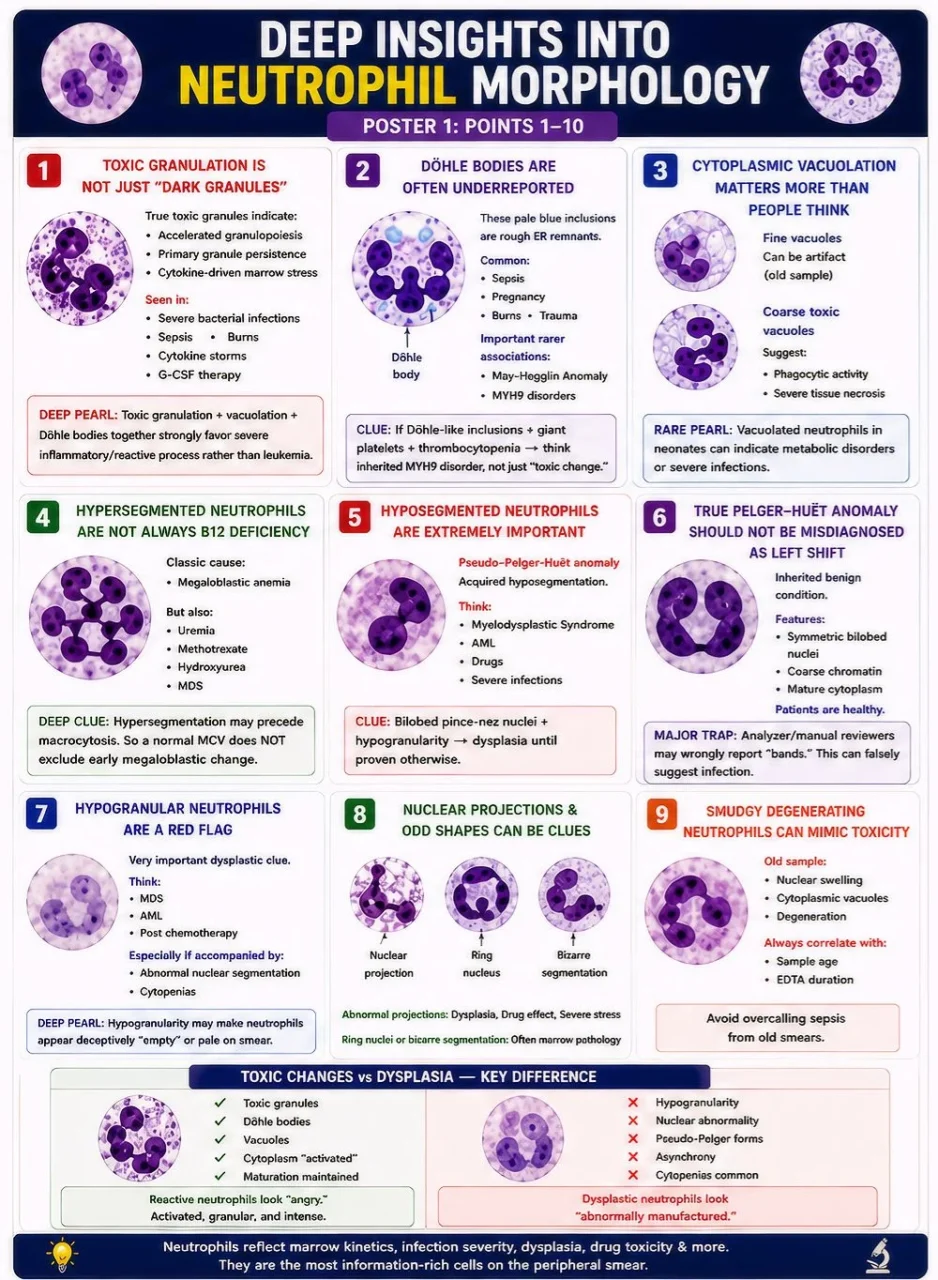
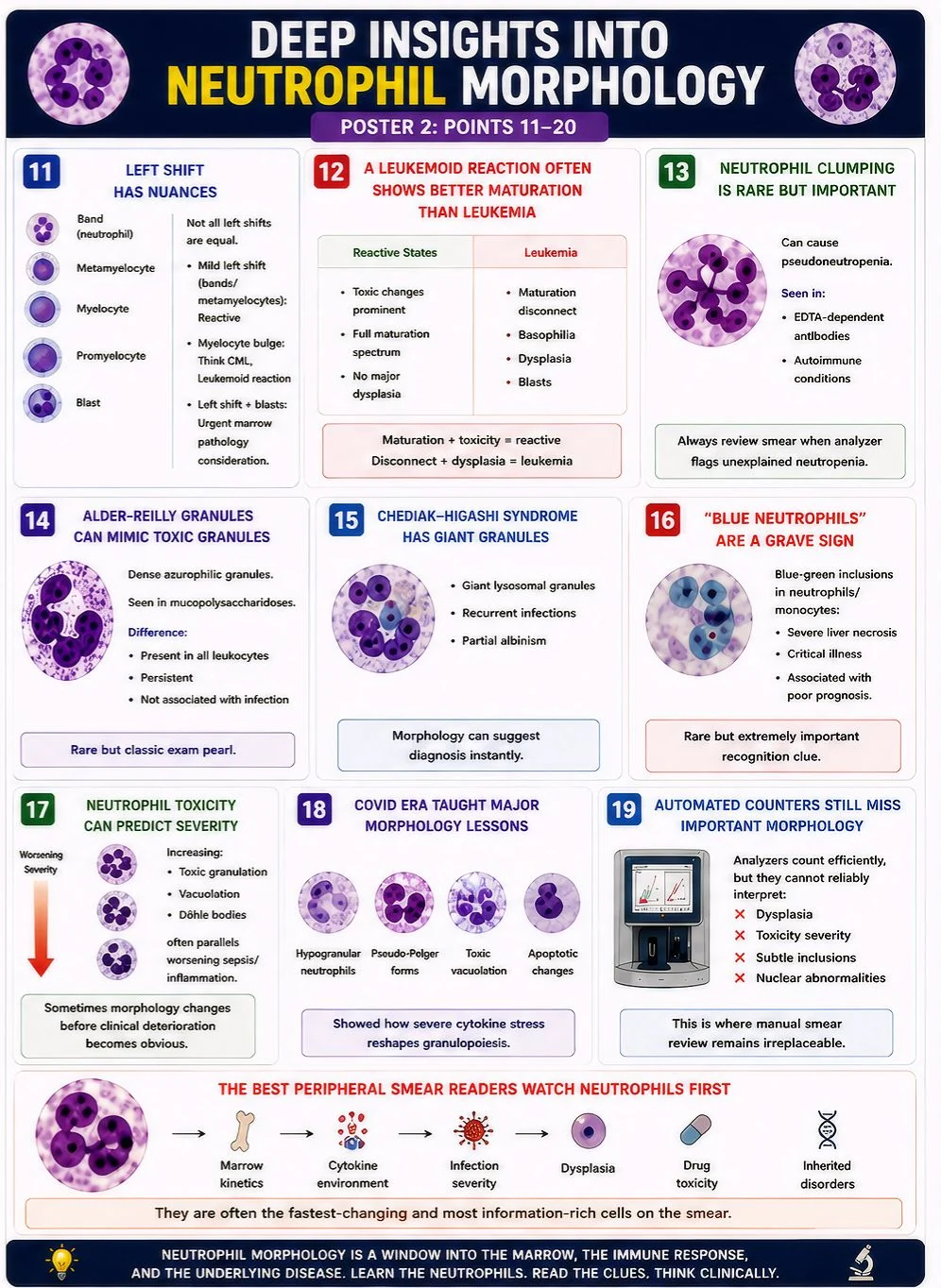
Smitirupa Mishra: Deep Insights Into Neutrophil Morphology
Smitirupa Mishra, Consultant Pathologist at Sparsh Hospitals and Lab Head at Pathkind Labs, shared a post on LinkedIn:
“Most often, we report ‘Total leukocytosis with absolute neutrophilia’ and move on.
But somewhere between automation flags, differential counts, and busy sign-outs, we forget to actually look at the neutrophils.
Neutrophil morphology is not just a decorative finding in the peripheral smear – it is a clinical conversation happening under the microscope.
Toxic granulation, Döhle bodies, cytoplasmic vacuoles, toxic vacuolation, hypogranulation, hypersegmentation, Pelger-Huët forms, giant bands, apoptotic neutrophils – each pattern tells a story.
A neutrophil can quietly hint at:
- Severe bacterial sepsis
- Cytokine storm
- Marrow stress
- Drug effect
- MDS
- Vitamin deficiencies
- Congenital anomalies
- Hidden inflammatory states
Automation can count neutrophils.
Only morphology can reveal what they are going through.
Sometimes the diagnosis is not in the CBC numbers.
It is in the attitude of the neutrophil.
The peripheral smear is still one of the most underrated ‘clinical photographs’ in medicine.”
Stay updated with Hemostasis Today.
-
Sep 29, 2026, 22:45Victor Agunyego: Paracetamol – The Most Common Drug We Underestimate
-
Sep 29, 2026, 22:42Nova Sinclair: Advancing the Future of Hematology – Meet Our 2027 Organizing Committee
-
Sep 29, 2026, 22:41Lorenz Räber: Intracoronary Imaging in PCI – Why, When, How, and Which Modality?
-
Sep 29, 2026, 22:31Selma Turkovic: Pleased to Deliver the Opening Presentation at Kingston Hospital
-
Sep 29, 2026, 22:31Miguel Teran: Ultrasound and Simulation in Arterial Blood Sampling
-
Sep 29, 2026, 21:47Javed Anees: DADA2 – When a Young Stroke Is More Than a Stroke
-
Sep 29, 2026, 22:28Mohammad Refaei: Navigating Your Career in Hematology From Training to Practice
-
Sep 29, 2026, 22:27Matteo Foschi: 10 Clinical Pearls for Antithrombotic Therapy in Secondary Stroke Prevention
-
Sep 29, 2026, 22:26A Global Call for Action on Cardiovascular Health on World Heart Day – ISTH