


William Wallace: Your Cholesterol Test is Missing a Particle that May Matter More than the One it Measures
William Wallace, Co-Founder and Chief Scientific Officer at Supplement Success Solutions, shared a post on LinkedIn:
“Your cholesterol test is missing a particle that may matter more than the one it measures.
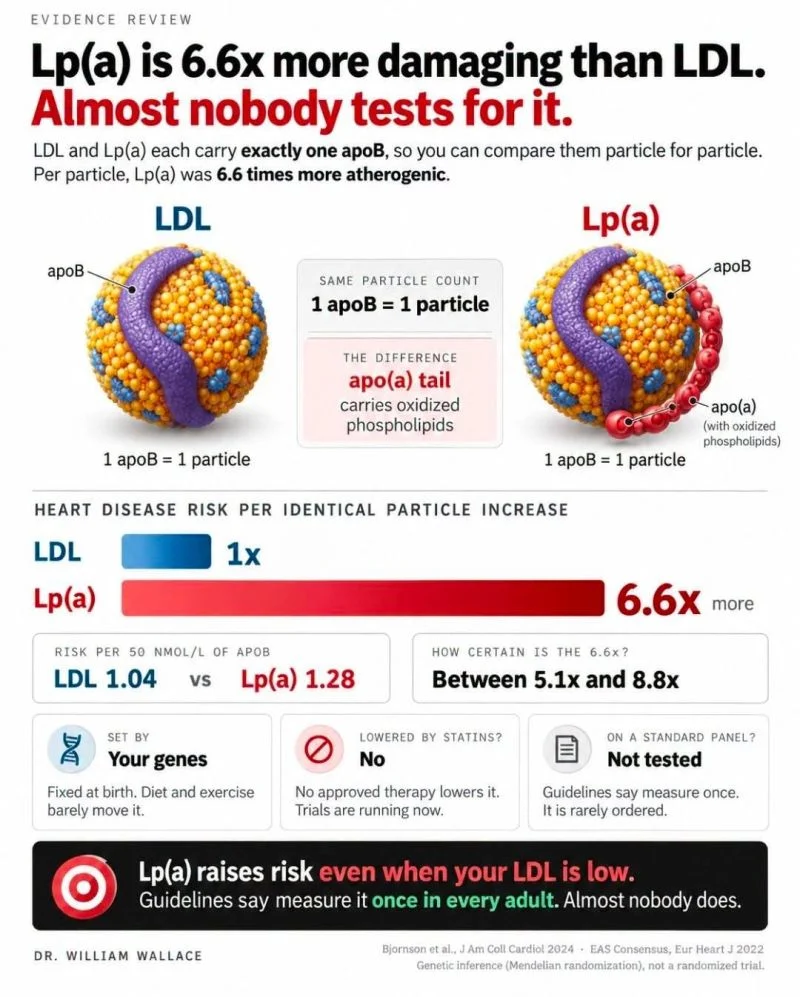
LDL and Lp(a) each carry exactly one copy of a protein called apoB.
One apoB, one particle.
That’s what makes it possible to line them up and ask a fair question: if you add the same number of each, which one does more damage to an artery?
Researchers answered that using genetic data from more than 300,000 people in the UK.
They compared people who inherited more of one particle against people who didn’t, which sidesteps the usual problem of diet and lifestyle muddying the picture.
Particle for particle, Lp(a) did about 6.6 times more damage than LDL.
The range the data supports runs from about 5 to 9 times more.
The reason is physical.
An Lp(a) particle is basically an LDL particle with an extra protein wrapped around it, called apo(a).
That tail carries oxidized fats that inflame the artery wall. Same cholesterol inside.
Extra weapon on the outside.
Three things make this worth knowing:
Your level is set by your genes. It’s essentially fixed at birth. Diet, exercise, and weight loss barely move it.
Statins don’t lower it. No approved drug currently does.
Drugs designed specifically to lower Lp(a) are in late-stage trials right now.
It isn’t on a standard cholesterol panel.
Guidelines say every adult should have it measured at least once.
In practice, almost nobody does.
So a person can get a reassuring cholesterol result and still be carrying serious inherited risk that no one ever looked for.
The honest limit: this comes from genetics, not from a treatment trial.
It’s the same kind of evidence that convinced everyone LDL causes heart disease, and it’s strong.
But nobody has yet lowered Lp(a) in a trial and shown fewer heart attacks.
That trial is running now.
Until it reports, the case rests on inheritance rather than on treating people and watching what happens.
If you’ve never had it checked, it’s a one-time blood test for a number that won’t change for the rest of your life.”
Other posts featuring William Wallace on Hemostasis Today.
-
Sep 28, 2026, 18:57Indu Thakur: Honoring Sickle Warriors and Advancing Diverse Blood Donation at Sickle Ball 2026
-
Sep 28, 2026, 18:48Orly Leiva: Rethinking JAK Inhibitor Cardiovascular Safety in MPNs
-
Sep 28, 2026, 18:42Wael Saad: Honored to Be Part of Portal and Mesenteric Vein Thrombosis Session at CIRSE 2026
-
Sep 28, 2026, 18:35Alejandro González Veliz: The Unbroken Connection Between Heart and Brain
-
Sep 28, 2026, 16:43Scott Sutton: Community and Connection in Immune Thrombocytopenia
-
Sep 28, 2026, 16:24Pankti Solanki: ISBT Recognized JAMA as the 49th Human Blood Group System
-
Sep 28, 2026, 15:52Kassa Tameru: Antithrombotic Management in GI Bleeding and Elective Endoscopy
-
Sep 28, 2026, 15:51Chengappa Kavadichanda: How Do aPLs Change Over Time in Early Lupus?
-
Sep 28, 2026, 15:18Linda Shore-Lesserson: Celebrating 25 Years of PBM at the SABM Meeting