

P-Selectin as a Therapeutic Target in Thrombosis
Can P-selectin Be Targeted to Interfere with Pathological Thromboinflammation while Preserving the Physiological Mechanisms Required for Normal Hemostasis?
It’s an important therapeutic question that P-Selectin’s biology has raised.
P-selectin, also known as CD62P, is a cell-adhesion molecule expressed mainly by activated platelets and endothelial cells.
Unlike many adhesion molecules that require new protein synthesis before appearing at the cell surface, P-selectin is already stored inside the cell, allowing it to respond within minutes to activation.
In platelets, it is kept in α-granules, while endothelial cells store it in Weibel-Palade bodies.
When these cells are activated by inflammatory or vascular stimuli, P-selectin rapidly moves to the cell surface.
Once exposed, P-selectin acts as an early signal that helps bring blood cells into contact with an activated vessel or platelet. Its main ligand is P-selectin glycoprotein ligand-1 (PSGL-1), which is expressed on leukocytes.
The interaction between P-selectin and PSGL-1 helps leukocytes initially attach and roll along activated endothelial surfaces, but its role extends well beyond simple cell adhesion.
It creates a physical and functional connection between activated platelets, leukocytes, and the endothelium.
This becomes particularly important when thrombosis and inflammation occur together.
P-selectin can promote the formation of platelet-leukocyte aggregates, bringing activated platelets into close contact with neutrophils and monocytes.
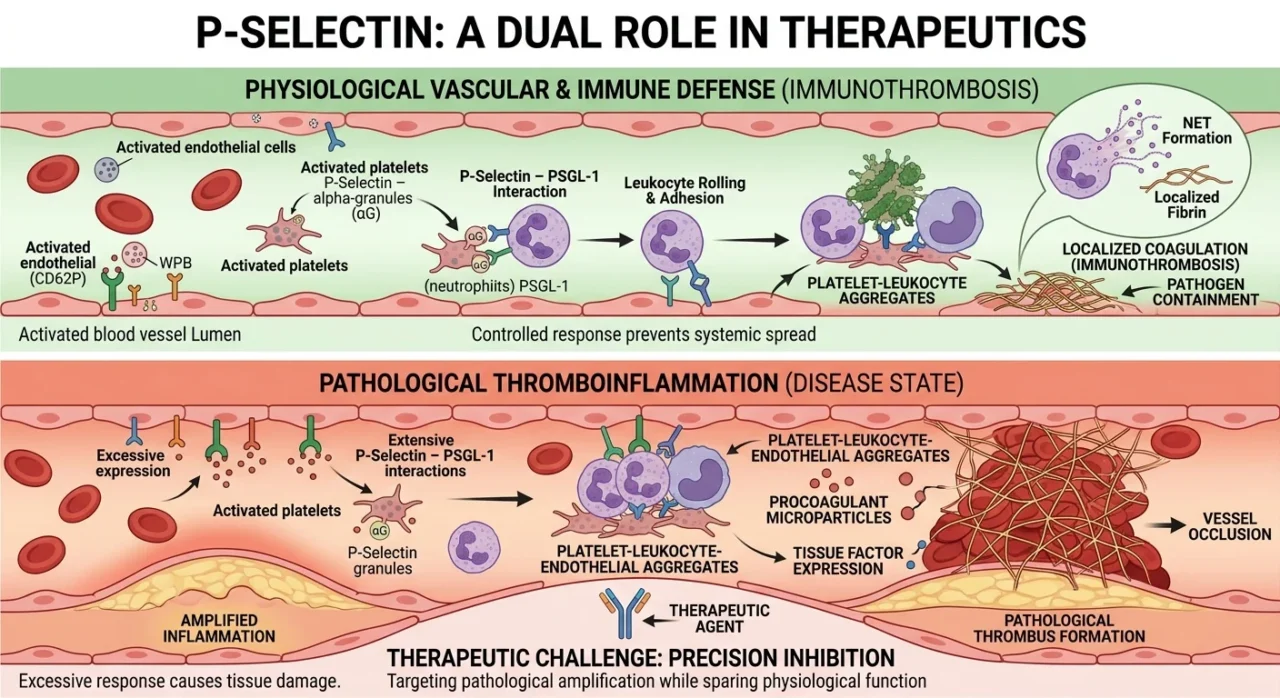
These interactions can stimulate leukocyte activation, tissue factor expression, release of procoagulant microparticles, and formation of neutrophil extracellular traps (NETs).
The result is an environment that favors thrombin generation and fibrin formation, allowing inflammation to reinforce coagulation and coagulation to further sustain inflammation.
The same pathway also has a physiological role. During infection, P-selectin-mediated interactions help recruit and localize leukocytes at sites where pathogens need to be contained.
Together with NET formation and localized coagulation, this process contributes to immunothrombosis, in which thrombosis acts as part of the innate immune response.
The problem arises when this response becomes excessive or persists after its protective purpose has been served.
In conditions such as severe infection, sepsis, atherosclerosis, and other thromboinflammatory diseases, sustained P-selectin activity can contribute to pathological platelet-leukocyte interactions and thrombus formation.
This dual role is important when considering P-selectin as a therapeutic target.
It is not simply a molecule that “causes” thrombosis; it is part of a broader communication network connecting platelets, leukocytes, endothelial cells, inflammation, and coagulation.
The therapeutic challenge is therefore to interrupt the pathological amplification of this pathway without interfering with its normal role in vascular and immune defense.
From P-Selectin to Thrombosis
Once P-selectin appears on the surface of an activated platelet or endothelial cell, it begins to change the local cellular environment.
By binding to PSGL-1 on leukocytes, it brings leukocytes into close contact with activated platelets and the vessel wall.
What starts as a cell-adhesion interaction can therefore develop into a much broader thromboinflammatory response.
One of the most important consequences is the formation of platelet-leukocyte aggregates.
Monocytes and neutrophils recruited through this interaction become activated and can contribute to coagulation in several ways. Monocytes, for example, can increase tissue factor expression, while activated neutrophils can release neutrophil extracellular traps (NETs).
These web-like structures can capture platelets and coagulation proteins and provide a surface on which thrombus formation is further promoted. At the same time, activated platelets continue to support thrombin generation.
P-selectin therefore helps bring together cells and processes that collectively push the vascular environment toward thrombosis.
The relationship does not stop there. As coagulation and inflammation intensify, newly generated thrombin and other inflammatory mediators can activate additional platelets and endothelial cells, leading to further P-selectin expression.
More P-selectin means more platelet-leukocyte interactions, which can produce more tissue factor, NETs, and other procoagulant signals. In this way, a process that begins with vascular or platelet activation can develop into a self-reinforcing cycle of inflammation and coagulation.
This mechanism helps explain why P-selectin has attracted attention across several thrombotic diseases.
In atherosclerosis, platelet-leukocyte interactions can contribute to inflammation within the vessel and become particularly important when an unstable plaque is disrupted.
In venous thrombosis, ischemic stroke, cancer-associated thrombosis, and severe systemic inflammation, similar interactions have been investigated as part of the processes that promote thrombus formation and persistence.
This also explains the therapeutic appeal of P-selectin.
Conventional antiplatelet drugs primarily interfere with platelet activation or aggregation, while anticoagulants act directly on the coagulation cascade.
P-selectin inhibition approaches the problem from a different angle: it attempts to disrupt the communication between activated platelets, leukocytes, and the vascular wall.
The idea is not simply to prevent platelets from forming a clot, but to interrupt the inflammatory signals that can help a thrombus develop and grow.
The challenge, however, is that P-selectin is not exclusively a pathological molecule. Its interactions with leukocytes also participate in normal immune and vascular responses.
This makes the therapeutic question more nuanced: can P-selectin be inhibited strongly enough to reduce pathological thromboinflammation while preserving the functions that the pathway normally performs?
The answer to this question has become the focus of several therapeutic strategies and clinical trials.
A Structural Foundation for Rational P-Selectin Inhibition
The therapeutic potential of this pathway became more concrete once researchers were able to define its molecular architecture.
Detailed structure-function studies showed that P-selectin does not recognize PSGL-1 through a single molecular contact.
Instead, binding depends on a precisely arranged combination of tyrosine sulfation and carbohydrate residues within the N-terminal region of PSGL-1.
Three sulfated tyrosines-at positions 46, 48, and 51-were found to be particularly important.
Together, they form a negatively charged surface that fits into a complementary region of P-selectin, while neighboring fucose and sialic acid residues provide additional contacts.
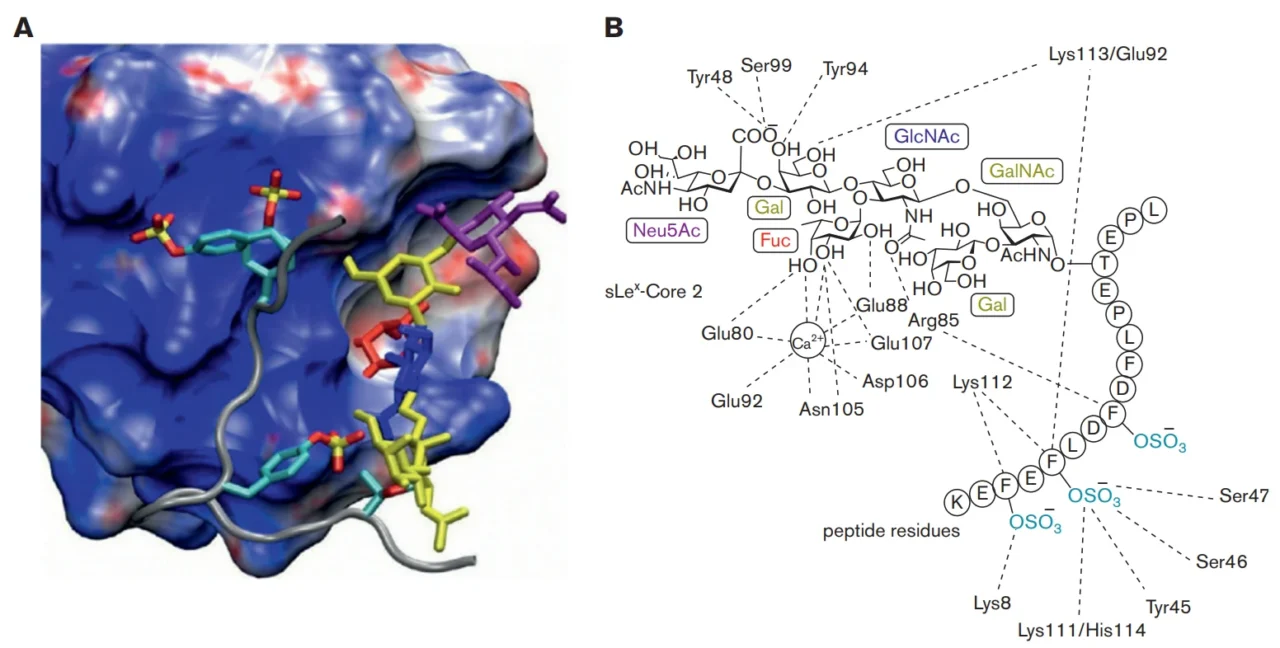
Figure 1. Interactions of PSGL-1 with P-selectin. (A) Structure of the P-selectin complex with the PSGL-1 ligand containing tyrosine O-sulfates and the sLex hexasaccharide. The P-selectin surface is color coded according to electrostatic potential (acidic region, blue; basic region, red). In addition, individual sugars in the sLex are color coded (Neu5Ac, purple; Gal and GalNAc, yellow; GlcNAc, blue; and Fuc, red) and the sulfur and oxygen atoms within the sulfate groups are yellow and red, respectively. (B) Interaction map of specific carbohydrate and peptide functional groups with amino acids in the P-selectin binding domain (adapted with permission from Sladek et al,31 Copyright 2024, American Chemical Society).Structural studies later confirmed how these components work together, explaining why relatively small changes in PSGL-1 can markedly affect its affinity for P-selectin.
This level of structural detail changed how the pathway could be targeted. Instead of blocking P-selectin in an undefined manner, researchers could use the molecular interface as a template for rational drug design.
The objective was to develop molecules capable of occupying the relevant binding region or otherwise disrupting the molecular contacts required for P-selectin recognition.
This approach established the foundation for the development of orthosteric P-selectin antagonists and other inhibitors of the P-selectin/PSGL-1 axis.
Importantly, the structural work did not itself demonstrate clinical efficacy; rather, it provided the mechanistic and molecular framework that made selective inhibition feasible.
The next step was to determine whether interfering with this interaction could actually alter thromboinflammatory disease in experimental models and, ultimately, in patients.
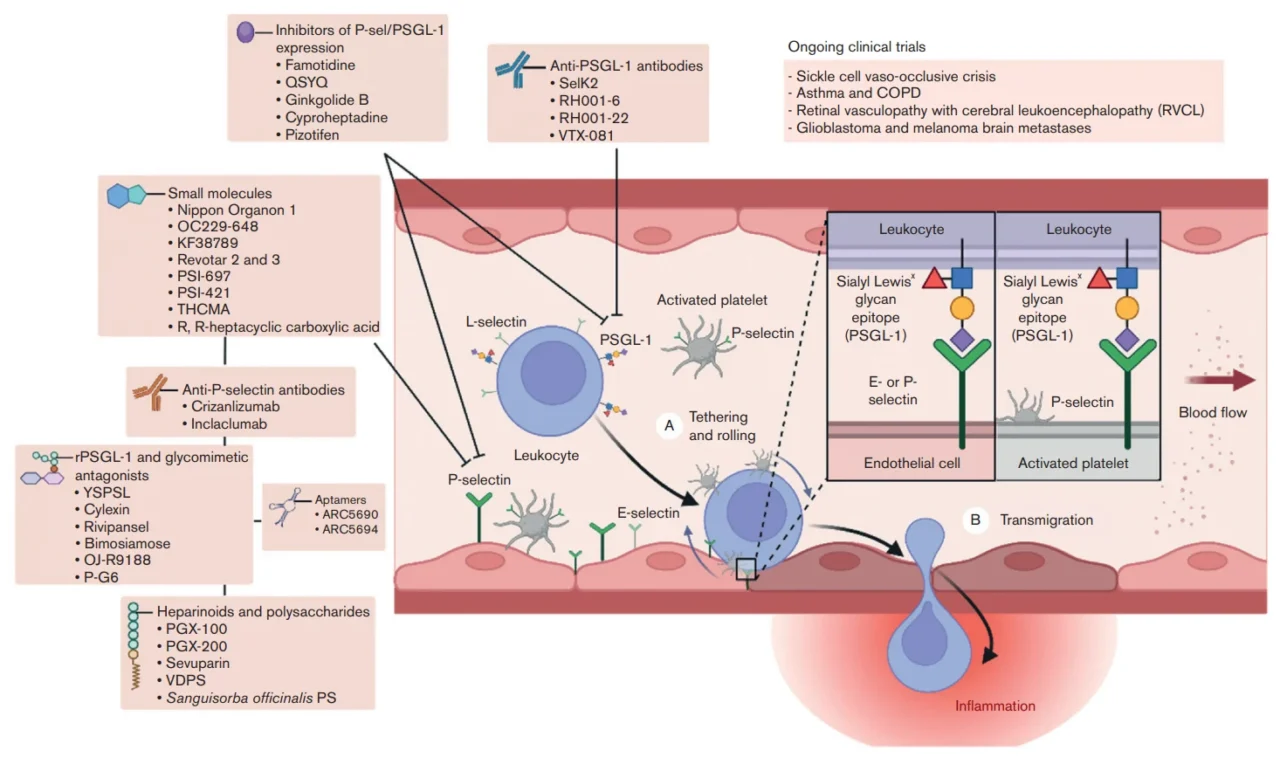
Figure 2. P-selectin/PSGL-1-mediated leukocyte rolling, adhesion, and transmigration, including a summary of antagonists and current clinical applications
From Target to Therapy
The clinical development of P-selectin inhibitors began with sickle cell disease, where blocking the pathway offered a way to interfere with the cellular interactions underlying vaso-occlusion.
Crizanlizumab, a monoclonal antibody directed against P-selectin, provided the first major clinical test of this approach.
In the phase 2 SUSTAIN trial, crizanlizumab reduced the annual rate of sickle cell-related vaso-occlusive crises compared with placebo, leading to its FDA approval in 2019.
The subsequent experience was less consistent.
In the phase 3 STAND trial, crizanlizumab did not reduce vaso-occlusive crises requiring healthcare visits compared with placebo.
The findings therefore failed to reproduce the clinical benefit observed in SUSTAIN, and the European Medicines Agency concluded that the benefits no longer outweighed the risks, leading to withdrawal of the European authorization in 2023.
The development of crizanlizumab has nevertheless continued to provide insight into how P-selectin inhibition might work in different diseases.
Studies have explored the antibody in conditions ranging from COVID-19-associated vascular complications to rare thromboinflammatory disorders and cancer.
These investigations have not established P-selectin blockade as a broadly effective treatment, but they have helped define where the pathway may-and may not-translate into clinical benefit.
Inclacumab represents another attempt to target P-selectin, with a stronger focus on cardiovascular disease.
In the phase 2 SELECT-ACS trial, patients with non-ST-elevation myocardial infarction received inclacumab before PCI.
The 20-mg/kg dose was associated with lower troponin I levels after PCI, providing an early signal that P-selectin inhibition could reduce periprocedural myocardial injury.
However, this was primarily a biomarker-based finding rather than evidence of improved major cardiovascular outcomes.
The subsequent testing of inclacumab again demonstrated the difficulty of translating this biological signal into consistent clinical benefit.
A phase 2 study in patients undergoing urgent coronary artery bypass surgery did not reproduce the expected effect, and the drug was subsequently evaluated in the THRIVE program for sickle cell disease.
The results of that program have further complicated the picture.
THRIVE-131, a phase 3 study of inclacumab for prevention of vaso-occlusive events in sickle cell disease, did not meet its primary endpoint, while THRIVE-132 was terminated because of slow recruitment.
These results have substantially tempered the earlier expectations surrounding P-selectin inhibition in sickle cell disease.
Taken together, the clinical development of crizanlizumab and inclacumab has established an important distinction between target validation and therapeutic success.
P-selectin can clearly be blocked pharmacologically, and early studies have demonstrated biological and, in some settings, clinical effects.
What remains less certain is when P-selectin is sufficiently central to disease biology for its inhibition to translate into meaningful patient benefit.
The answer may depend on the specific thromboinflammatory disease, the timing of intervention, patient selection, and the clinical endpoint being measured.
P-Selectin Across Thrombotic Diseases
The importance of P-selectin is not limited to sickle cell disease.
Because the P-selectin/PSGL-1 pathway connects activated platelets, leukocytes, and the vascular wall, it has been investigated across a broad range of thrombotic and thromboinflammatory conditions.
The strength of the evidence, however, differs considerably between diseases.
Cardiovascular disease
Atherosclerosis and acute coronary syndromes provide one of the clearest examples of how P-selectin may connect inflammation with arterial thrombosis.
Activated platelets can bind circulating monocytes through P-selectin, forming platelet-monocyte aggregates and promoting further inflammatory and procoagulant signaling.
These interactions have been associated with tissue factor expression and other changes that can favor thrombus formation after plaque disruption. Recent studies continue to investigate platelet-monocyte aggregates as both markers of platelet activation and potential contributors to cardiovascular disease.
This provides a potential explanation for why P-selectin inhibition has attracted interest in acute coronary syndromes.
The SELECT-ACS study of inclacumab, for example, showed a reduction in troponin I after PCI in patients with non-ST-elevation myocardial infarction.
Although this did not establish a reduction in major cardiovascular events, it provided clinical evidence that interfering with P-selectin-mediated interactions can influence the biological response to coronary intervention.
Venous thromboembolism
P-selectin has also been implicated in venous thrombosis, where the contribution of inflammation is increasingly recognized alongside the traditional concepts of stasis and hypercoagulability.
In experimental models, P-selectin-mediated recruitment of leukocytes can facilitate interactions between platelets, neutrophils, and the vessel wall, supporting thrombus development and organization.
P-selectin and related selectin pathways have therefore been investigated as potential targets for reducing thrombosis without directly suppressing the coagulation cascade.
This distinction is particularly relevant in VTE.
Anticoagulants remain the foundation of treatment, but their effect on the coagulation system also creates a bleeding risk.
A strategy that interferes more selectively with thromboinflammatory signaling could, in principle, complement anticoagulation or provide an alternative approach in selected settings.
Whether this can be achieved safely and effectively in humans remains an open clinical question.
Ischemic stroke
The same platelet-leukocyte interactions are relevant to arterial thrombosis in the cerebral circulation.
P-selectin-mediated adhesion can promote the recruitment of leukocytes to activated endothelium and contribute to inflammatory amplification around an evolving thrombus.
Experimental work has therefore placed P-selectin among several targets involved in the interaction between platelet activation, endothelial injury, and inflammation in ischemic stroke.
Importantly, however, evidence for P-selectin inhibition in stroke remains less mature than the biological rationale might suggest.
Stroke is a particularly complex setting in which the timing of intervention, reperfusion, vascular injury, and the balance between thrombosis and bleeding can all influence whether targeting an adhesion pathway will translate into clinical benefit.
Cancer-associated thrombosis
Cancer provides another setting in which P-selectin may have relevance.
Tumors can create a strongly procoagulant and inflammatory environment in which platelets, leukocytes, endothelial cells, and tumor cells interact extensively.
P-selectin-mediated cellular adhesion may contribute to this network and has therefore been investigated as part of the broader biology linking malignancy with thrombosis.
The potential importance of this pathway extends beyond thrombosis itself.
P-selectin-dependent interactions can influence how circulating cells interact with the vascular endothelium and may participate in tumor-platelet and tumor-leukocyte interactions.
This has led to interest in P-selectin blockade not only as a possible antithrombotic strategy but also in other aspects of cancer biology.
The broader picture
Across these diseases, the recurring theme is that P-selectin sits at an interface rather than at a single point in the coagulation cascade.
It does not replace thrombin, fibrin, or platelet aggregation as central components of thrombosis.
Instead, it helps coordinate the cellular interactions that can make thrombus formation more inflammatory and persistent.
This may ultimately be the most important reason to continue studying P-selectin.
Its therapeutic value may not come from treating every thrombotic disease in the same way, but from identifying situations in which platelet-leukocyte and endothelial interactions are particularly important drivers of disease.
Recent work continues to explore this concept, including the role of P-selectin in immunothrombosis and platelet-monocyte signaling.
Challenges and Unanswered Questions
The biological rationale for targeting P-selectin is compelling, but translating that rationale into consistent clinical benefit has proved more difficult.
The experience with crizanlizumab and inclacumab illustrates an important distinction: demonstrating that a pathway contributes to thromboinflammation does not necessarily mean that blocking it will improve clinical outcomes.
P-selectin may be highly relevant in one disease while playing a less decisive role in another, making the clinical context in which the pathway is targeted particularly important.
One of the main challenges is therefore patient and disease selection.
Thrombosis is not driven by identical mechanisms in every patient.
Platelet-leukocyte interactions and endothelial activation may be particularly important in some thromboinflammatory conditions, while coagulation activation, vascular injury, or other inflammatory pathways may dominate in others.
This raises the possibility that P-selectin inhibition may be most useful in carefully defined patient populations rather than as a universal antithrombotic strategy.
Timing is another unresolved issue.
P-selectin is rapidly expressed following platelet and endothelial activation, but its contribution may not be equally important throughout the entire course of a thrombotic event.
An intervention aimed at the early cellular interactions that help initiate thromboinflammation may therefore have a different effect from treatment given after a thrombus is already established.
Determining when P-selectin becomes most therapeutically relevant remains an important area for experimental and clinical research.
There is also the problem of biological redundancy.
P-selectin is only one component of a much larger network involving other adhesion molecules, tissue factor, NETs, platelet activation, complement, and the coagulation system.
Blocking P-selectin can disrupt an important connection between platelets and leukocytes without necessarily eliminating the downstream mechanisms that sustain thrombosis.
This may help explain why a clear biological effect does not always translate into a meaningful reduction in clinical events.
Another challenge is determining which endpoints should define success.
Biomarkers can show that a drug is affecting the intended pathway, but a biological signal does not automatically translate into fewer thrombotic events or better long-term outcomes.
The SELECT-ACS trial provides a useful example.
In patients with NSTEMI undergoing PCI, inclacumab 20 mg/kg was associated with lower post-procedural troponin I levels, but the study was not powered to determine whether P-selectin inhibition reduced major cardiovascular outcomes.
Safety also deserves careful consideration.
P-selectin is not exclusively involved in pathological thrombosis; it participates in normal interactions between platelets, endothelial cells, and leukocytes and is part of the innate immune response.
The therapeutic goal is therefore unlikely to be maximal suppression of the pathway.
Instead, the challenge is to determine whether P-selectin can be inhibited sufficiently to reduce pathological thromboinflammation without meaningfully interfering with physiological vascular and immune functions.
Finally, P-selectin inhibition may not need to replace conventional antithrombotic therapy.
One possibility is combination treatment, in which P-selectin inhibition targets the inflammatory and cellular component of thrombosis while anticoagulants or antiplatelet agents act on coagulation or platelet activation.
Preclinical and review-level evidence has provided a rationale for this approach in venous thromboembolism, although clinical evidence remains limited.
Taken together, these challenges have shifted the central question surrounding P-selectin.
The issue is no longer simply whether P-selectin participates in thrombosis-it clearly does-but when, where, and in which patients its inhibition can meaningfully change the course of disease.
Answering that question will determine whether P-selectin becomes a clinically useful component of antithrombotic therapy or remains primarily an important therapeutic concept within thromboinflammation.
Where Is the Field Going?
The future of P-selectin targeting will likely depend less on developing stronger inhibitors and more on identifying where the pathway matters most.
The mixed results of clinical trials suggest that P-selectin may not be equally important across all thrombotic diseases.
Future studies will therefore need to focus on specific thromboinflammatory settings and better-defined patient populations rather than treating P-selectin as a universal antithrombotic target.
Another important direction is patient selection and combination therapy.
Biomarkers such as soluble P-selectin and platelet-monocyte aggregates may eventually help identify patients with greater P-selectin activity, although their role in guiding treatment remains to be established.
At the same time, P-selectin inhibition could potentially complement conventional anticoagulant or antiplatelet therapy by targeting the inflammatory component of thrombosis rather than replacing established approaches.
Ultimately, the field is moving toward a more precise view of thromboinflammation.
Rather than broadly suppressing thrombosis, the goal is to interfere with specific pathological interactions while preserving normal hemostasis and immune function.
P-selectin, positioned at the interface between platelets, leukocytes, endothelium, and inflammation, fits this concept well.
Whether that biological promise can be translated into meaningful clinical benefit will depend on selecting the right disease, patients, timing, and endpoints.
Conclusion
P-selectin has emerged as an important link between platelet activation, leukocyte recruitment, endothelial dysfunction, and thrombosis.
Its position at the intersection of inflammation and coagulation makes it fundamentally different from conventional antithrombotic targets, offering the possibility of interfering with the cellular interactions that help initiate and sustain thromboinflammation.
At the same time, the clinical development of P-selectin inhibitors has shown that a compelling biological target does not automatically translate into therapeutic success.
Results from crizanlizumab and inclacumab have been mixed, highlighting the importance of disease context, patient selection, timing, and clinically meaningful endpoints.
The next stage of P-selectin research will therefore be less about proving that the pathway is involved in thrombosis and more about determining when and in whom targeting it can make a meaningful difference.
If that distinction can be established, P-selectin may become part of a more precise approach to treating thromboinflammatory disease-one that targets pathological thrombosis while seeking to preserve normal hemostasis.
FAQ
1. What is P-selectin?
P-selectin, also known as CD62P, is a cell-adhesion molecule expressed mainly on activated platelets and endothelial cells. It helps mediate interactions between platelets, leukocytes, and the vascular wall.
2. Where is P-selectin stored before activation?
In platelets, P-selectin is stored in α-granules, while endothelial cells store it in Weibel-Palade bodies. This allows P-selectin to move rapidly to the cell surface following cellular activation without requiring new protein synthesis.
3. How does P-selectin contribute to thrombosis?
P-selectin binds to P-selectin glycoprotein ligand-1 (PSGL-1) on leukocytes, promoting platelet-leukocyte interactions. These interactions can enhance tissue factor expression, NET formation, and other procoagulant processes, linking inflammation with coagulation and promoting thrombus formation.
4. Why is P-selectin considered a therapeutic target?
Unlike conventional antiplatelet and anticoagulant therapies, which primarily target platelet activation or the coagulation cascade, P-selectin inhibition aims to interfere with the cellular communication between platelets, leukocytes, and the endothelium that contributes to thromboinflammation.
5. Which thrombotic and thromboinflammatory diseases involve P-selectin?
P-selectin has been investigated in several conditions, including cardiovascular disease, venous thromboembolism, ischemic stroke, cancer-associated thrombosis, severe systemic inflammation, and sickle cell disease.
6. Which P-selectin inhibitors have reached clinical trials?
Two of the most extensively studied agents are crizanlizumab, a monoclonal antibody targeting P-selectin, and inclacumab, another P-selectin-directed monoclonal antibody. Their clinical development has provided important evidence for both the potential and limitations of this therapeutic strategy.
7. Have P-selectin inhibitors demonstrated clinical benefit?
The results have been mixed. Crizanlizumab initially reduced vaso-occlusive crises in the phase 2 SUSTAIN trial, but the later phase 3 STAND trial did not reproduce this benefit. Inclacumab produced a reduction in troponin I in the SELECT-ACS trial, but this represented a biomarker signal rather than demonstrated improvement in major cardiovascular outcomes.
8. Why have promising P-selectin therapies produced inconsistent results?
Several factors may contribute, including disease heterogeneity, patient selection, treatment timing, biological redundancy, and differences in clinical endpoints. P-selectin may be an important driver of thromboinflammation in some settings but less central in others.
9. Could P-selectin inhibition replace anticoagulants or antiplatelet drugs?
Not at present. P-selectin inhibition is better viewed as a potentially complementary approach that targets the inflammatory and cellular component of thrombosis. Whether combining P-selectin-directed therapy with conventional antithrombotic treatment can provide meaningful clinical benefit remains an area of investigation.
10. What is the future of P-selectin-targeted therapy?
Future research is likely to focus on better patient selection, biomarkers of P-selectin activity, combination strategies, and more selective disruption of the P-selectin/PSGL-1 pathway. The key question is no longer simply whether P-selectin participates in thrombosis, but when and in whom targeting it can meaningfully change disease outcomes.
Written by Robert Tadevosyan.
Stay updated with Hemostasis Today.
-
Sep 26, 2026, 15:42Michael Tadao Inouye: The Next Frontier in Genomic Population Health
-
Sep 26, 2026, 15:32Katariina Öörni: Familial Hypercholesterolaemia in Children Why Early Diagnosis Matters
-
Sep 26, 2026, 15:27Berkan Kurt: The Role of Biomarkers in Cardiovascular Prevention
-
Sep 26, 2026, 15:21Consuela A. Albright: Five Concrete Ways Steps to Advocate for Sickle Cell Disease
-
Sep 26, 2026, 15:09New ASH Funding Opportunities for Hematology Researchers
-
Sep 26, 2026, 14:54Khaled Musallam: TIF Guidelines Advance Emergency Care for Blood-Disorders
-
Sep 26, 2026, 14:47GUMBIT Study Investigating Microbiome Links to ITP – ITP Support Association
-
Sep 26, 2026, 14:41Understanding Recovery After Pulmonary Embolism – ISTH
-
Sep 26, 2026, 14:36Biplab K Saha: Updating the Clinical Approach to IPH