

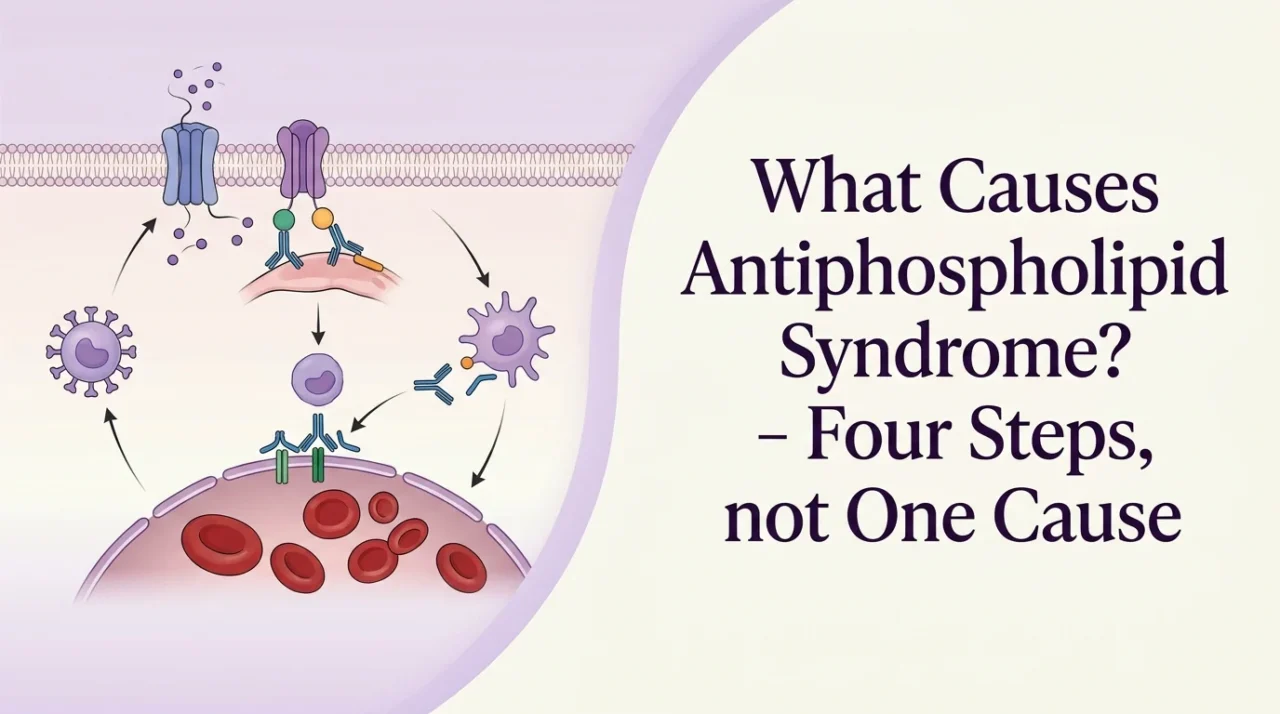
Andra T.: What Causes Antiphospholipid Syndrome? – Four Steps, not One Cause
Andra T., Intelligence Liaison Officer at JMED MCM CBRN, shared a post on LinkedIn:
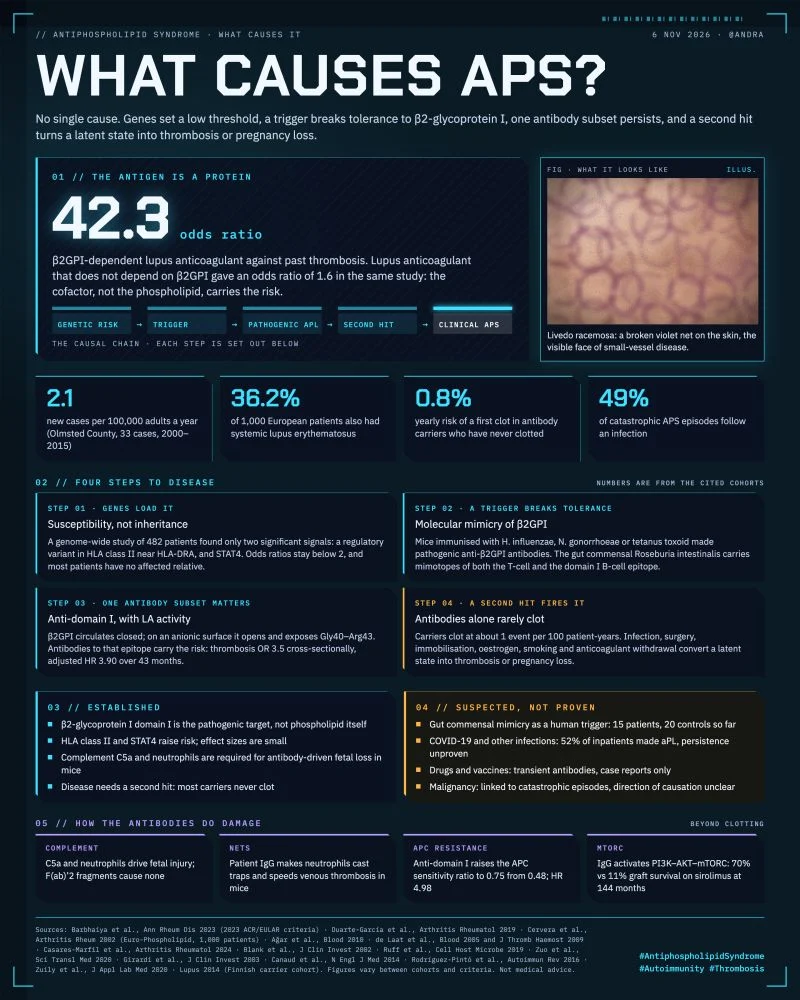
“What causes antiphospholipid syndrome? Four steps, not one cause.
The name misleads.
The antibodies that matter in APS do not target a phospholipid.
They target β2-glycoprotein I, a plasma protein that circulates closed and circular – over 99% of it.
Bound to an anionic surface it opens, exposing a cryptic epitope in domain I (Gly40–Arg43).
Antibodies to that epitope are the pathogenic subset. β2GPI-dependent lupus anticoagulant carried an odds ratio of 42.3 for past thrombosis; lupus anticoagulant that did not depend on β2GPI, 1.6.
So what starts it?
- Genes load it. The first genome-wide study in primary APS (482 patients) found two significant signals: a regulatory variant in HLA class II near HLA-DRA, and STAT4. Odds ratios under 2. Susceptibility, not inheritance.
- A trigger breaks tolerance. Mice immunised with H. influenzae, N. gonorrhoeae or tetanus toxoid – all carrying β2GPI-like sequences – made pathogenic anti-β2GPI antibodies and lost pregnancies. The gut commensal Roseburia intestinalis carries mimotopes of both the T-cell and the domain I B-cell epitope, and patient T-cell clones cross-react with it.
- One antibody subset persists. Anti-domain I IgG: thrombosis OR 3.5 cross-sectionally, adjusted HR 3.90 over 43 months of follow-up.
- A second hit fires it. The part we under-teach. Asymptomatic carriers clot at roughly 1 event per 100 patient-years, and single positivity sits at background population risk. Of 500 catastrophic APS episodes, 65% had an identifiable precipitant, most often infection (49%). The antibodies had usually been present for years.
And the damage is not only clot. Patient IgG activates PI3K–AKT–mTORC in endothelium – 70% vs 11% graft survival at 144 months on sirolimus. In mice, C5a and neutrophils are required for antibody-driven fetal loss; F(ab)′2 fragments cause none.
Still unsettled: whether infection-induced antibodies, post-COVID included, ever become the persistent pathogenic type.”
Stay updated with Hemostasis Today.
-
Nov 8, 2026, 17:57Dhiren Patel: PLD1-Derived Phospholipids Regulate NAD Kinase and ROS Production in Neutrophils
-
Nov 8, 2026, 17:38Nasrin Samadi: Can a Normal Clotting Test Be Misleading?
-
Nov 8, 2026, 17:36Paschalis Evangelidis: The Multifactorial Nature of Cardiovascular Risk in People With Hemophilia
-
Nov 8, 2026, 17:32Evangelos Panagiotopoulos: Apixaban Reduces Stroke and Major Bleeding Risk in Secondary Stroke Prevention
-
Nov 8, 2026, 17:27Danny Gaskin: Applications Open for the BBTS Specialist Certificate in Clinical Transfusion Practice
-
Nov 8, 2026, 16:54James P. Crowley: DOAC Testing Under 50 ng/mL Safely Expedites Urgent Hip Fracture Surgery
-
Nov 8, 2026, 16:21Alessandra Bosch: Women and Girls With Bleeding Disorders and the DACH Registries at HHS 2026
-
Nov 8, 2026, 15:0310 Posts Not to Miss This Week
-
Nov 8, 2026, 14:55Andra T.: Antiphospholipid Syndrome and Its Thrombotic Risks