


Peter Graves: When the Bleeding Does Not Stop
Peter Graves, Independent Consultant Driving Innovation in Surgical Infection Prevention and Patient Safety, shared a post on LinkedIn:
”When the Bleeding Does Not Stop: The Hidden Burden of Disruptive Surgical Hemorrhage
Surgical bleeding remains one of the most common intra- and post-operative complications, varying in severity based on patient, procedure, hospital, and provider factors. While most bleeding can be managed with standard measures such as suturing or direct pressure, disruptive surgical bleeding occurs when hemorrhage or hematoma complicates the procedure despite these interventions. This type of bleeding is not only clinically significant but also economically burdensome.
Hemostatic agents are frequently deployed when conventional measures fall short. These agents vary in mechanism and application and are chosen based on patient characteristics, coagulation status, surgical site, and surgeon preference. Yet, even with their use, disruptive bleeding still occurs and carries serious consequences.
A recent large real-world analysis of nearly 120,000 patients undergoing bariatric surgery, colorectal surgery, spine surgery, total hip arthroplasty, and total knee arthroplasty (TKA) revealed that 10.8% experienced disruptive bleeding despite hemostat use. Incidence varied widely by procedure, from 5.4% in bariatric surgery and 5.6% in TKA to 20% in colorectal surgery. The impact was significant. Disruptive bleeding significantly prolonged operating room time, increased ICU admissions, ventilator use, length of stay, and 90-day readmission. Mortality rose notably in bariatric surgery patients, reaching an alarming 55% when bleeding occurred.
The economic burden was equally striking. Incremental hospital costs ranged from $3,377 for TKA to $23,346 for colorectal surgery. These costs reflect not only additional resources consumed during the index hospitalization but also downstream effects such as readmissions and extended recovery.
This study confirms that disruptive surgical bleeding remains an unmet challenge even with hemostatic agent use. The findings highlight the urgent need for innovation in surgical bleeding control, optimization of topical agents, and broader adoption of enhanced recovery and risk-reduction strategies. For hospitals and health systems, improving bleeding management is not simply a clinical imperative but a financial necessity.
The evidence is clear. When bleeding persists, patient outcomes worsen, costs climb, and the value of surgery is compromised. Future solutions must address both the clinical and economic dimensions of this challenge.”
Reed full article here.
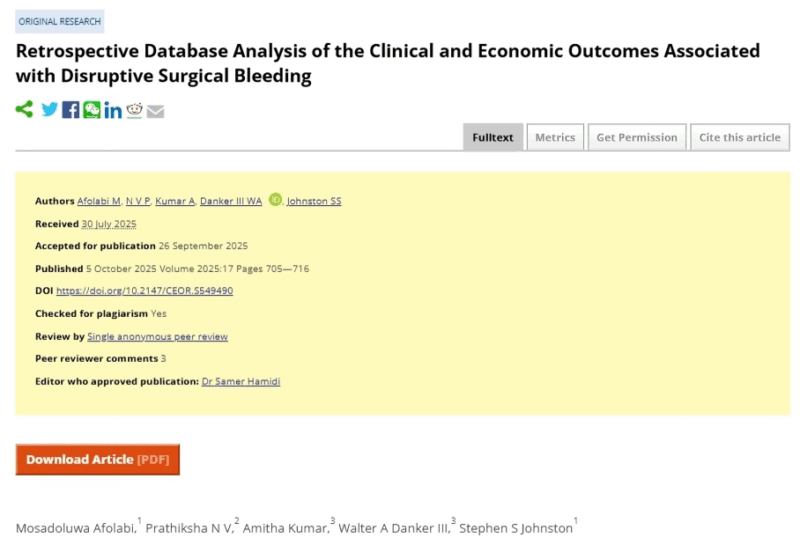
Title: Retrospective Database Analysis of the Clinical and Economic Outcomes Associated with Disruptive Surgical Bleeding
Authors: Mosadoluwa Afolabi, Prathiksha N V, Amitha Kumar, Walter A Danker III, Stephen S Johnston
Stay updated on all scientific advances with Hemostasis Today.
-
Oct 13, 2026, 02:01Nour Al-Mozain: Is It Really Anti-D? – Unraveling Auto-Anti-LW in the Transfusion Laboratory
-
Oct 13, 2026, 01:51Berenice Villegas: The Role of Morphologic Evaluation in Body Fluid Differential Analysis
-
Oct 13, 2026, 01:44Debadrita Ray: Evaluating vWF and VITRO Score for Detecting CSPH in cACLD Patients
-
Oct 13, 2026, 01:34Nagesh Ramesh: Donating Blood for International Plasma Awareness Week
-
Oct 12, 2026, 21:51Sam Botchey: Orthobiologics Are Advancing but the Evidence Must Keep Pace
-
Oct 12, 2026, 21:50Serum Vitamin D, Platelet Function, and Bleeding in Primary ITP – Platelets Journal
-
Oct 12, 2026, 21:30Nika Samadzadeh Tabrizi: Looking Forward to the PACeS Trial on Anticoagulation for POAF
-
Oct 12, 2026, 21:28Michael Megaly: Does Coronary Ectasia Affect Outcomes in Acute Coronary Syndromes?
-
Oct 12, 2026, 21:25Vitor Borin P. de Souza: Think Twice Before Anticoagulating an Isolated Subsegmental PE