

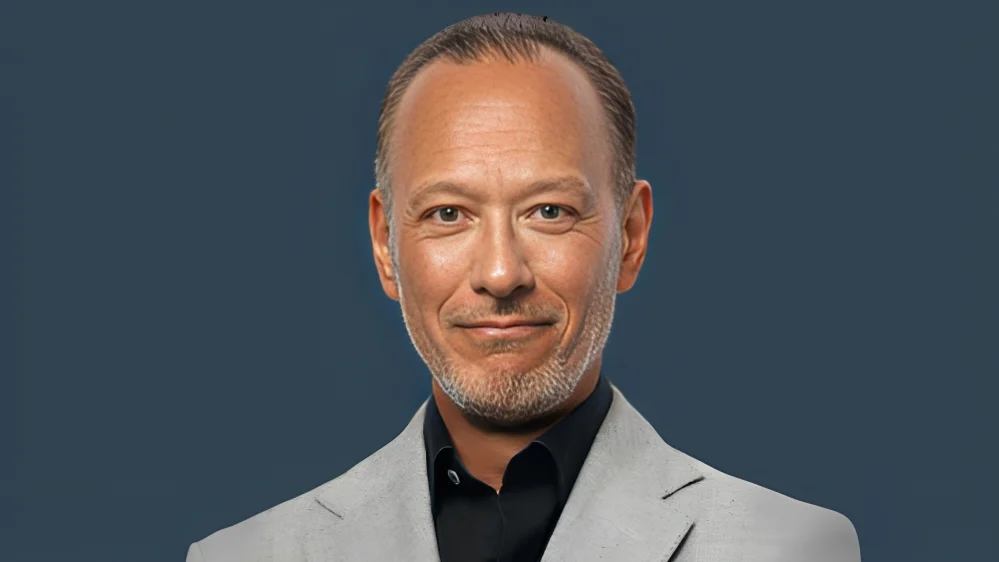
Joseph Raffaele: Can Improving Mitochondrial Quality in Immune Cells Alter Immune Aging Markers?
Joseph Raffaele, Physician-Scientist in Longevity Medicine, CEO of PhysioAge LLC, shared a post on LinkedIn about a recent article by Dominic Denk et al, published in Nature Aging:
”Mitochondria shape immune function over decades.
A recent human trial asked whether we could change this fate.
If we improve mitochondrial quality inside immune cells, can we alter immune aging markers in people?
As immune cells age, mitochondrial dysfunction accumulates.
Damaged mitochondria persist due to impaired mitophagy (damaged mitochondria cleanup).
Energy production declines, reactive oxygen species increase, and immune cells drift toward exhaustion and chronic inflammatory signaling.
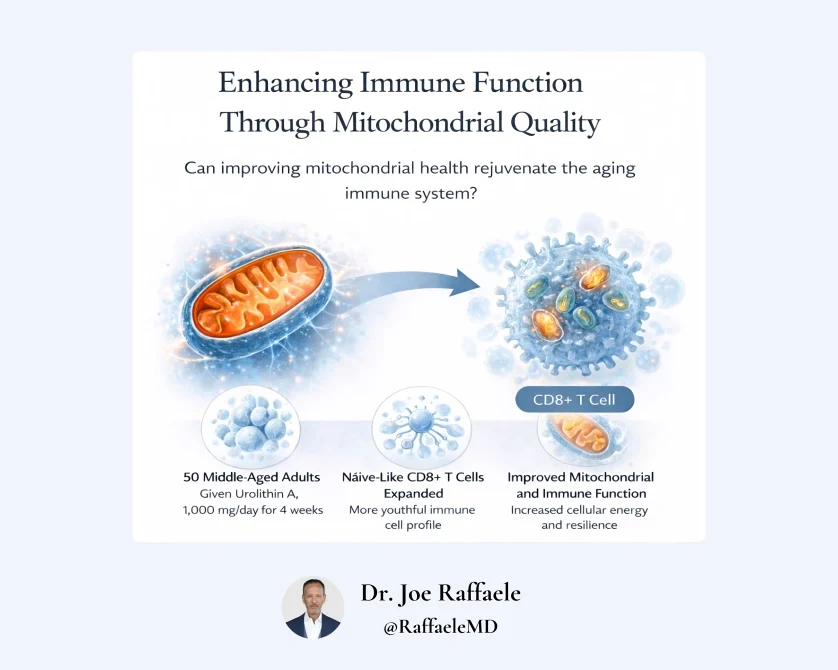
In this study, 50 healthy middle-aged adults received 𝟏,𝟎𝟎𝟎 𝐦𝐠/𝐝𝐚𝐲 𝐨𝐟 𝐮𝐫𝐨𝐥𝐢𝐭𝐡𝐢𝐧 𝐀 𝐟𝐨𝐫 𝐟𝐨𝐮𝐫 𝐰𝐞𝐞𝐤𝐬, a compound shown to induce mitophagy and improve mitochondrial quality control.
Primary endpoints focused on phenotypic and metabolic remodeling of peripheral immune cells, rather than nonspecific clinical outcomes.
Participants receiving urolithin A showed:
- An expansion of naïve-like CD8 T cells
- Improved immune cell metabolic flexibility
- Increased mitochondrial biogenesis in key immune populations
Importantly, inflammatory cytokines and immune function were evaluated alongside cellular metabolism, allowing investigators to directly link mitochondrial quality with immune behavior rather than treating them as separate phenomena.
What makes this study important is the template it provides.
Aging biology advances when trials target a known mechanism, measure the right cell populations, and use human-relevant endpoints. This is the kind of evidence that moves geroscience from theory toward clinical practice.”
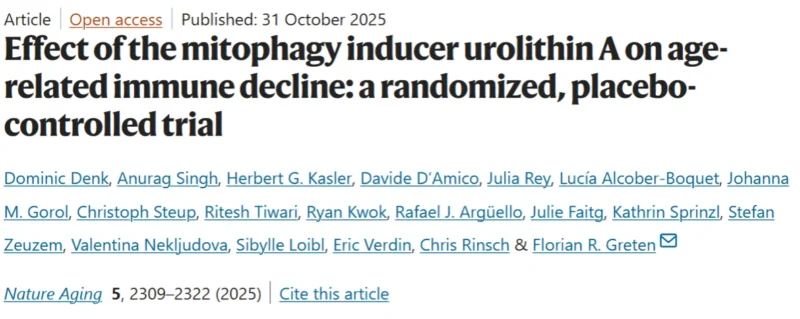
Title: Effect of the mitophagy inducer urolithin A on age-related immune decline: a randomized, placebo-controlled trial
Authors: Dominic Denk, Anurag Singh, Herbert G. Kasler, Davide D’Amico, Julia Rey, Lucía Alcober-Boquet, Johanna M. Gorol, Christoph Steup, Ritesh Tiwari, Ryan Kwok, Rafael J. Argüello, Julie Faitg, Kathrin Sprinzl, Stefan Zeuzem, Valentina Nekljudova, Sibylle Loibl, Eric Verdin, Chris Rinsch, Florian R. Greten
Read the Full Article on Nature Aging
Stay updated with Hemostasis Today.
-
Oct 14, 2026, 20:36How Does Inflammation Reshape Red Blood Cell Production? – ASH
-
Oct 14, 2026, 20:30Marilena Vrana: Putting Faces to the Chain – Donors and Patients Connect in Milan for IPAW 2026
-
Oct 14, 2026, 20:25Asim Alam: Hillsborough County and Partners Demonstrate Drone-Based Emergency Blood Delivery
-
Oct 14, 2026, 20:19Zahid Khanzada: 3rd Position in the Hematology Quiz at PCUH
-
Oct 14, 2026, 20:14Samiul Bashir: The 47th Recognized System in Transfusion Medicine
-
Oct 14, 2026, 20:06Mavis Agnes Kisakye: Petition Advocating for Enhanced Haemophilia Care Presented to EALA Parliament
-
Oct 14, 2026, 20:03Sheharyar Raza: What Are Ways AI and ML Are Impacting How We Collect and Transfuse Blood?
-
Oct 14, 2026, 19:58Alessandro Lucchesi: Three Minutes of RiseMPN 2025
-
Oct 14, 2026, 19:55Talha Waseem: HbA1c – What Does Its Name Actually Mean?