


David Hunt: The Critical Importance of Stroke Awareness
David Hunt, Senior Vice President and Chief Nursing Officer at University of Maryland Baltimore Washington Medical Center, shared on LinkedIn:
”At the University of Maryland Medical System, team members strive to deliver safe, efficient and high-quality care.
This month, I would like to take a moment to stress the critical importance of early stroke awareness.
Stroke is one of the leading causes of death and disability in the United States; however, quick recognition and rapid action can save lives and dramatically improve recovery.
Many people don’t realize just how fast a stroke can develop.
A stroke occurs when blood flow to the brain is suddenly interrupted — and when that happens, every second counts.
For every minute during a stroke, approximately 2 million brain cells are lost.
The sooner someone experiencing a stroke receives medical attention, the better their chances of surviving and maintaining quality of life.
In the hospital, this is why early recognition and rapid activation of our stroke protocols are essential.
Whether you are at the bedside, providing support services or coordinating care behind the scenes, we teach our teams that each of us plays a key role in detecting early warning signs.
It is essential for everyone — not just medical professionals — to know the warning signs.
An easy way to remember them is through the acronym, BE FAST:
- B – Balance: Sudden loss of balance or coordination
- E – Eyes: Sudden vision changes
- F – Face: Facial drooping or numbness
- A – Arms: Arm weakness or drift
- S – Speech: Slurred or difficult speech
- T – Time: Time to call a stroke alert immediately
If you notice any of these signs in yourself, a family member, a friend or even a stranger — do not wait.
Call 911 immediately. Quick action can mean the difference between a full recovery and lifelong residual challenges.
At University of Maryland Baltimore Washington Medical Center (UM BWMC), our stroke team is trained and ready to respond at a moment’s notice, 24 hours a day.
I am proud to say that our response times, interprofessional teamwork and dedication to evidence-based practice save lives every day. But we also recognize that maintaining excellence requires constant vigilance and ongoing education.
Our interdisciplinary stroke team at UM BWMC is committed to developing training refreshers, case reviews and updates designed to strengthen our collective response.
We encourage everyone to participate, ask questions and share insights from their clinical experiences.
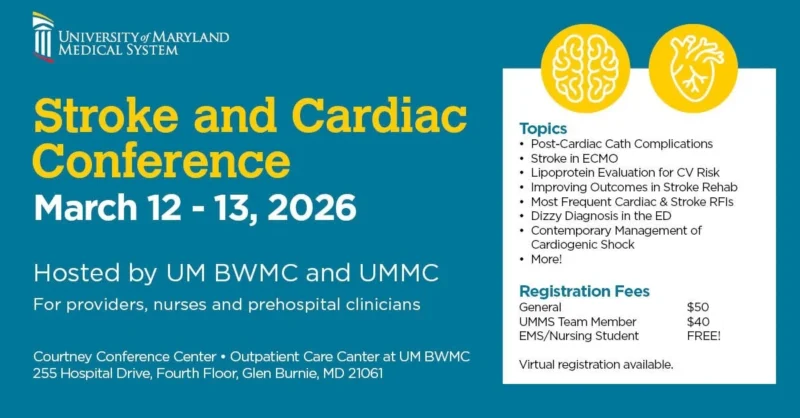
With that in mind, I am excited to share that UM BWMC will be co-hosting the annual Stroke and Cardiac Conference with University of Maryland Medical Center from March 12 to 13 at our Outpatient Care Center.
Providers, nurses and prehospital clinicians are invited to this two-day educational program to learn and discuss best practices in stroke and cardiac care.
Registration is $40 for UMMS colleagues, and there is also a virtual registration option for those unable to attend in person.
More details are available on the event registration website.
I encourage those interested in attending to reserve their spots today, and I hope to see you there.
Thank you for partnering with hospitals and emergency medical services in keeping our communities safe and healthy.
By learning and sharing the signs of stroke, you may help save someone’s life — perhaps even someone you love!
Sincerely,
David G. Hunt, DNP, MBA, RN, NEA-BC”
Stay updated with Hemostasis Today.
-
Oct 5, 2026, 09:20Jan Sloves: Medial Thigh Venous Perforators – Why Diameter Isn’t the Whole Story
-
Oct 5, 2026, 09:16Emmanuele Kouvousis: ASH Sets New Standards for Diagnosing Iron Deficiency
-
Oct 5, 2026, 09:12Arun V J: Fresh Whole Blood vs Evidence-Based Transfusion
-
Oct 5, 2026, 09:06Edward Lee Carter: NOTION-4 – HALT and Clinical Outcomes
-
Oct 4, 2026, 15:06Vasiliki Gkalea: Journal of Clinical Medicine Launches Special Issue on Hematologic Thrombosis and Bleeding
-
Oct 4, 2026, 14:55Quentin Brebant: What Defines a High-Quality Red Blood Cell Concentrate?
-
Oct 4, 2026, 14:47Rana Al-Hrout: Recognizing Non-Anemic Iron Deficiency – Why Iron Matters Beyond Hemoglobin
-
Oct 4, 2026, 14:41David McIntosh: International Plasma Awareness Week 2026 – Closing the Global Plasma Gap
-
Oct 4, 2026, 14:33Pete Stibbs: CleanerVac Real-World Study Presented at VIVA and The VEINS 2026