


Omar Adwan Explains Antibody Detection with the HI Test
Omar Adwan, Medical Laboratory Technologist of Modawah lab center, shared a post on LinkedIn:
“Hemagglutination Inhibition (HI) Test:
1. Objective
To identify and measure antibodies that inhibit the ability of viruses to agglutinate red blood cells (RBCs)
2. Principle
Certain viruses (like Influenza) have surface proteins (hemagglutinins) that cause RBCs to clump together (hemagglutination).
If a patient’s serum contains specific antibodies, they will bind to the virus and block hemagglutination.
Thus, no agglutination = positive inhibition = antibodies present.
3. Materials
Patient serum sample
Viral antigen (e.g., Influenza virus)
Red blood cells (usually chicken, guinea pig, or human O-type)
Microtiter plates (V-bottom or U-bottom)
Phosphate buffered saline (PBS)
Micropipettes
4. Procedure
- Heat inactivate the patient serum (to remove non-specific inhibitors).
- Prepare serial dilutions of serum in microtiter plate wells.
- Add a constant amount of virus antigen to each well.
- Add a standardized suspension of RBCs.
- Incubate and observe results.
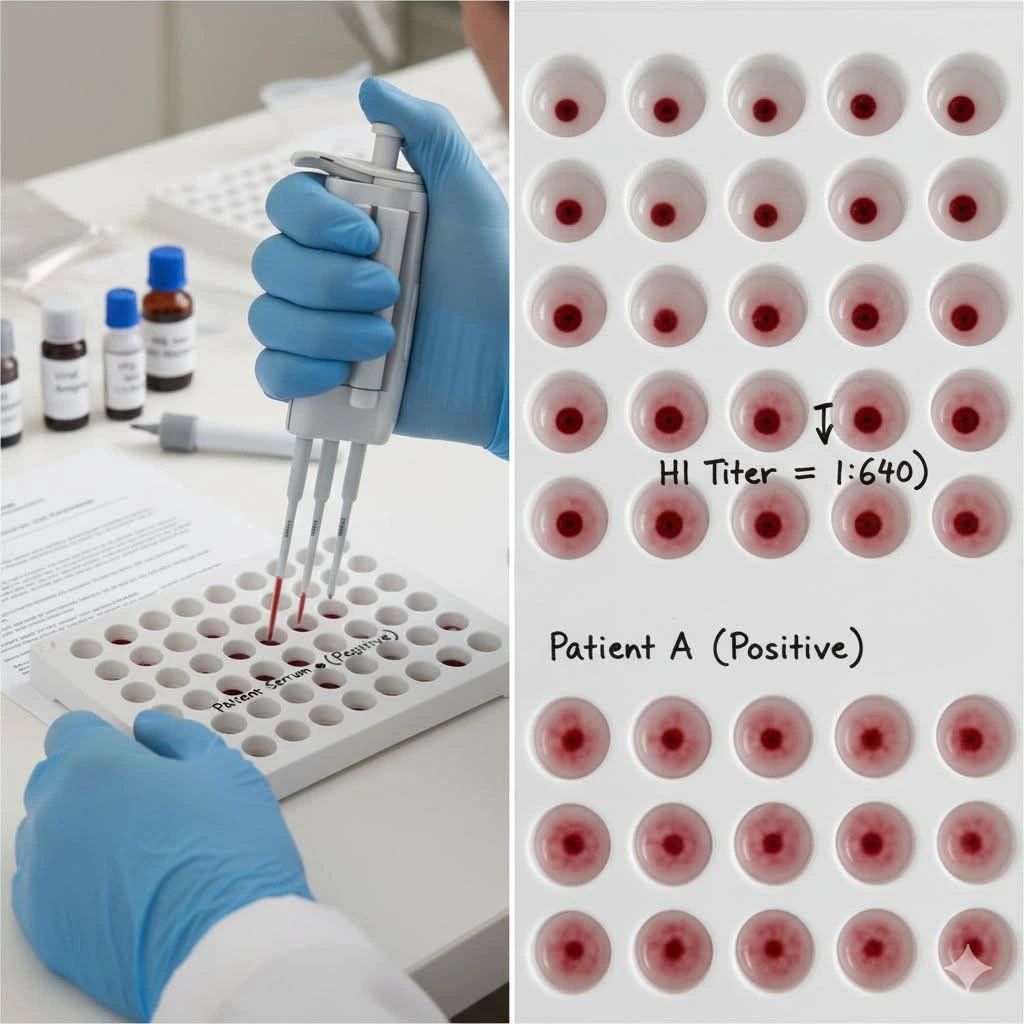
5. Results
Positive (Inhibition): A clear button of RBCs at the bottom of the well (no agglutination). Indicates presence of antibodies.
Negative (No Inhibition): RBCs form a diffuse lattice across the well (agglutination occurs). No antibodies present.
The HI titer is the highest serum dilution that completely inhibits hemagglutination.
6. Uses
Diagnosis of viral infections (e.g., Influenza, Measles, Mumps, Rubella).
Measurement of antibody titers after vaccination.
Surveillance of circulating viral strains.
7. Conclusion
The HI test is a simple, sensitive, and widely used method for detecting virus-specific antibodies and plays a key role in vaccine development and viral epidemiology.”
Stay updated with Hemostasis Today.
-
Apr 3, 2026, 17:59A Free Hemoglobin Screening Camp for Kaikadi Vasti and Eramushti Community Women – Hope Foundation Sironcha
-
Apr 3, 2026, 17:53Carlos Henrique Del Carlo: HFpEF and Iron Deficiency – Why Treating the Mitochondrial Engine Matters More Than We Thought?
-
Apr 3, 2026, 17:46Michelle Leona Cecil: A Call to Protect Patient Care and The Nation’s Blood Supply for Blood Disorders Community
-
Apr 3, 2026, 17:38Shahab Sheikhalishahi: A Rare Case of Portal Vein Thrombosis After Echis Carinatus Envenomation
-
Apr 3, 2026, 17:33Kimberly Ha: Epia Neuro Aims to Restore Movement in Stroke Survivors
-
Apr 3, 2026, 17:28Ryan Perry: Heart and Stroke Announces 2026 Grants-in-Aid Indigenous Research Stream Funding Opportunity
-
Apr 3, 2026, 17:21Maxime Dely: A Meaningful Journey of 14 years in Blood Transfusion
-
Apr 3, 2026, 17:19Arun V J: Don’t Miss TRANSCON 2026 – A Direct Pathway Into India’s Clinical and Institutional Network
-
Apr 3, 2026, 17:17Louise St. Germain Bannon: Preparating for ISTH 2026 and Highlighting Best Aspects of Congress