


Paul Watton: Could Repetitive Head Impacts Leave a Molecular Memory?
Paul Watton, Independent Researcher, shared a post on LinkedIn:
“A provocative possibility emerges when the biology of repetitive head injury is viewed alongside recent ME/CFS research and the discovery that a certain extracellular matrix protein can mediate a type of dementia.
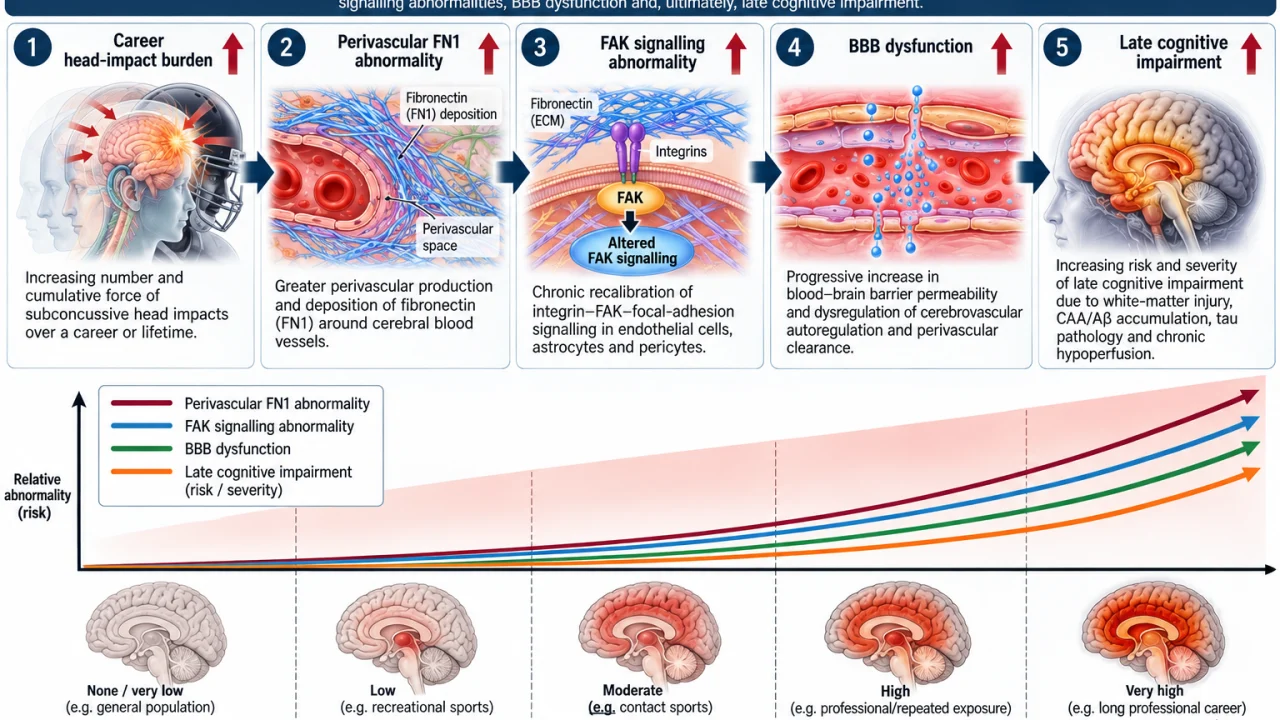
In contact sports, repeated subconcussive impacts can produce cumulative microvascular stress, transient BBB disruption and repeated activation of tissue-repair pathways.
Fibronectin is normally recruited as part of that repair response.
But if impacts recur before the extracellular matrix has fully reset, repeated FN1 deposition, stretching, proteolysis and reassembly could progressively leave behind an abnormal perivascular matrix – a form of ‘mechanochemical memory.’
This is strikingly analogous to the mechanism now being considered in ME/CFS.
The initiating insult is different – mechanical injury in sport, post-infectious/ viral disturbance in ME/CFS – but both could converge on persistent fibronectin/ ECM dysregulation, chronically altered integrin–FAK signalling and failure of vascular homeostasis to return to baseline.
A recently published study by Bhattarai et al. (2026) make this sports-injury hypothesis particularly compelling by showing that excess perivascular astrocyte-derived fibronectin can itself drive integrin–FAK-dependent blood–brain barrier dysfunction; repetitive head impacts could therefore plausibly engage the same FN1-mediated gliovascular pathway through repeated cycles of microvascular injury and repair.
The critical question is now whether cumulative head-impact exposure produces a measurable dose–response in perivascular FN1 abnormality – FAK dysregulation – BBB failure – later cognitive impairment.
The same biological principle may therefore connect two apparently very different disorders:
Repeated failure to restore the extracellular matrix to its normal homeostatic state can convert a transient insult into persistent pathological signalling.”
Stay updated with Hemostasis Today.
-
Sep 30, 2026, 12:41The Journey to ISTH 2027 Starts in Vancouver
-
Sep 30, 2026, 11:36Basit Ali: A Closer Look at CT Venography
-
Sep 30, 2026, 11:16Christina Pohlman: Could aPL Levels Help Predict Stroke Recurrence?
-
Sep 30, 2026, 10:55Rana Al Hrout: Diagnostic Approach to Hypochromic Microcytic Anemia
-
Sep 30, 2026, 01:52Javed Anees: DADA2 – When a Young Stroke Is More Than a Stroke
-
Sep 30, 2026, 01:51How a Venous Thrombus Becomes Revascularized – ISTH
-
Sep 29, 2026, 22:45Victor Agunyego: Paracetamol – The Most Common Drug We Underestimate
-
Sep 29, 2026, 22:42Nova Sinclair: Advancing the Future of Hematology – Meet Our 2027 Organizing Committee
-
Sep 29, 2026, 22:41Lorenz Räber: Intracoronary Imaging in PCI – Why, When, How, and Which Modality?