

Tareq Abadl: Are Premarital Tests a Luxury Or a Medical Necessity?
Tareq Abadl, Medical Laboratory Specialist and Director of the Blood Bank at Dr. Abdelkader Al-Mutawakkil Hospital, shared a post on LinkedIn:
“Before You Say “Congratulations”… Ask This First
Are premarital tests a luxury?
Or a medical necessity that could protect your future children from lifelong suffering?
Many people think premarital screening is just routine paperwork.
That’s wrong.
These tests are a life decision, not a formality.
Whether the marriage is between relatives or not, the risks — and the role of testing — are real.
Let’s get it straight
Why Are Premarital Tests Important?
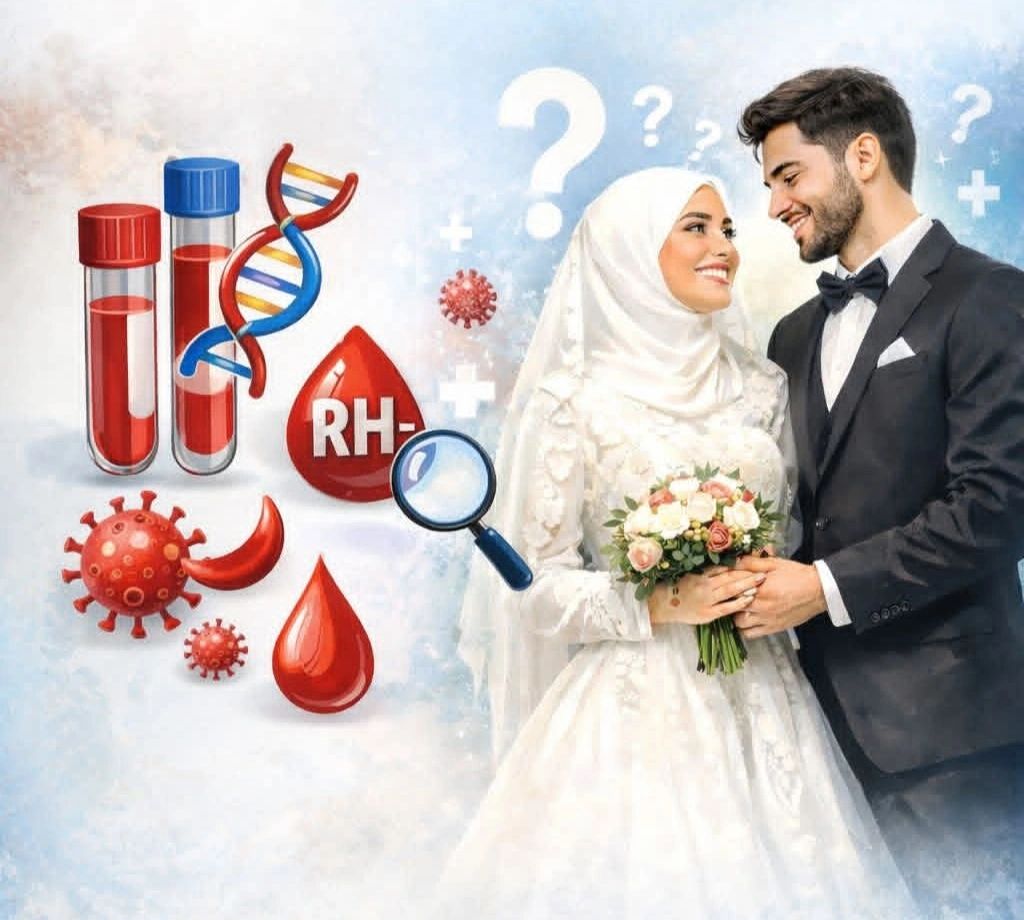
Premarital screening helps to:
- Reduce the risk of genetic diseases in children
- Detect infectious diseases that can be transmitted to the partner
- Protect both spouses’ long-term health
- Prevent future psychological and family problems
- Enable safe and informed pregnancy planning
Marriage Between Relatives (Consanguinity)
Why Is It Riskier?
Relatives often:
Share the same genes
May carry the same genetic disorder without symptoms
This significantly increases the chance that a child will be:
Affected, not just a carrier
Essential Tests for Relatives
- Complete Blood Count (CBC)
Screens for:
Inherited anemia
Thalassemia
Hemoglobin disorders - Thalassemia Testing
(Hb Electrophoresis / HPLC)
Critical because:
A person may be a carrier without knowing
Carrier + Carrier = High risk of affected child - Sickle Cell Disease Screening
Especially important in certain geographic regions
A chronic, painful disease that affects:
Quality of life
Life expectancy - Targeted Genetic Tests (Based on Family History)
Examples:
G6PD deficiency
Inherited metabolic disorders
Genetic liver or kidney diseases
Marriage Between Non-Relatives
Some people say:
> “We’re not related, why test?”
Wrong assumption.
Not all serious diseases are genetic.
Mandatory Infectious Disease Tests
HBV (Hepatitis B)
HCV (Hepatitis C)
HIV
Syphilis (VDRL)
Purpose:
Protect the uninfected partner
Prevent transmission
Protect future pregnancies
Blood Group and Rh Factor
Especially important if:
Husband: Rh positive
Wife: Rh negative
To prevent:
Recurrent pregnancy loss
Hemolytic disease of the newborn
Severe neonatal anemia
Additional Tests (When Indicated)
Blood glucose
Liver function tests
Kidney function tests
To ensure:
Safe pregnancy
No hidden chronic diseases
When Should These Tests Be Done?
* Well before marriage * To allow time for:
Medical counseling
Discussion
Informed decision-making without pressure
Final Message
Premarital testing is:
Not complication
Not pessimism
Awareness
Compassion
Protection for children not yet born
Tests don’t stop marriage.
Ignorance can destroy happiness for a lifetime.”
Explore more posts for deeper insights into hemostasis with Hemostasis Today.
-
Sep 30, 2026, 12:52Paul Watton: Could Repetitive Head Impacts Leave a Molecular Memory?
-
Sep 30, 2026, 12:41The Journey to ISTH 2027 Starts in Vancouver
-
Sep 30, 2026, 11:36Basit Ali: A Closer Look at CT Venography
-
Sep 30, 2026, 11:16Christina Pohlman: Could aPL Levels Help Predict Stroke Recurrence?
-
Sep 30, 2026, 10:55Rana Al Hrout: Diagnostic Approach to Hypochromic Microcytic Anemia
-
Sep 30, 2026, 01:52Javed Anees: DADA2 – When a Young Stroke Is More Than a Stroke
-
Sep 30, 2026, 01:51How a Venous Thrombus Becomes Revascularized – ISTH
-
Sep 29, 2026, 22:45Victor Agunyego: Paracetamol – The Most Common Drug We Underestimate
-
Sep 29, 2026, 22:42Nova Sinclair: Advancing the Future of Hematology – Meet Our 2027 Organizing Committee