


Sasha A. Singh, MSc, PhD, FAHA/LinkedIn
Nov 12, 2025, 10:54
Sasha Singh: Even Well-Known Biology Still Holds Secrets – New ATVB Findings on Lipoproteins
Sasha Singh, Director of Proteomics Research at the CICS, Brigham and Women’s Hospital, Harvard Medical School, posted on LinkedIn:
”I am very grateful to Drs Kanter and Vaisar for highlighting our recent study in ATVB, an American Heart Association Journal, demonstrating that (apo)lipoproteins circulate as ADP-ribosylated forms that accumulate in developing plaques. Our paper underscores that even a well-studied biology still hides many secrets, and that mass spectrometry is a powerful technology to unveil them.”
Read the full article here.
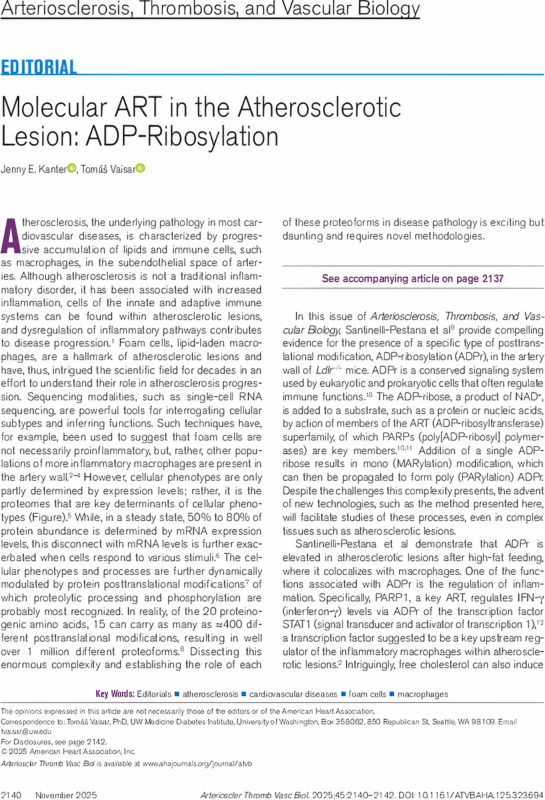
Title: Molecular ART in the Atherosclerotic Lesion: ADP-Ribosylation
Authors: Jenny E. Kanter, Tomáš Vaisa
Stay updated with Hemostasis Today.
AHA
American Heart Association
American Heart Association Journal
and Vascular Biology
Arteriosclerosis
Atherosclerosis
Atherosclerotic Lesions
Brigham and Women's Hospital
Harvard Medical School
Health
Hematology
Hemostasis
Hemostasis Today
Jenny E. Kanter
Medicine
Sasha Singh
thrombosis
Tomáš Vaisa
Vascular Biology
-
Oct 4, 2026, 15:06Vasiliki Gkalea: Journal of Clinical Medicine Launches Special Issue on Hematologic Thrombosis and Bleeding
-
Oct 4, 2026, 14:55Quentin Brebant: What Defines a High-Quality Red Blood Cell Concentrate?
-
Oct 4, 2026, 14:47Rana Al-Hrout: Recognizing Non-Anemic Iron Deficiency – Why Iron Matters Beyond Hemoglobin
-
Oct 4, 2026, 14:41David McIntosh: International Plasma Awareness Week 2026 – Closing the Global Plasma Gap
-
Oct 4, 2026, 14:33Pete Stibbs: CleanerVac Real-World Study Presented at VIVA and The VEINS 2026
-
Oct 4, 2026, 13:56Maria Elisa Mancuso: EHC 2026 Highlights the Unmet Needs of Women with Bleeding Disorders
-
Oct 4, 2026, 13:53Nirmal Shaji George: Individualizing Anticoagulation in Complex APS and Thrombocytopenia
-
Oct 4, 2026, 13:5210 Posts Not to Miss This Week
-
Oct 4, 2026, 13:45Suswapna Singh Rawat: The Clinical Significance of Coronary Plaque Stability