


Arthur Allen: Empowering Clinicians to Act
Arthur Allen, Anticoagulation Program Manager at VA Salt Lake City Health Care System, shared Edward Lee Carter’s post on LinkedIn about a recent article, by Allison Ranusch et al, published in JMIR Humans Factors, adding:
“Well said Edward Lee Carter, BSPharm, CPP! Studies have shown that just making recommendations doesn’t move the needle. This is especially true in the era of alert fatigue. Here is one example I had the pleasure of being involved in a few years back, showing the importance of individual clinician authority.”
Edward Lee Carter, Clinical Pharmacist Practitioner at U.S. Department of Veterans Affairs shared a post on LinkedIn:
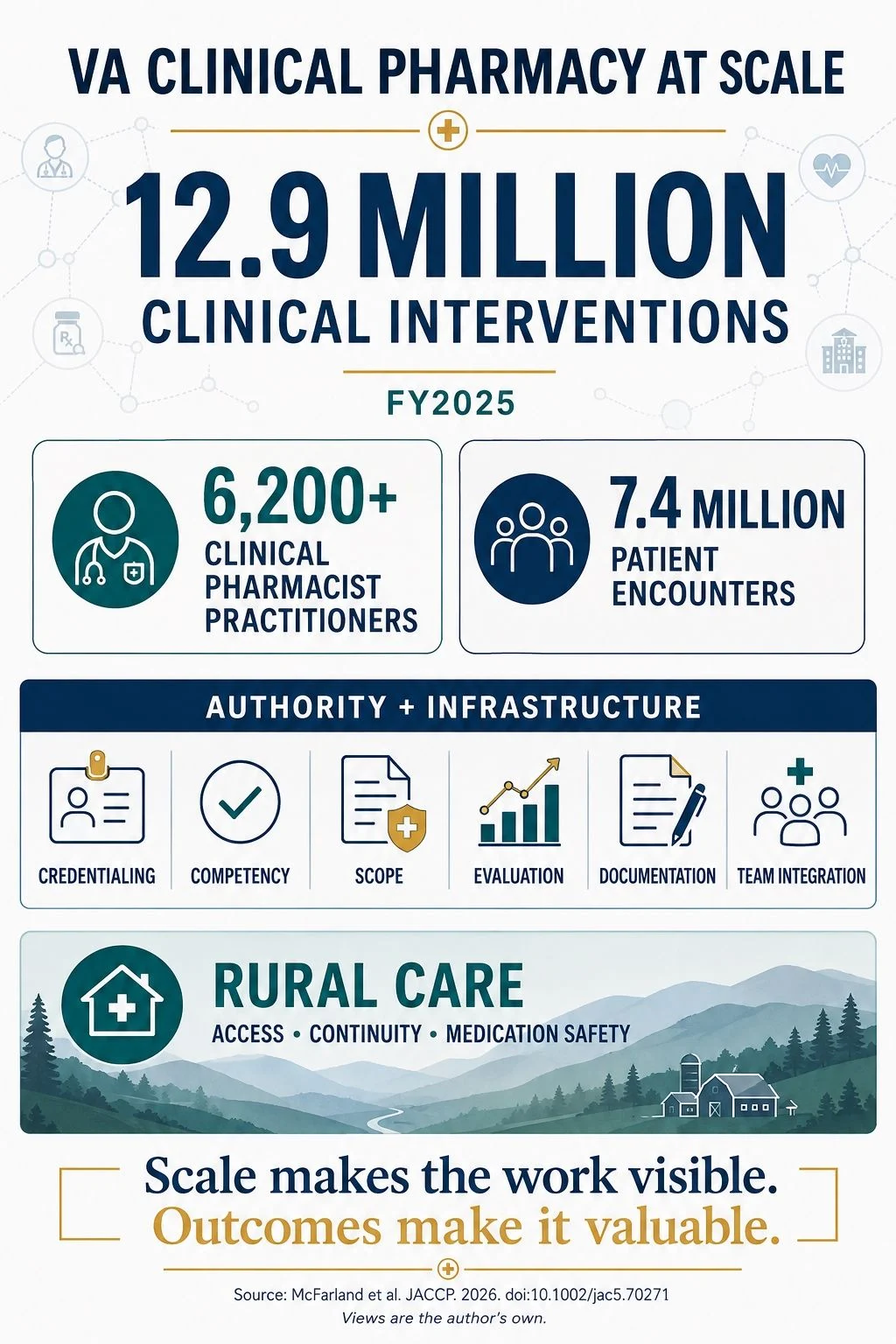
“In a new Journal of the American College of Clinical Pharmacy Pharmacy Forum paper, ‘Transforming Veteran Care Through Standardized Clinical Pharmacy Practice,’ M. Shawn McFarland and colleagues report that more than 6,200 VA CPPs completed nearly 7.4 million encounters and documented 12.9 million interventions in FY2025.
The scale matters. How U.S. Department of Veterans Affairs made that scale possible matters even more.
VA did not advance clinical pharmacy simply by granting pharmacists greater authority. It paired that authority with:
- Medical-staff credentialing
- Competency-based scopes
- Prescriptive authority
- Ongoing professional practice evaluation
- Standardized documentation
- Integration into interprofessional teams
- After four decades in pharmacy—and two decades within VA—I have watched the pharmacist’s role move far beyond providing recommendations from the edge of the care team.
Today, VA CPPs manage medication therapy with autonomy and in collaboration with other clinicians. Within approved scopes, they order monitoring, adjust treatment, address medication-safety concerns, and provide longitudinal follow-up.
In a rural VA clinic, that role is particularly meaningful.
A CPP can be one of the most practical ways to expand access—managing anticoagulation, optimizing chronic-disease therapy, resolving complex medication problems, and allowing every clinician to work closer to the top of their scope.
One important nuance: a standardized credentialing pathway should not require every CPP to have an identical scope. Clinical authority should reflect demonstrated competence, practice area, and local patient needs.
Standardization should mean consistent standards—not identical practice.
And while 12.9 million interventions make the work visible, volume alone is not the same as value.
An intervention count cannot fully capture the stroke prevented through careful anticoagulation management, the hospitalization avoided through timely follow-up, or the Veteran who finally understood and felt confident in the treatment plan.
These numbers deserve recognition. They should also prompt the next question:
Are health systems providing the staffing, scheduling support, technology, and protected follow-up time needed to perform this work safely and well?
The broader lesson is clear:
Expanded authority matters. But it becomes sustainable clinical practice only when supported by infrastructure, accountability, and outcomes that matter to patients.
That may be the most transferable part of the VA model.
Paper and supporting sources in the first comment.
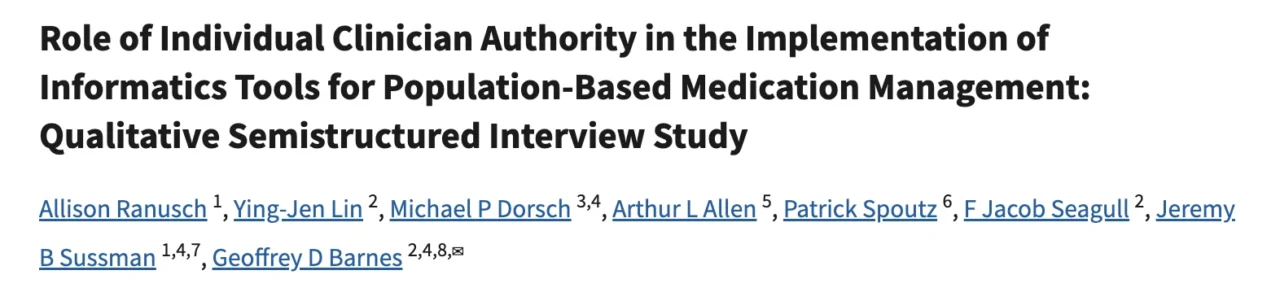
Title: Role of Individual Clinician Authority in the Implementation of Informatics Tools for Population-Based Medication Management: Qualitative Semistructured Interview Study
Authors: Allison Ranusch, Ying-Jen Lin, Michael P Dorsch, Arthur L Allen, Patrick Spoutz, F Jacob Seagull, Jeremy B Sussman, Geoffrey D Barnes
Stay updated on all scientific advances with Hemostasis Today.
-
Oct 5, 2026, 15:31Irma Bagdoniene: Multidisciplinary Management of High-Risk Familial Hypercholesterolaemia and CAD
-
Oct 5, 2026, 15:00Serena Williams and Pulmonary Embolism: From Personal Crisis to Lessons in Venous Thromboembolism
-
Oct 5, 2026, 14:55Marco Moscarelli: 3D Reconstruction Enhances Volumetric Assessment of Post-TAVI Thrombosis
-
Oct 5, 2026, 13:24Abdul Muqtadir Abbasi: Diagnostic Pearls for Evaluating Isolated Thrombocytopenia in Residents
-
Oct 5, 2026, 13:16Katerina Pavenski: Rethinking What ‘Normal’ Means for Iron Deficiency
-
Oct 5, 2026, 13:09Rick Matthews: Balancing Established VTE Partnerships with Innovative Interventional Technologies
-
Oct 5, 2026, 13:01Nawsherwan Mohammad: Recognizing TTP Before the ADAMTS13 Result Arrives
-
Oct 5, 2026, 12:51Bruno Pougault: The Hidden Challenges Behind Anti Xa Testing
-
Oct 5, 2026, 12:41Syed Huzaifa Khan: Rethinking CTRP12 as a Biomarker for In Stent Restenosis