


Bartosz Hudzik: Choosing The Right Anticoagulant for Acute Venous Thromboembolism
Bartosz Hudzik, Associate Profesor at Medical University of Silesia, shared a post on LinkedIn about a recent article by Lana A. Castellucci et al, adding:
”Choosing the right anticoagulant for acute venous thromboembolism (VTE) often comes down to balancing efficacy with bleeding risk.
A recent international randomized trial compared apixaban and rivaroxaban, two of the most commonly used direct oral anticoagulants for treating acute pulmonary embolism and proximal deep-vein thrombosis.
Study design
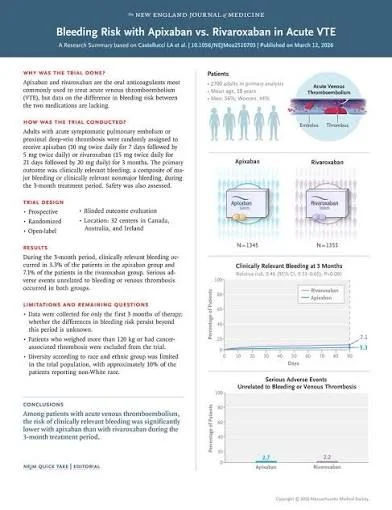
- 2,760 patients with acute symptomatic VTE
- Randomized 1:1 to apixaban or rivaroxaban
- 3-month treatment period
- Primary endpoint: clinically relevant bleeding (major plus clinically relevant non-major bleeding)
Dosing
- Apixaban: 10 mg BID for 7 days – 5 mg BID
- Rivaroxaban: 15 mg BID for 21 days – 20 mg daily
Key results
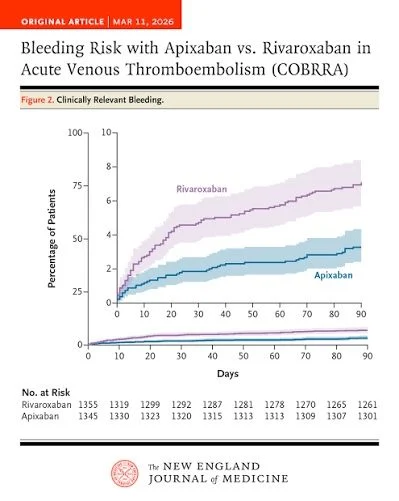
Clinically relevant bleeding:
- Apixaban: 3.3%
- Rivaroxaban: 7.1%
- Relative risk: 0.46 (95% CI 0.33–0.65, P < 0.001)
This represents ~54% lower risk of clinically relevant bleeding with apixaban over the 3-month treatment period.
Mortality remained very low in both groups
- Apixaban: 0.1%
- Rivaroxaban: 0.3%
Takeaway
Among patients with acute VTE, apixaban demonstrated a significantly lower bleeding risk compared with rivaroxaban, while maintaining similar overall safety outcomes.”
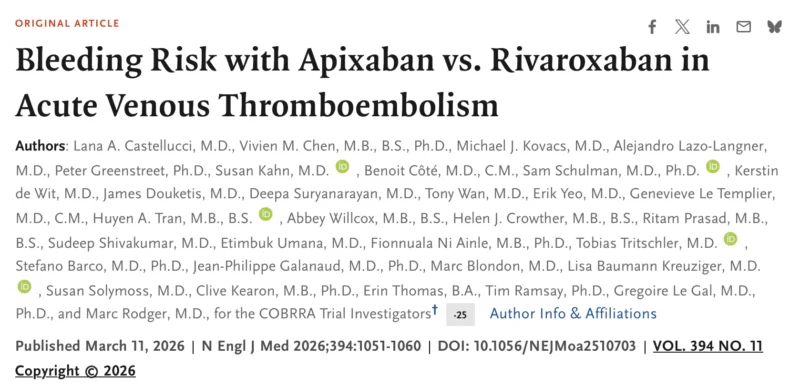
Title: Bleeding Risk with Apixaban vs. Rivaroxaban in Acute Venous Thromboembolism
Authors: Lana A. Castellucci, Vivien M. Chen, Michael J. Kovacs, Alejandro Lazo-Langner, Peter Greenstreet, Susan Kahn, Benoit Côté, Sam Schulman, Kerstin de Wit, James Douketis, Deepa Suryanarayan, Tony Wan, Erik Yeo, Genevieve Le Templier, Huyen A. Tran, Abbey Willcox, Helen J. Crowther, Ritam Prasad, Sudeep Shivakumar, Etimbuk Umana, Fionnuala Ni Ainle, Tobias Tritschler, Stefano Barco, Jean-Philippe Galanaud, Marc Blondon, Lisa Baumann Kreuziger, Susan Solymoss, Clive Kearon, Erin Thomas, Tim Ramsay, Gregoire Le Gal, Marc Rodger, for the COBRRA Trial Investigators
Read the Full Article on NEJM
Stay updated on all scientific advances with Hemostasis Today.
-
Oct 30, 2026, 11:49Advancing Global Care for Hemophilia and Bleeding Disorders – World Federation of Hemophilia
-
Oct 30, 2026, 05:18Flora Peyvandi: Molecular and Lab Markers Linked to Bleeding Severity in Factor VII Deficiency
-
Oct 30, 2026, 05:11Rana Al-Hrout: Exploring Approach to Macrocytic Anemia
-
Oct 30, 2026, 04:22Francisco Chacón-Lozsán: Acute Pulmonary Embolism in 2026 – Blood Pressure Is Not the Same as Perfusion
-
Oct 30, 2026, 04:15Samin Mohsenian: Launching the PRO-RBDD-FX Registry for Rare Coagulation Factor X Deficiency
-
Oct 30, 2026, 03:59Emil List Larsen: Identifying SERPINC1 Variants and Limitations of Routine Antithrombin Testing
-
Oct 30, 2026, 02:43D Chandra: Reduce the Apixaban Dose for a Patient with VTE and a Creatinine Clearance of 25?
-
Oct 30, 2026, 02:38Spencer Dorn: Why AI Decision Support Must Integrate Local Clinical Context
-
Oct 30, 2026, 02:33Jens Eschen: Randomized Controlled Trial on Acute Aortic Dissection Anticoagulation Strategies