


Bhupesh Prusty: How Patient-Derived IgG Immune Complexes Directly Affect Human Cells
Bhupesh Prusty, Associate Professor at Riga Stradins University, shared on LinkedIn about a recent article he and his colleagues co-authored, adding:
”New Publication Alert | ME/CFS and Post-COVID Mechanisms
We are pleased to share our latest open-access study in Brain, Behavior, and Immunity – Health:
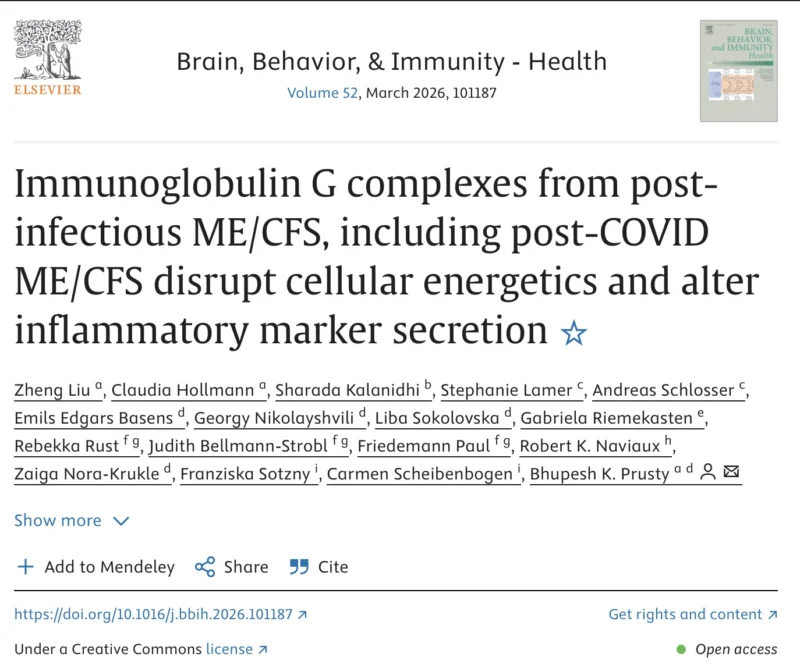
‘Immunoglobulin G Complexes from Post-infectious ME/CFS, including post-COVID ME/CFS, Disrupt Cellular Energetics and Alter Inflammatory Marker Secretion.’
Why this matters
ME/CFS and post-COVID (PASC) are debilitating, multi-system conditions with poorly understood cellular drivers.
Our study addresses a key mechanistic gap by examining how patient-derived IgG immune complexes directly affect human cells.
Key findings
- Disease-specific IgG complexes from ME/CFS and post-COVID ME/CFS induce mitochondrial fragmentation and alter cellular energetics in endothelial cells, supporting an antibody-mediated mechanism of metabolic dysfunction.
- Immune-complex proteomics reveals distinct molecular signatures that differentiate ME/CFS from post-COVID ME/CFS.
- Beyond classical immunology, we show that antibodies can enter specific cell types, uncovering a previously unrecognized intracellular dimension of antibody action.
- Elevated antigens in circulation may reflect redistribution and depletion from tissues where they are functionally required, challenging conventional interpretations of serum proteomics.
Broader impact
By linking circulating autoantibodies to endothelial and metabolic dysfunction, this work strengthens the biological basis of ME/CFS and post-COVID and opens new directions for biomarker discovery and therapeutic intervention.
This study is less about claiming novelty and more about challenging long-standing assumptions that deserve re-examination.”
Title: Immunoglobulin G complexes from post-infectious ME/CFS, including post-COVID ME/CFS disrupt cellular energetics and alter inflammatory marker secretion
Authors: Zheng Liu, Claudia Hollmann, Sharada Kalanidhi, Stephanie Lamer, Andreas Schlosser, Emils Edgars Basens, Georgy Nikolayshvili, Liba Sokolovska, Gabriela Riemekasten, Rebekka Rust, Judith Bellmann-Strobl, Friedemann Paul, Robert K. Naviaux, Zaiga Nora-Krukle, Franziska Sotzny, Carmen Scheibenbogen, Bhupesh K. Prusty
Read the Full Article on Brain, Behavior, and Immunity – Health
Stay updated on all scientific advances with Hemostasis Today.
-
Sep 17, 2026, 15:33Alexandros Makis: When Microcytic Anemia Has an Inherited Cause
-
Sep 17, 2026, 15:22α2-Antiplasmin Inhibition and the Future of Thrombolysis
-
Sep 17, 2026, 15:20Fatma M. Attia: Expanding the Evidence Base for Therapeutic Plasma Exchange Across Multiple Indications
-
Sep 17, 2026, 15:19Conan McIlwrath: The Haemophilia Society Engages With IBCA
-
Sep 17, 2026, 15:06Eleftheria Hatzimichael: A Contemporary Diagnostic Approach to Inherited Microcytic Anemias
-
Sep 17, 2026, 14:51Konstantin Yenkoyan: Emicizumab and the Power of Translational Science
-
Sep 17, 2026, 14:47Zachary Sutton: Translating the 2026 KDIGO Guideline Into Practice
-
Sep 17, 2026, 14:43Leah Williams: Evaluating Medical Device Haemocompatibility Under ISO 10993-4
-
Sep 17, 2026, 14:32Ria Ahuja: Scaling Evidence-Informed Anemia Interventions Through Training