


Retheesh Das: Avoiding Unnecessary Transfusions – Why Less Can Be Safer
Retheesh Das, Nursing Officer at Madhya Pradesh Medical Science University (MPMSU), shared a post on LinkedIn:
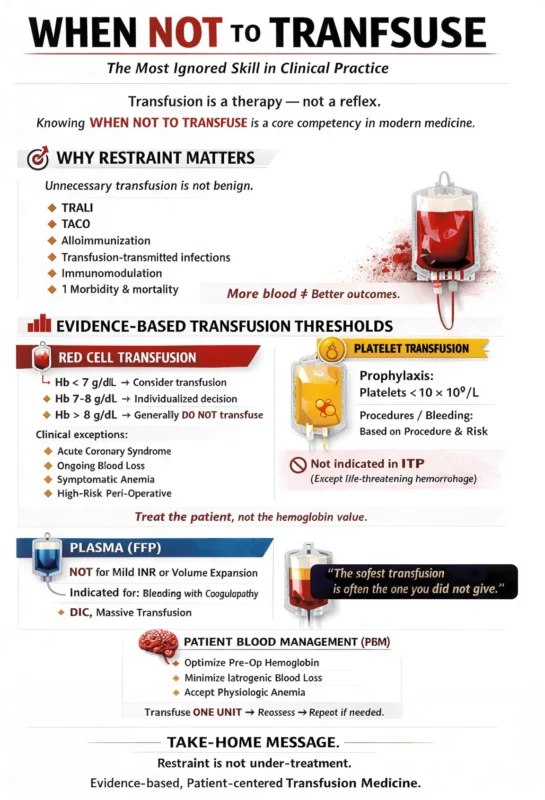
”Avoiding Unnecessary Transfusions
Blood transfusion isn’t an automatic response – it’s a deliberate treatment.
Mastering the decision of when to hold back is essential in today’s healthcare.
The Importance of Caution
Extra transfusions aren’t harmless. They come with real dangers, such as:
- TRALI: An immune-triggered lung damage causing sudden breathing problems.
- TACO: Overloading the system with fluid, resulting in lung swelling.
- Alloimmunization: Building antibodies that mess up later transfusions or births.
- Infections: Uncommon spread of bugs like viruses or bacteria, even with checks.
- Immunomodulation: Tweaking immunity, raising chances of infections or cancer return.
- Elevated risks: More issues, longer recoveries, and higher death rates in those over-transfused.
Key Idea: Extra blood doesn’t mean superior results. Studies prove that conservative approaches often match or surpass aggressive ones.
Guidelines Backed by Research….
Red Blood Cells
• Below 7 g/dL Hb: Think about transfusing to avoid oxygen shortages.
• 7-8 g/dL Hb: Tailor to the individual’s age, health issues, and signs.
• Above 8 g/dL Hb: Usually skip it—risks typically eclipse benefits.
• Special Cases: Heart attacks, active bleeding, anemia symptoms, or risky operations.
• Reminder: Focus on the person’s condition, not just the lab result.
Plasma (FFP)
• Skip for: Slight INR rises or just needing more fluid.
• Use for: Actual bleeding tied to clotting problems.
• Instances: DIC from sepsis or injury, or huge blood loss scenarios.
Approaches to Blood Conservation (PBM)
• Boost Hb before surgery with checks and fixes like iron or vitamins.
• Cut down on needless blood draws using efficient methods.
• Embrace natural low Hb in steady patients—the body adjusts.
• Method: Give one unit, check progress, add more only if required.
Final Insight….
Holding off isn’t skimping – it’s wise practice. Strive for science-driven, individualized care that balances dangers and gains.”
Retheesh Das/LinkedIn
Stay updated with Hemostasis Today.
-
Sep 22, 2026, 09:18Shamee Shastry: How Transfusion Medicine Research Is Evolving in India
-
Sep 22, 2026, 09:11Tarique Shahzad Chachar: Why Warfarin Remains the Gold Standard for Mechanical Heart Valves
-
Sep 22, 2026, 09:04Bianca Rocca: Thromboinflammatory Injury in Ischemic Limb Necrosis During Severe Shock
-
Sep 22, 2026, 09:01Ash Paul: Comparing Left Atrial Appendage Occlusion and Oral Anticoagulation
-
Sep 22, 2026, 08:50Emily Horner: Lipoprotein(a) Links Oxidized Phospholipids to Platelet Hyperactivity
-
Sep 22, 2026, 08:42Sally Mandour: Bone Marrow Needle Gauge Explained
-
Sep 22, 2026, 08:39Alessandro Sionis: Navigating Anticoagulation in Mechanical Circulatory Support
-
Sep 22, 2026, 08:28Raghavendra Rao: The Latest Research on Varicose Veins
-
Sep 22, 2026, 08:23Aravind Palraj: Three Essential Tests in Antiphospholipid Syndrome