


Caroline Dixon and Colleagues on LMWH Dosing to Reduce The Risk of VTE in Pregnant Women With Inherited ATD
Journal of Thrombosis and Haemostasis (JTH) shared on LinkedIn:
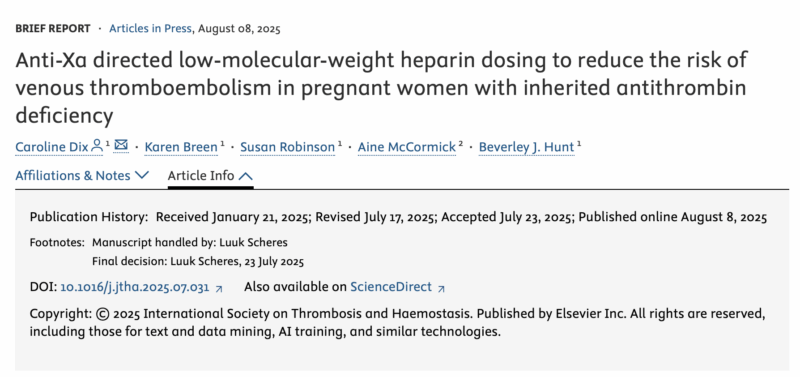
”Anti-Xa–directed low-molecular-weight heparin dosing to reduce venous thromboembolism in pregnant women with inherited antithrombin deficiency
By Caroline Dixon, Karen Breen, Sue Robinson, Aine McCormick, and Professor Beverley Hunt OBE
• Challenge: Inherited antithrombin deficiency (ATD) markedly increases VTE risk during pregnancy, but LMWH efficacy depends on antithrombin levels.
• Approach: A single-centre cohort (32 pregnancies, 17 women) adopted anti-Xa-guided LMWH dosing with selective peripartum antithrombin concentrate.
• Outcome: Overall VTE rate was 12.5%, yet no VTE occurred in adherent women receiving anti-Xa–adjusted LMWH. Haemorrhage risk remained acceptable (12.5%, mostly moderate).”
Read the full article in JTH.
Article: Anti-Xa directed low-molecular-weight heparin dosing to reduce the risk of venous thromboembolism in pregnant women with inherited antithrombin deficiency
Authors: Caroline Dixon, Karen Breen, Susan Robinson, Aine McCormick, Beverley J. Hunt
Stay updated on all scientific advances in the field of thrombosis with Hemostasis Today.
-
Oct 14, 2026, 19:58Alessandro Lucchesi: Three Minutes of RiseMPN 2025
-
Oct 14, 2026, 19:55Talha Waseem: HbA1c – What Does Its Name Actually Mean?
-
Oct 14, 2026, 19:47Aarti Merai: A 50-Year Blood Group Mystery Has Finally Been Solved!
-
Oct 14, 2026, 18:20Yuria Ito: Does an MCV Below 100 Mean There Is No Vitamin B12 Deficiency?
-
Oct 14, 2026, 18:08Micheal Avoseh: Nanoparticle Research for Venous Thrombosis
-
Oct 14, 2026, 18:00A Decade of Symptoms Before a Rare Disease Diagnosis – ITP Support Association
-
Oct 14, 2026, 17:52David McIntosh: The Global Blood Shortage and the Need for Sustainable Donor Recruitment
-
Oct 14, 2026, 17:41Emmanuel J Favaloro։ October 13 is World Thrombosis Day
-
Oct 14, 2026, 17:24EHC ERIN Webinar on Fibrinogen Disorders