

Deepak Yadav: What If the Way We Classify Stroke Tissue Is Too Simplistic for Modern Stroke Care?
Deepak Yadav, Consultant and Assistant Professor of Neurology at Amrita Hospital, shared on LinkedIn about a recent article by Umberto Pensato et al, published in Stroke:
”’What if the way we classify stroke tissue is too simplistic for modern stroke care?’
For years, acute ischemic stroke has been taught as a binary battle:
- Core equals dead tissue
- Penumbra equals salvageable tissue
But real brains don’t behave in binaries.
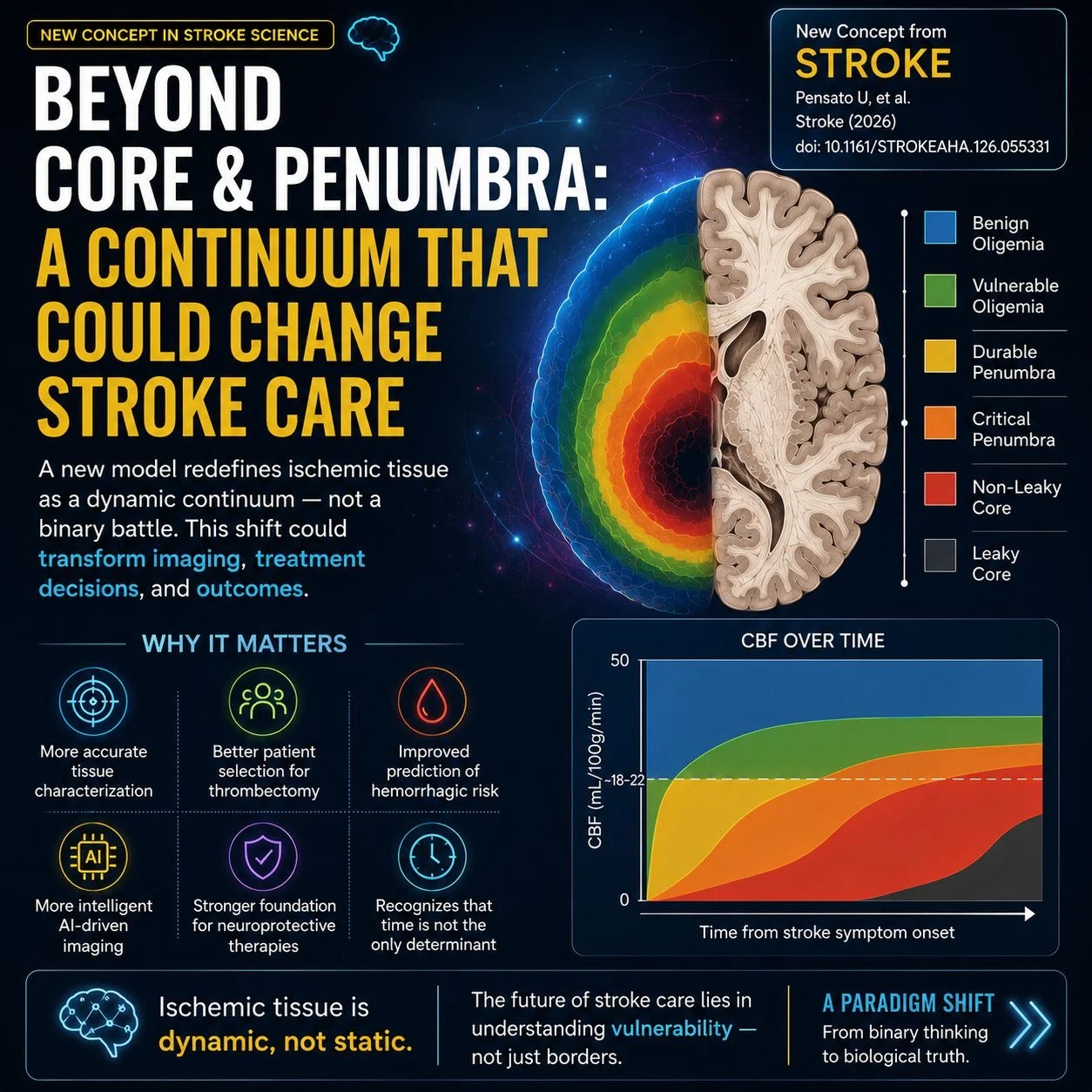
A new concept published in Stroke challenges the traditional ‘core vs penumbra’ model and proposes a continuum of ischemic injury instead.
The proposed spectrum:
- Benign oligemia
- Vulnerable oligemia
- Durable penumbra
- Critical penumbra
- Non-leaky core
- Leaky core
Why does this matter?
Because two patients with the same perfusion scan may have completely different tissue fate, hemorrhagic risk, and response to reperfusion therapy.
This shifts stroke thinking from:
‘Dead vs alive tissue’
to:
‘Degrees of tissue vulnerability over time’
That perspective could fundamentally change:
- How we interpret perfusion imaging
- How we select thrombectomy candidates
- How we estimate hemorrhagic transformation risk
- How AI-based stroke software classifies tissue
- How future neuroprotective therapies are targeted
The most powerful idea from this paper:
Ischemic tissue is dynamic, not static.
- Some ‘core’ may still be recoverable.
- Some ‘penumbra’ may already be biologically doomed.
And perhaps most importantly: Time alone is not the only determinant anymore.
Collateral status, metabolism, BBB integrity, inflammation, and tissue resilience may matter just as much as the clock.
As neurologists, we may be entering an era where stroke imaging evolves from:
Anatomical snapshots
to:
Biological tissue characterization.
That could redefine acute stroke decision-making over the next decade.
Reference:
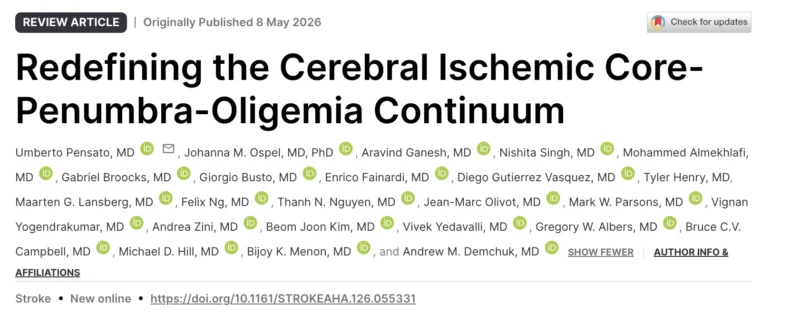
Pensato U, Ospel JM, Ganesh A, et al.
‘Redefining the Cerebral Ischemic Core–Penumbra–Oligemia Continuum.”’
Title: Redefining the Cerebral Ischemic Core-Penumbra-Oligemia Continuum
Authors: Umberto Pensato, Johanna M. Ospel, Aravind Ganesh, Nishita Singh, Mohammed Almekhlafi, Gabriel Broocks, Giorgio Busto, Enrico Fainardi, Diego Gutierrez Vasquez, Tyler Henry, Maarten G. Lansberg, Felix Ng, Thanh N. Nguyen, Jean-Marc Olivot, Mark W. Parsons, Vignan Yogendrakumar, Andrea Zini, Beom Joon Kim, Vivek Yedavalli, Gregory W. Albers, Bruce C. V. Campbell, Michael D. Hill, Bijoy K. Menon, Andrew M. Demchuk
Stay updated on all scientific advances with Hemostasis Today.
-
Sep 30, 2026, 15:58Bernhard Merget: New Frontiers in Thrombosis and Stroke Research
-
Sep 30, 2026, 15:39Ifeanyichukwu Ifechidere: The Molecular Orchestra of Primary Hemostasis
-
Sep 30, 2026, 15:28Reassessing the Benefit–Risk Balance of Extended Anticoagulation in Cancer Patients – ESC Working Group on Cardiovascular Pharmacotherapy
-
Sep 30, 2026, 15:07Chiranjeev Sharma: Targeting Factor XIa with the Synthetic Inhibitor SB-01
-
Sep 30, 2026, 14:41Bruna Gigante: Balancing Thrombosis and Bleeding in Cardiovascular Care
-
Sep 30, 2026, 14:13Ashok Choudhury: Portal Vein Thrombosis and Outcomes in Cirrhosis
-
Sep 30, 2026, 13:57Leslye Conde Bazán: When Conventional Imaging Is Not Enough – The Role of IVUS
-
Sep 30, 2026, 13:41Huda Salah Eldin: The Challenge of Balancing Antithrombotic Therapy After PCI
-
Sep 30, 2026, 13:29Abdus Salam: What Can CT Venography Reveal About the Veins?