


Elad Asher: What Should a Patient Take after Left Atrial Appendage Occlusion?
Elad Asher, Interventional cardiologist, Head of ICCU, Deputy Director of the Heart Center at SZMC, and Associate Professor of Cardiology at the Hebrew University of Jerusalem, shared a post on LinkedIn about a recent article by Laurent Fauchier et al., published in EuroIntervention, adding:
“What should a patient take after left atrial appendage occlusion?
The device trials answered with their own protocols, and practice has drifted toward simpler regimens without much comparative evidence. A propensity-matched analysis in EuroIntervention by Laurent Fauchier, Gregory Lip and colleagues is the largest comparison so far.
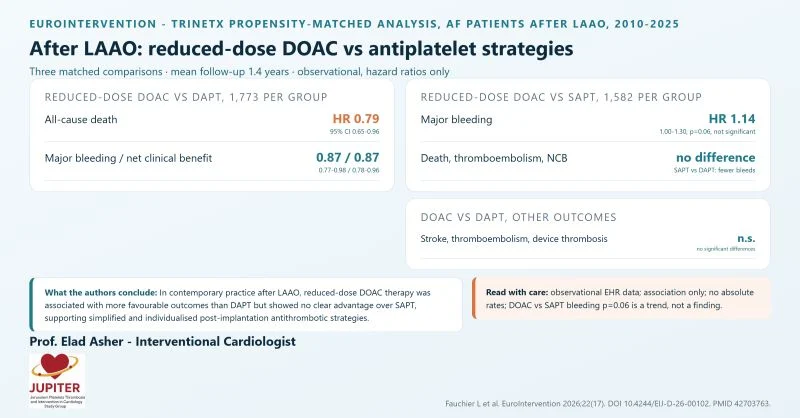
Using the TriNetX Global Network, the authors identified adults with atrial fibrillation who underwent percutaneous LAAO between 2010 and 2025 and built three parallel propensity score-matched comparisons: reduced-dose DOAC versus dual antiplatelet therapy, single antiplatelet versus dual, and reduced-dose DOAC versus single antiplatelet.
In the main comparison, 1,773 patients per group, mean follow-up 1.4 years, reduced-dose DOAC was associated with lower all-cause death (hazard ratio 0.79, 95% confidence interval 0.65 to 0.96) and less major bleeding (0.87, 0.77 to 0.98), with no significant difference in ischaemic stroke, thromboembolism or device-related thrombosis. Net clinical benefit favoured the DOAC (0.87, 0.78 to 0.96).
Single antiplatelet therapy also bled less than dual therapy. Against single antiplatelet therapy, however, 1,582 per group, reduced-dose DOAC showed a non-significant trend toward more major bleeding (1.14, 1.00 to 1.30, p=0.06) and no difference in mortality, thromboembolic outcomes or net clinical benefit.
The authors’ conclusion is measured: reduced-dose DOAC looked more favourable than DAPT but showed no clear advantage over SAPT, which supports simplified and individualised post-implantation strategies.
Limitations: electronic health record data, not a trial. Matching cannot remove the reasons a clinician chose a DOAC over antiplatelets, follow-up is short, and the abstract gives no absolute event rates, so the hazard ratios cannot be turned into numbers needed to treat.
What this means in practice: it does not license a new default. It does make dual antiplatelet therapy the regimen that now has the least support in comparative data, and it puts single antiplatelet and reduced-dose DOAC side by side as the candidates a randomised trial should compare.
What do you discharge your LAAO patients on today, and what would change your mind?”
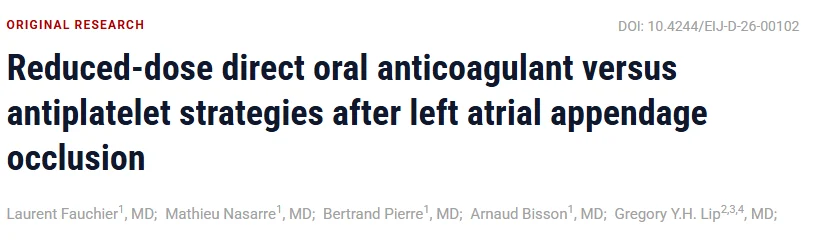
Title: Reduced-dose direct oral anticoagulant versus antiplatelet strategies after left atrial appendage occlusion
Authors: Laurent Fauchier, Mathieu Nasarre, Bertrand Pierre, Arnaud Bisson, Gregory Y.H. Lip
Stay updated on all scientific advances with Hemostasis Today.
-
Sep 19, 2026, 01:19Stefano Garzon: Comparing DOACs SAPT and DAPT After LAAO
-
Sep 19, 2026, 00:48Mahmoud Mehawed: Heparin vs Warfarin vs DOACs Understanding the Key Differences
-
Sep 18, 2026, 17:48Ronak H. Mistry: Updated ASH Guidelines Bring New Focus to Iron Deficiency
-
Sep 18, 2026, 17:32Hassan Kawtharany: New Ferritin Cutoffs for the Diagnosis of Iron Deficiency With or Without Anemia
-
Sep 18, 2026, 17:20Abhishek G P: GAVE as an Important Cause of Chronic Gastrointestinal Blood Loss
-
Sep 18, 2026, 17:08Irem Karaman Sebin: ASH 2026 Changes a Key Concept in Iron Deficiency
-
Sep 18, 2026, 16:51Adarsh Krishnan Sundara Rajan: Is VTE the Most Underdiagnosed Critical Threat in Modern Healthcare?
-
Sep 18, 2026, 16:19CRISPR and Hemophilia: The Next Frontier of In Vivo Gene Editing
-
Sep 18, 2026, 16:13Christian Irsara: PF4 Immunothrombosis Following Natural Adenovirus Infection