


Heghine Khachatryan: New evidance – Antiphospholipid Antibodies and Ischemic Stroke
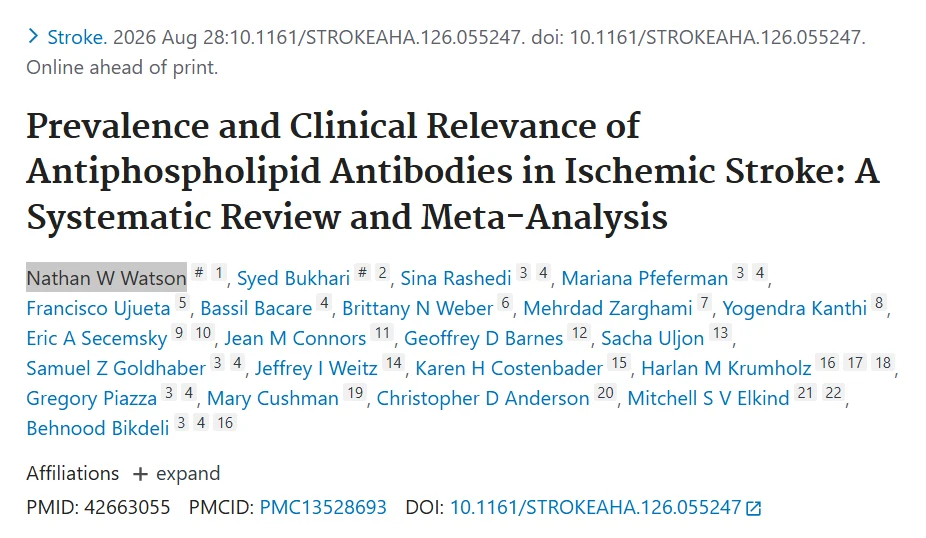
Heghine Khachatryan, Editor-in-Chief of Hemostasis Today, Head of Hemophilia and Thrombosis Center at Yeolyan Hematology and Oncology Center, shared a post on LinkedIn about a recent article by Nathan W Watson et al., published in Stroke, adding:
“New evidance | Antiphospholipid Antibodies and Ischemic Stroke
A new systematic review and meta-analysis including 52 studies examined the association between antiphospholipid antibodies (aPL) and ischemic stroke.
Approximately 19.1% of patients with ischemic stroke were aPL-positive.
The presence of aPL was associated with a higher likelihood of a first ischemic stroke (OR 2.93), with the strongest association observed for lupus anticoagulant (OR 6.69).
Importantly, the analysis did not demonstrate a significant increase in recurrent stroke risk among aPL-positive patients.
Clinical perspective
These findings support targeted aPL testing in appropriately selected patients, particularly in:
- Younger patients with ischemic stroke
- Cryptogenic stroke
- Unusual arterial thrombosis
- Patients with a relevant autoimmune background
At the same time, a single positive aPL result should not be equated with a diagnosis of antiphospholipid syndrome (APS).
Transient or incidental aPL positivity may occur, including in the setting of an acute thrombotic event.
Diagnosis of APS requires the appropriate clinical context, a relevant antibody profile, and confirmation of persistent positivity according to established criteria.
The study reinforces an important principle: aPL positivity is common enough to matter, but interpretation must remain clinically disciplined.”
Title: Prevalence and Clinical Relevance of Antiphospholipid Antibodies in Ischemic Stroke: A Systematic Review and Meta-Analysis
Authors: Nathan W Watson, Syed Bukhari, Sina Rashedi, Mariana Pfeferman, Francisco Ujueta, Bassil Bacare, Brittany N Weber, Mehrdad Zarghami, Yogendra Kanthi, Eric A Secemsky, Jean M Connors, Geoffrey D Barnes, Sacha Uljon, Samuel Z Goldhaber, Jeffrey I Weitz, Karen H Costenbader, Harlan M Krumholz, Gregory Piazza, Mary Cushman, Christopher D Anderson, Mitchell S V Elkind, Behnood Bikdeli
Other posts featuring Heghine Khachatryan on Hemostasis Today.
-
Sep 14, 2026, 23:42Eman M. Elsabbagh: Successful HCT Does Not End at Engraftment
-
Sep 14, 2026, 23:31Antonis Kattamis: Proud to Be Part of this Endeavour and Senior Author of the Pivotal Trial
-
Sep 14, 2026, 23:23Farjah Algahtani: Stroke Incidence and Risk Factors in Saudi Patients with Sickle Cell Disease
-
Sep 14, 2026, 20:53YoonHwa An: Rusfertide in Polycythemia Vera – From Clinical Benefit to Strategic Value
-
Sep 14, 2026, 20:52Andres Alberto Mercado Pompa: External Validation of Prognostic Risk Scores in Cerebral Venous Thrombosis
-
Sep 14, 2026, 20:50Balaji Kirushnan: Advancing Regional Citrate Anticoagulation in CRRT – From Experience to Implementation
-
Sep 14, 2026, 20:48Valerie Dehondt: Nutritional Anemia Is Associated With Increased Risk of Severe COPD Exacerbations
-
Sep 14, 2026, 20:46Nupur Choudhury: Exploring AI-Based Detection of Anemia Using Eye and Fingernail Images
-
Sep 14, 2026, 20:44Shamee Shastry: Chart Before You Chase – Diagnosing Drug-Induced Hemolytic Anemia