


Wolfgang Miesbach: New Research Reveals Clonogenic Hepatocytes as the Key Drivers of Liver Growth and Gene Therapy Success
Wolfgang Miesbach, Professor of Medicine at Frankfurt University Hospital, shared a post on LinkedIn:
“Only 15-20% of newborn hepatocytes generate 90% of adult liver tissue. New research from San Raffaele Telethon Institute characterizes hepatocyte heterogeneity and reveals that ‘clonogenic hepatocytes‘ – a small subset of liver cells in newborn mice – are responsible for most adult liver growth:
- Gene editing by HDR preferentially targets these clonogenic cells, expanding edited liver areas during growth
- Lentiviral vectors show age-dependent efficiency – higher in newborns, lower in adults (reversible with proteasome inhibition)
- Peri-central hepatocyte identity develops after weaning
- Clonogenic hepatocytes co-localize with hematopoietic progenitor cells in specialized tissue niches research
Gene Therapy Impact:
This discovery transforms pediatric gene therapy timing and targeting strategies. Understanding when and which hepatocytes to target could unlock more effective treatments for inherited liver diseases
The team used cutting-edge single-cell/spatial transcriptomics, clonal tracing, and mathematical modeling to map hepatocyte proliferation and maturation after birth
Congratulations to Alessio Cantore, Michela Milani, Francesco Starinieri, Matteo Iannacone, Renato Ostuni, Giulia Bortolussi, Ivan Merelli, Stefano Beretta, Marco Monti!”
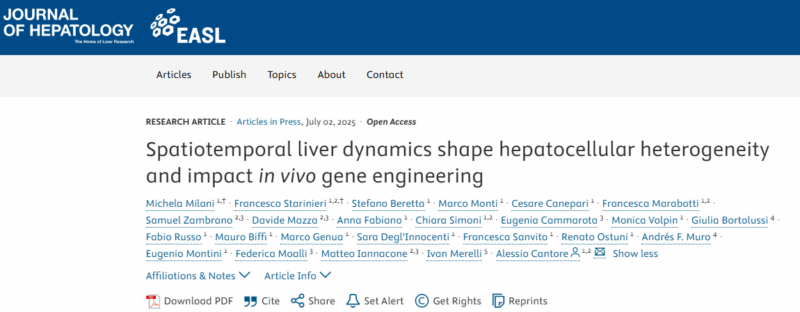
Title: Spatiotemporal liver dynamics shape hepatocellular heterogeneity and impact in vivo gene engineering
Authors: Michela Milani, Francesco Starinieri, Stefano Beretta, Marco Monti, Cesare Canepari, Francesca Marabotti, Samuel Zambrano, Davide Mazza, Anna Fabiano, Chiara Simoni, Eugenia Cammarota, Monica Volpin, Giulia Bortolussi, Fabio Russo, Mauro Biffi, Marco Genua, Sara Degl’Innocenti, Francesca Sanvito, Renato Ostuni, Andrés F. Muro, Eugenio Montini, Federica Moalli, Matteo Iannacone, Ivan Merelli, Alessio Cantore
Read the full article here.
More recent insights on Hemostasis Today.
-
Nov 9, 2026, 09:29Veronica Sanchez: A Framework for Woman’s Health
-
Nov 8, 2026, 19:31Anna Kajaste-Rudnitski: Presenting AAV-Induced p53 Signalling in Human CNS Cells at ESGCT 26
-
Nov 8, 2026, 19:29David McIntosh: Cybersecurity Matters, but Blood Availability Remains the Bigger Challenge
-
Nov 8, 2026, 19:26Wenxue Ma: An Integrative Framework for Macrophage-Mediated Therapeutic Resistance in Cancer
-
Nov 8, 2026, 19:25Yildiz Yigit: Presenting a Polycythemia Vera Case at the MPN Subcommittee Session
-
Nov 8, 2026, 18:56Denis Oduor: Strengthening the Regulation and Delivery of Blood Transfusion and Transplantation Services
-
Nov 8, 2026, 18:28Raghavendra Rao: A Narrative Review on Chronic Venous Disease during Pregnancy
-
Nov 8, 2026, 17:57Dhiren Patel: PLD1-Derived Phospholipids Regulate NAD Kinase and ROS Production in Neutrophils
-
Nov 8, 2026, 17:48Andra T.: What Causes Antiphospholipid Syndrome? – Four Steps, not One Cause