


Jeremiah Bernier-Latmani: Could Angpt2 Blockade Become a New Treatment for GI Bleeding in VWD
Jeremiah Bernier-Latmani, Senior Researcher at University of Lausanne, shared a post on LinkedIn about a recent article he and his colleagues co-authored, published in Blood:
“New paper in Blood from Anna Randi, Adela Constantinescu-Bercu and team showing that VWF deficiency drives abnormal blood vessel growth and bleeding in the gut by increasing Angpt2 levels – and that blocking Angpt2 could be a promising new treatment for GI bleeding in von Willebrand disease patients.
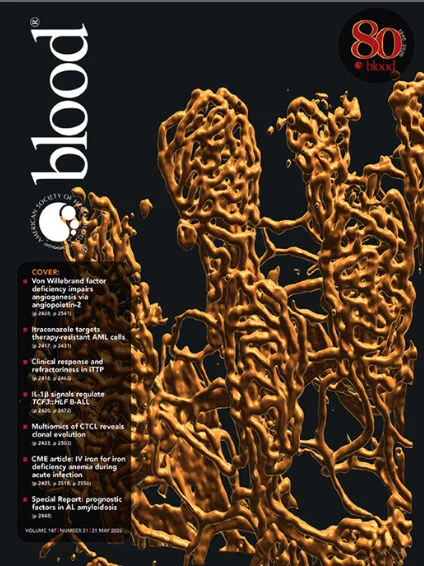
Bonus: I of course love to see their cover image of intestinal villi!
Delighted to have contributed to this work!”
Title: Von Willebrand factor deficiency impairs angiogenesis via angiopoietin-2: relevance for gut angiodysplasia
Authors:Adela Constantinescu-Bercu, Koval E Smith, Shuo Yi Wong, Mattia Ballerini, Alessia Nastro, Benjamin G Wiggins, Daniela Pirri, Yucheng Li, Juun Evers, Olga Tsiamita, Matthew Dibble, Charis Pericleous, Koralia Paschalaki, Graeme M Birdsey, Jeremiah Bernier-Latmani, Tatiana V Petrova, Michael A Laffan, Suthesh Sivapalaratnam, Marco Rasponi, Anna M Randi
Stay updated with Hemostasis Today.
-
Oct 10, 2026, 07:59Leila Caroline Souza Reis: Enoxaparin Dosing for VTE Prevention in Adults With Obesity
-
Oct 10, 2026, 07:41Adeeb Bazuhair: New Evidence for Catheter Directed Thrombolysis in Acute PE
-
Oct 10, 2026, 07:22Poppy Clarke: Turning Steps Into Support for Thrombosis Awareness
-
Oct 10, 2026, 07:12Hamzah Khan: The Role of Genuine Curiosity in Driving High-Impact Academic Research
-
Oct 10, 2026, 06:58Nita Radhakrishnan: Turning Evidence Into Action for Hemophilia Care in India
-
Oct 10, 2026, 06:48Nutan Kaushik: HemeNext 2.0 Brings Global Perspectives to Hematology
-
Oct 10, 2026, 06:43Suthesh Sivapalaratnam: Advancing Bleeding Disorder Care at EHC 2026
-
Oct 10, 2026, 02:38Brianne D.: Sex Differences in RIPK1 Signaling Following Intracerebral Hemorrhage
-
Oct 10, 2026, 02:17Dino Mehic: Managing Heavy Menstrual Bleeding in Patients with BDUC