


John Abraham: Breaking the ‘Bleeding Disorder’ Myth About Cirrhosis and Coagulation
John Abraham, Assistant Professor at Christian Medical College and Hospital, shared a post on Linkedin about a recent article by Conor Bell published in Journal of Thrombosis and Haemostasis, adding:
“Cirrhosis and Coagulation — Beyond the ‘Bleeding Disorder’ Myth
For years, we were taught that cirrhosis meant a bleeding tendency.
But evolving evidence tells a very different story.
Paper: Prevention and treatment of thrombosis in patients with decompensated cirrhosis
Journal: Journal of Thrombosis and Haemostasis (JTH), 2026
Authors: Conor Bell, Amber Afzal, Stephanie Carlin, Lara N. Roberts
DOI: 10.1016/j.jtha.2025.12.018
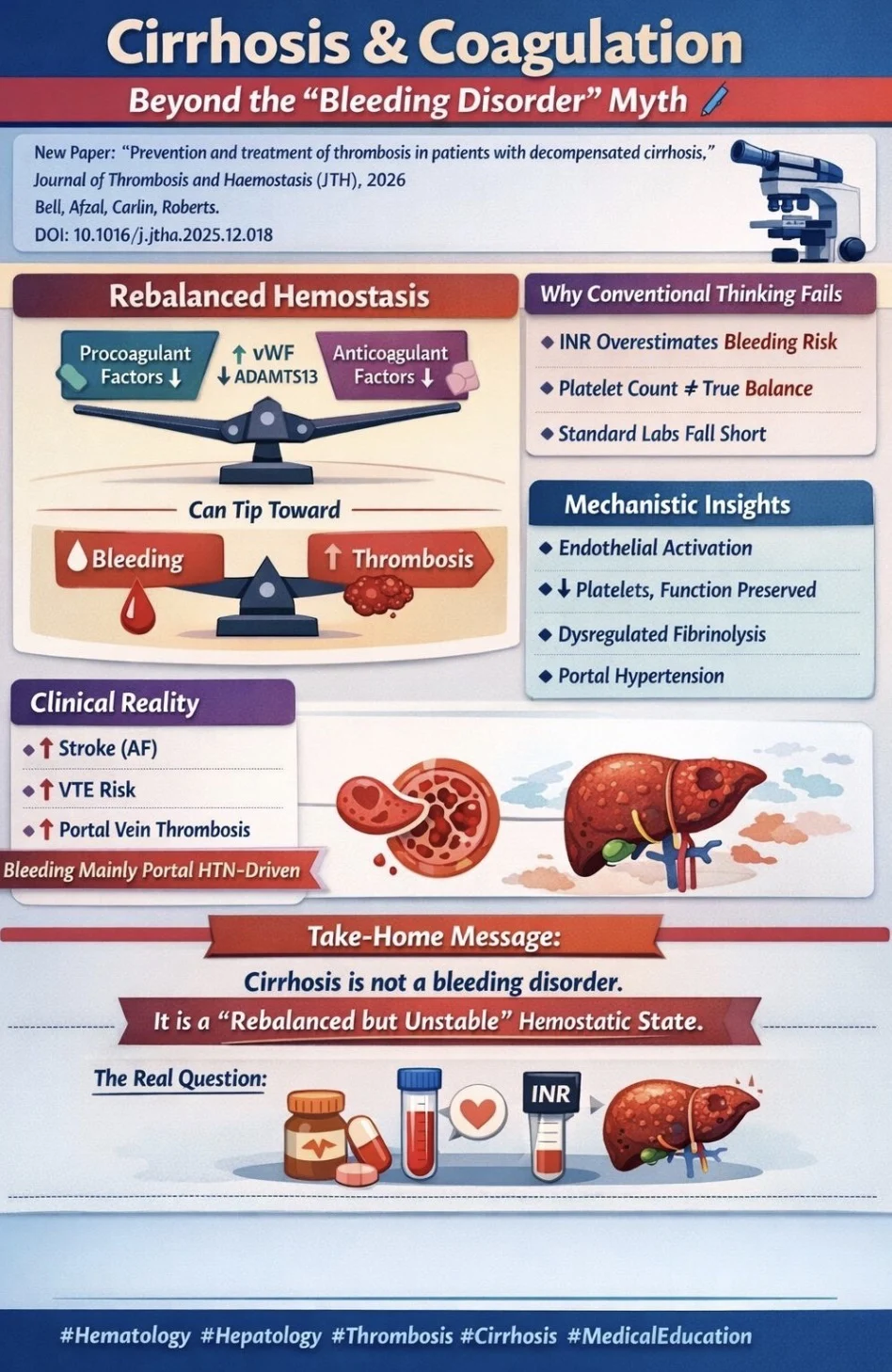
The Core Concept: Rebalanced Hemostasis
Cirrhosis leads to a ‘simultaneous decline in procoagulant and anticoagulant factors’, creating a fragile equilibrium—not a hypocoagulable state.
- Decreased Factors II, V, VII, IX, X
- Decreased Protein C, Protein S, Antithrombin
- Increased von Willebrand factor
- Decreased ADAMTS13
Net effect: A system that can tip toward bleeding or thrombosis
Why Conventional Thinking Fails
- INR reflects only procoagulant deficiency and therefore overestimates bleeding risk
- Platelet count does not capture compensatory mechanisms (increased vWF)
- Standard labs isn’t true hemostatic balance
Mechanistic Insights
- Endothelial activation creates a prothrombotic milieu
- Platelet count is reduced but function relatively preserved
- Fibrinolysis is dysregulated (both hyper and hypo states)
- Portal hypertension is the major driver of bleeding
Clinical Reality
- High Risk of stroke (AF)
- High risk of VTE (2× risk)
- High Risk of Portal vein thrombosis
At the same time:
Bleeding risk is real—but largely ‘portal hypertension–driven’, not purely coagulopathic
Take-Home Message
Cirrhosis is not a bleeding disorder.
It is a ”rebalanced but unstable’ hemostatic state’.
This paradigm shift is crucial when:
- Deciding on anticoagulation
- Interpreting INR/platelets
- Managing PVT or AF
As clinicians, the challenge is no longer ‘Should we anticoagulate?’ but ‘Who, when, and how safely?’”
Title: Prevention and treatment of thrombosis in patients with decompensated cirrhosis
Authors: Conor Bell, Amber Afzal, Stephanie Carlin, Lara N. Roberts
Read the Full Article on Journal of Thrombosis and Haemostasis
Stay updated with Hemostasis Today.
-
Sep 30, 2026, 15:58Bernhard Merget: New Frontiers in Thrombosis and Stroke Research
-
Sep 30, 2026, 15:39Ifeanyichukwu Ifechidere: The Molecular Orchestra of Primary Hemostasis
-
Sep 30, 2026, 15:28Reassessing the Benefit–Risk Balance of Extended Anticoagulation in Cancer Patients – ESC Working Group on Cardiovascular Pharmacotherapy
-
Sep 30, 2026, 15:07Chiranjeev Sharma: Targeting Factor XIa with the Synthetic Inhibitor SB-01
-
Sep 30, 2026, 14:41Bruna Gigante: Balancing Thrombosis and Bleeding in Cardiovascular Care
-
Sep 30, 2026, 14:13Ashok Choudhury: Portal Vein Thrombosis and Outcomes in Cirrhosis
-
Sep 30, 2026, 13:57Leslye Conde Bazán: When Conventional Imaging Is Not Enough – The Role of IVUS
-
Sep 30, 2026, 13:41Huda Salah Eldin: The Challenge of Balancing Antithrombotic Therapy After PCI
-
Sep 30, 2026, 13:29Abdus Salam: What Can CT Venography Reveal About the Veins?